ISO has released its 35th annual ISO Survey, providing data on total certificates worldwide for ISO 9001, ISO 14001, and other standards. The latest report includes data as of 2025. Since 2002, Oxebridge has updated its analysis each year, focusing on ISO 9001 data and using its own ISO Survey database dating back to 1993.
This represents the most comprehensive review of ISO 9001 certifications available.
Downloads
To download Oxebridge’s full dataset of ISO 9001 certificates from 1993 onward, click the following:
- Oxebridge Full Data Set. (ZIP file, single Excel sheet, 54 KB).
This is a single spreadsheet of ISO Survey data going back to 1993 for all countries. It only includes ISO 9001. This is raw data, no charts or analysis, and does not include some of the year-t0-year adjustments we make to compensate for ISO and IAF misreporting. Sometimes, ISO changes the prior year’s data (without explanation), and this would not include those adjustments. This presents the data as it was reported each year when the ISO Survey was published. It’s about as accurate as we can get.
Also, if you rely on Oxebridge’s annual analysis of the ISO Survey or just like the content here, be sure to follow me on LinkedIn, and jump onto our Discord channel for real-time chat.
Also, don’t forget to go grab my Dr. Cuba crime horror novels!
TL;DR Takeaways
The “too long; didn’t read” takeaway points from this year’s survey are as follows:
- ISO now reports a total of over 1.6 million ISO 9001 certificates.
- That’s an increase of 8.94% over last year.
- The data is highly polluted by what is clearly a flood of fake certificates coming out of India, which now outpaces China in pure one-year growth. Indian scams in the certification scheme are not accepted as a feature, not a bug. Global ACI’s complacency is enabling it, rather than curbing it.
- The use of IAF CertSearch to collate the data has resulted in better reporting on sector penetration, but only slightly.
- Türkiye and Peru have unusually high single-year spikes, both of which cannot be explained without further study. Peru’s spike may be because of increased Chinese investments in the country.
- The US growth has been nearly flat since last year.
One note: ISO reports on both total “certificates” and total “sites“. Oxebridge ignores the site data and focuses only on certificates.
History
The ISO Survey was originally launched in 1990 as The Mobil Survey, published by Mobil Oil Co. ISO took over the reporting in 1996, and has published the Survey ever since. Initially, the surveys were labeled as “cycles,” a naming convention that ISO dropped, but which Oxebridge maintains for nostalgia and consistency. The 2024 data represents the 34th Cycle by that naming system.
As mentioned, since 2002, Oxebridge has released a corresponding “ISO Survey Analysis” report, which tries to look past ISO’s generic (and often misleading) press release blurbs to see the real trends behind the data. While ISO has changed its reporting methods over the years — in 2018, for example, ISO stopped reporting prior years’ data entirely — Oxebridge has been carefully collecting the data since 1993, and then merges the data so that it remains consistent. That allows us to have more accurate trend reporting over the full period from 1993 to the present.
Periodic changes by ISO in how it reported the data added inconsistencies, but ISO then handed the Survey over to IAF. That resulted in a few years of even more inconsistent data, as many bodies did not participate in the IAF’s CertSearch.
For this Survey, representing data up until 2025, things are better, but there remain a lot of bodies that still don’t provide data. Still, it’s an improvement.
This Oxebridge report tries to show long-term trends — over decades — in order to smooth out these inconsistencies. Because Oxebridge has the data going back to 1993, the annual Oxebridge follow-up report on the ISO Survey tends to provide a far better historical picture than the annual snapshots provided by ISO and, now, IAF.

World Outlook
ISO now reports a total of 1,611,729 ISO 9001 certificates, representing a 8.94% increase over the prior year. For the 2024 data (released last year), the estimated growth was just over 50% (ignoring some data irregularities due to China not providing data in 2023), suggesting a cooling off by nations for the moment.
Here is the global picture:
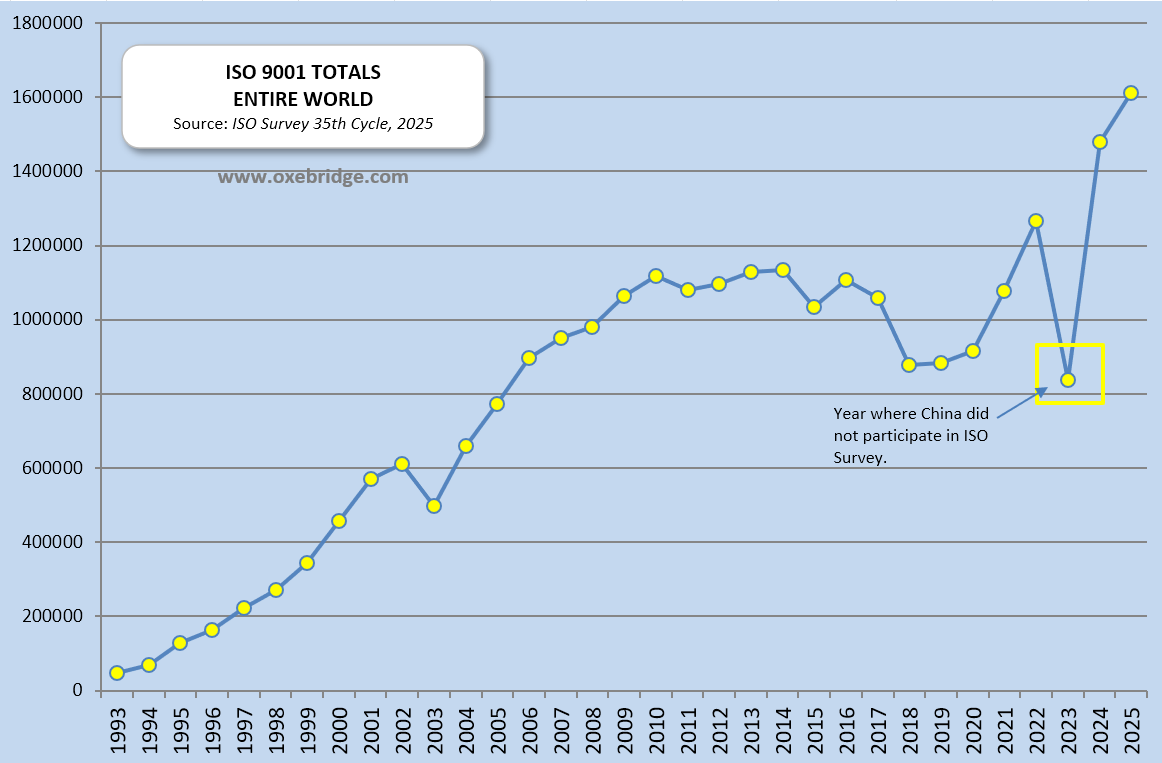 If we ignore the China hiccup in 2023, we do see steady growth.
Here is what the year-to-year changes look like (click to enlarge):
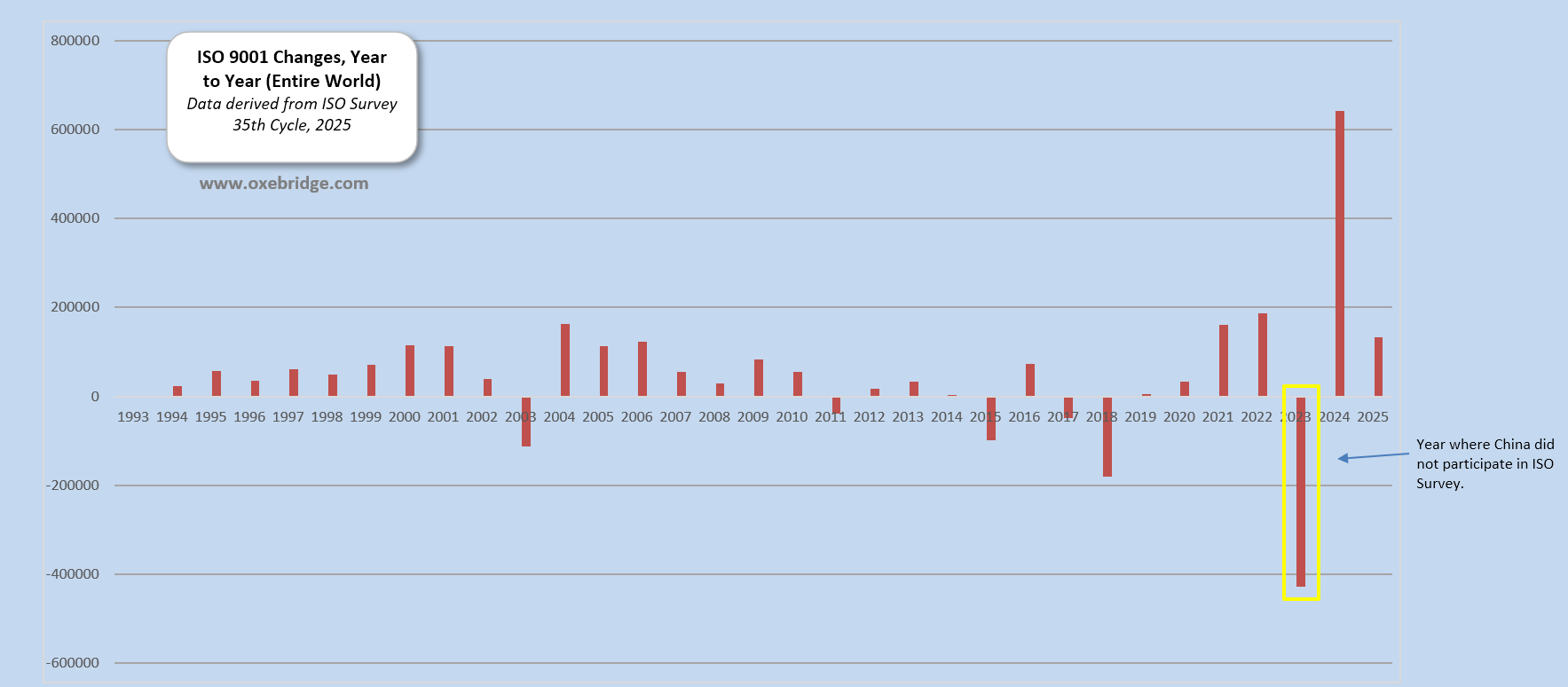
The apparent spike in 2024 was simply because China began reporting again.
China
China continues to dominate global ISO 9001 adoption, but (for the first time) has fallen to second place in single-year growth as India takes the top spot. China’s total now sits at 673,426 certificates, representing 41.7% of the world’s ISO 9001 certifications.
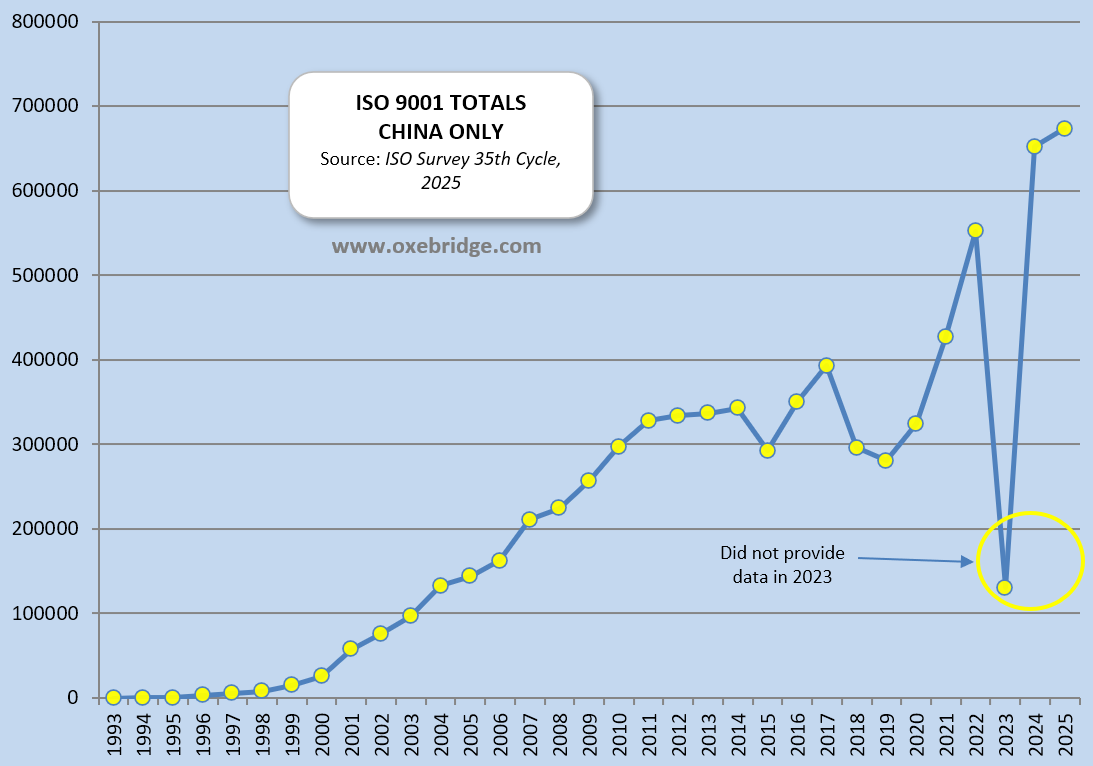
If we compare the total number of ISO 9001 certificates including vs. excluding China, the chart looks like this:
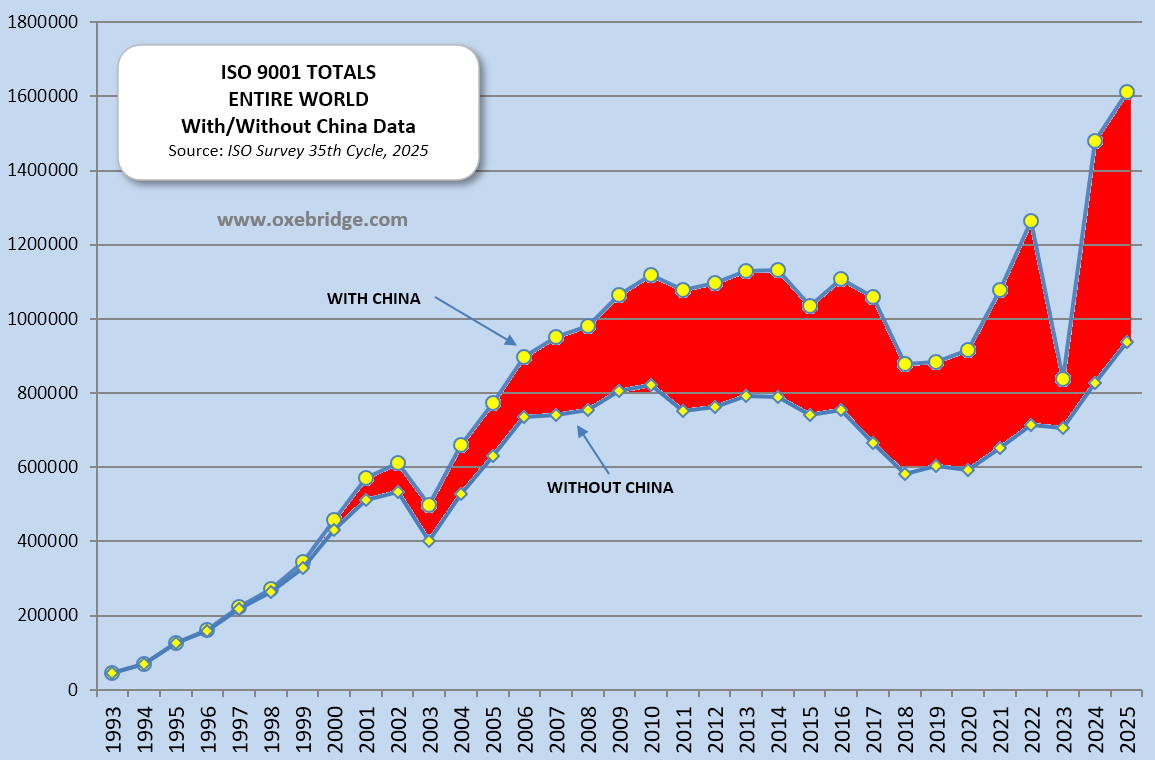
As I mentioned in last year’s report, my view on China has shifted. Previously, I had blamed China’s numbers on fraud. Since then, I have become active on Chinese social media, specifically Xiaohongshu and WeChat, talking to actual citizens and business operators in the country. The platforms allow for direct one-to-one conversations, without any oversight or censorship. What I learned is that while there is fraud in China, when it comes to ISO 9001, it is far less than I had thought.
I am working on a well-researched set of articles on how Chinese quality is set to eclipse the world, if it hasn’t already, so I’m saying this only after gathering some data to back it up. The sheer number of manufacturing plants in China is staggering, and so it tracks that the number of ISO 9001 certificates would boggle the mind as well.
Compounding this is the fact that China has taken dramatic steps to root out corruption in the scheme, making violations a criminal act, unlike in the “soft” West where such things are not only tolerated, but embraced. (See the IAF’s reaction to India.)
So, I have to recant. The Chinese data may well be accurate.
2025 Totals:
- China: 673,426 (+ 21,575 since 2024)
 United States of America
It’s clear that for many years, the US has effectively gone cold on ISO 9001, a worrying trend that is likely to only worsen as word of the disastrous ISO 9001:2026 rewrite spreads.
For 2025, the US total is stalled at 28,997, a growth of only 194 (!!) from the prior year. The US has been unable to break the 30,000 barrier for ten years, and the current total is a sharp drop from the nation’s all-time high of 44,883 in 2006.
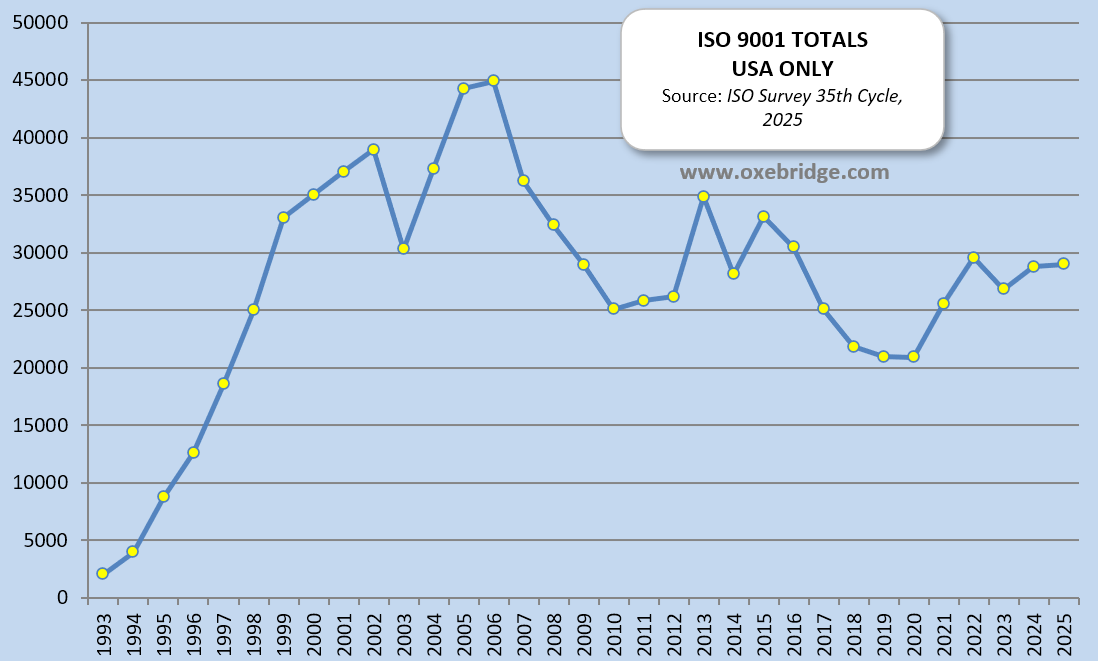
Perhaps the US government should reconsider having ANSI as its official ISO representative body? They are a private publishing company with far too many conflicts of interest to be trusted, and they refuse to either represent the wishes of American industry or stop rubber-stamping whatever product ISO spits out so they can resell it at criminally inflated prices.
If the 2000 version of ISO 9001 was the high water mark, let’s see how the US voted with its feet since the private consultants, like Lorri Hunt and Jose Dominguez, took over the standards development work. The following filters the US data to show only the years after the publication of ISO 9001:2000.
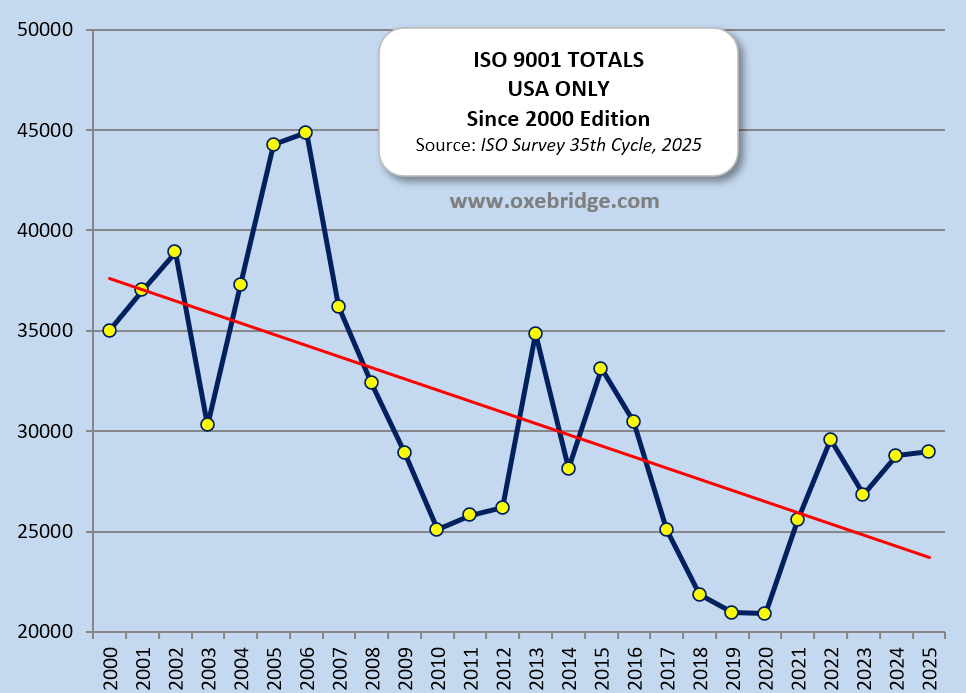
We see that ISO’s cash-grab to re-release ISO 9001:2000 without any changes other than the date on the cover, in 2008, was not met well by the Americans. The 2015 “Lorri Hunt Remix” made things worse.
2025 Totals:
- USA: 28,977 (+ 194 since 2024)
North America
Comparing the US to its North American neighbors, the data appears as follows:
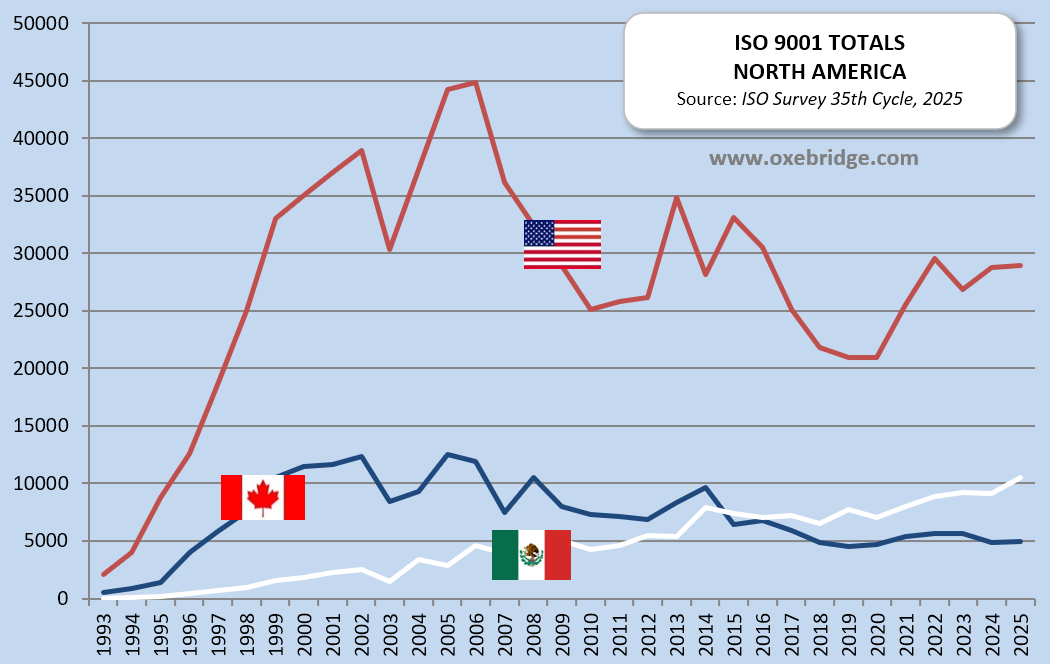
For another straight year, Mexico has outpaced Canada with the gap growing. It’s worth pointing out that Canada’s body, SCC, takes a “pro-ISO” posture much like the US’ ANSI, and the Canadian government may want to rethink its chosen delegation body.
2025 Totals:
- USA: 28,977 (+ 194 since 2024)
- Mexico: 10,530 (+ 1,440 since 2024)
- Canada: 4,944 (+ 108 since 2024)
South America
Looking at some key South American bellwether nations, here is what we see:
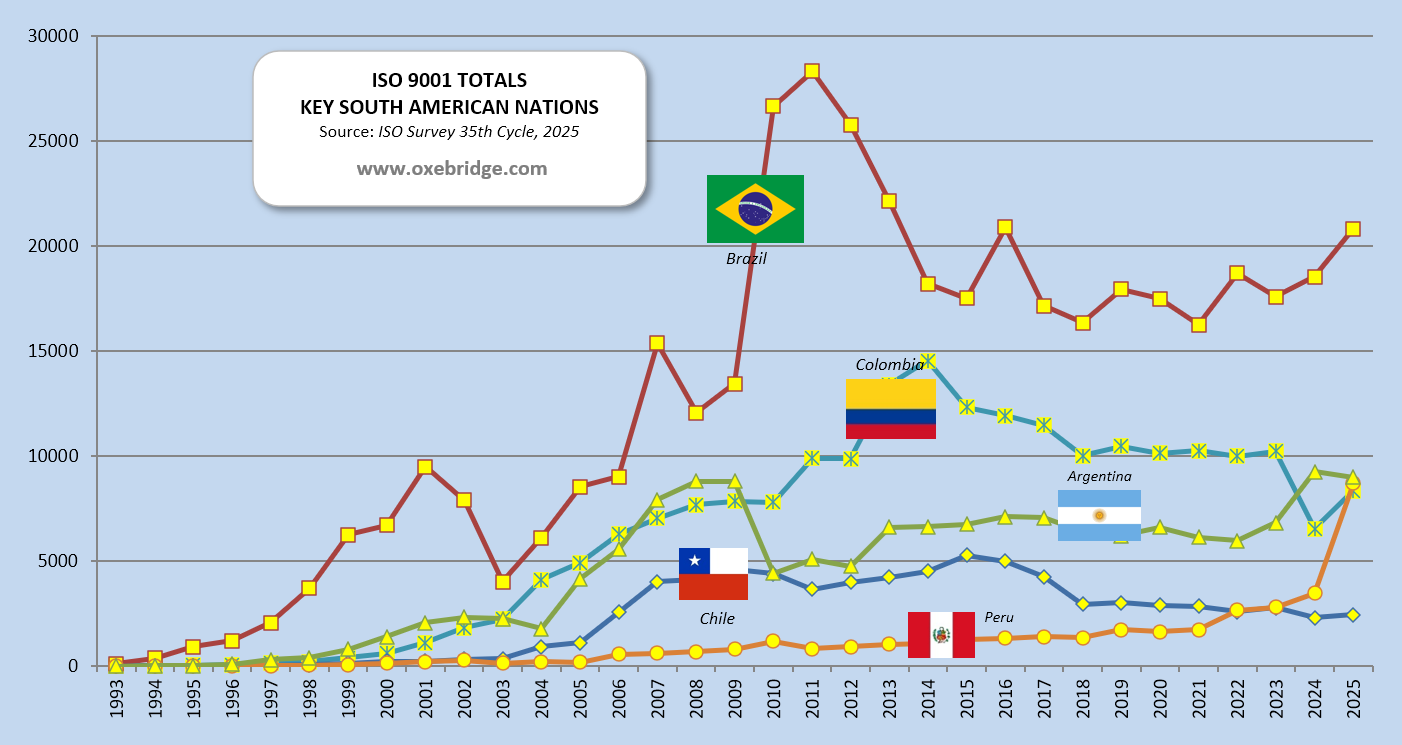
While the Brazil domination remains prevalent, the real story here is Peru. As someone who has lived in the country for 15 years, I can’t make head or tail of it.
Peru’s ISO 9001 certificates have skyrocketed, jumping from 3,473 to 8,720 certificates in just one year! That put Peru in sixth place among the nations with the most single-year growth.
The nation’s accreditation body, INACAL, has shown the usual signs of corruption. It has failed to act on fraud reports and seems generally incompetent on simple accreditation matters. But I don’t think these certificates are entirely fake.
I‘ve seen a flood of ISO consultants in the country over the past few years, as Industrial Engineering degrees are booming at Peruvian universities. So the new consultants might just be exposing more companies to certification. In addition, China has been investing heavily in Peru and opening more mining, shipping, and even manufacturing companies here. They may be importing their penchant for ISO 9001 certification, as well.
2025 Totals:
- Brazil: 20,818 (+ 2,282 since 2024)
- Colombia: 8,360 (+ 1,814 since 2024)
- Argentina: 8,988 (- 259 since 2024)
- Peru: 8,720 (+ 5,247 since 2024)
- Chile: 2,444 (+ 141 since 2024)

European Bellwethers
Every year, we report on a few key European nations to gauge how things are going on the continent where ISO 9001 was born; these are Italy, Germany, France, and ISO’s home country of Switzerland. The chart below shows this data, and I’ve added the Netherlands this year, since they have such an outsized influence on the actual text of ISO 9001 revisions.
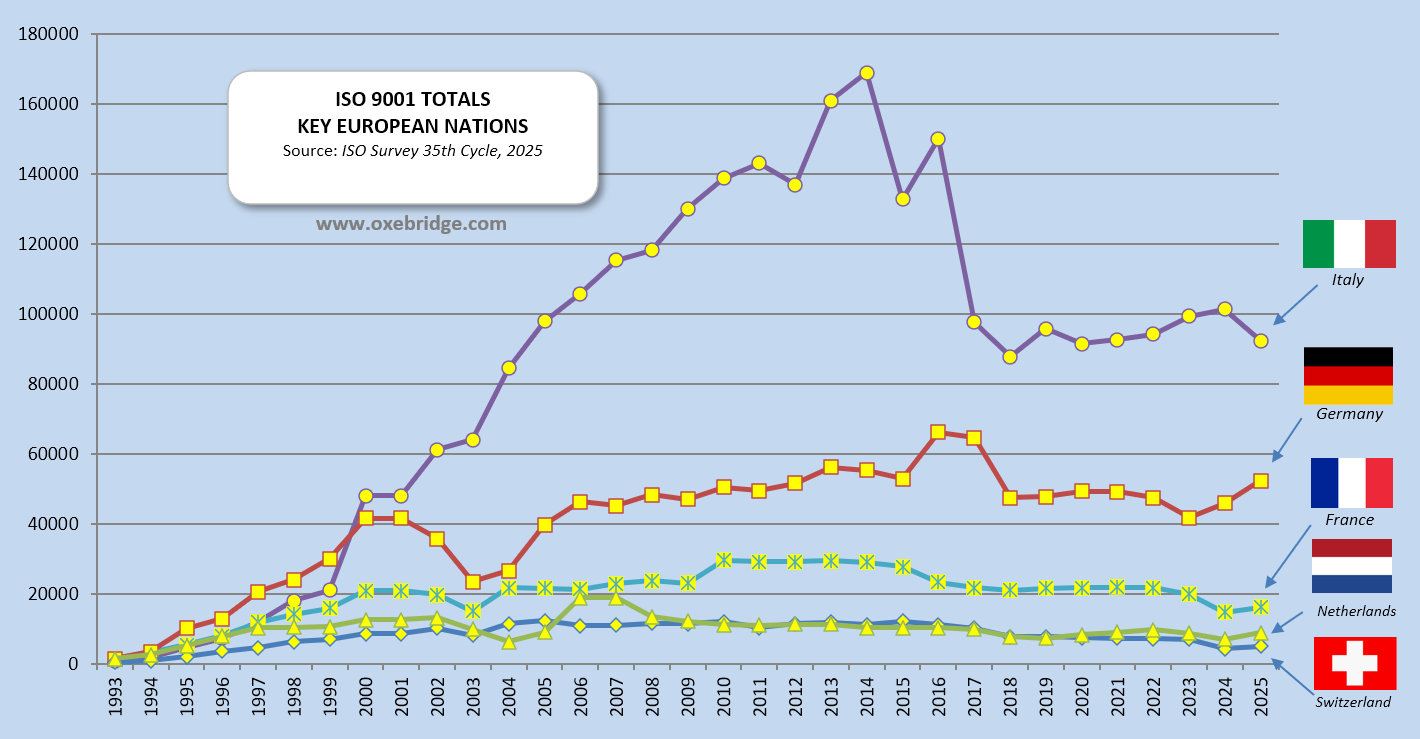
For the first time in many years, we see Italy declining. But they still dominate.
Germany remains on an uptick, as do the others, all to lesser degrees.
However, it’s not quite the full-throated endorsement of ISO 9001 you’d expect from Europe, which largely decides ISO 9001-related matters and content.
2025 Totals:
- Italy: 92,459 (- 8,967 since 2024)
- Netherlands: 9,013 (+ 1,859 since 2024)
- Switzerland: 5,098 (+ 657 since 2024)
- Germany: 52,404 (+ 6,421 since 2024)
- France: 16,246 (+ 1,480 since 2024)
United Kingdom
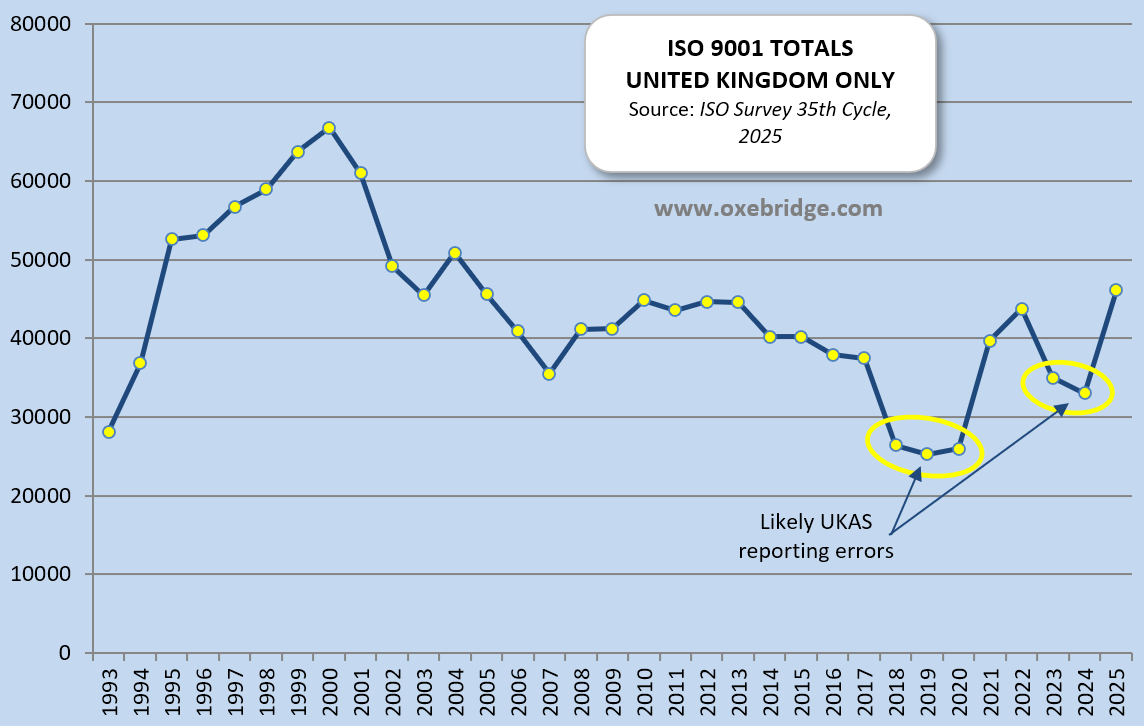
For the UK, we saw a ridiculous spike over the past few years that didn’t make much sense. The ISO gods claimed this was due to improved reporting through the UKAS CertSearch database. It now appears that UKAS borked up its reporting, showing artificially low totals for 2018, 2019, 2020 and then again in 2023 and 2024. If you ignore the low dips, the actual trend suggests a continuous — if modest — increase.
Keep in mind, the UKAS CertCheck database is the same software as IAF CertSearch, so it’s not clear why UKAS is having such difficulty ensuring data integrity. But they are hosing it up royally. Pardon the pun, Your Majesty.
The UK is still far from its 2000 high point, though.
2025 Totals:
- United Kingdom: 46,094 (+ 13,106 since 2024)
India & Pakistan
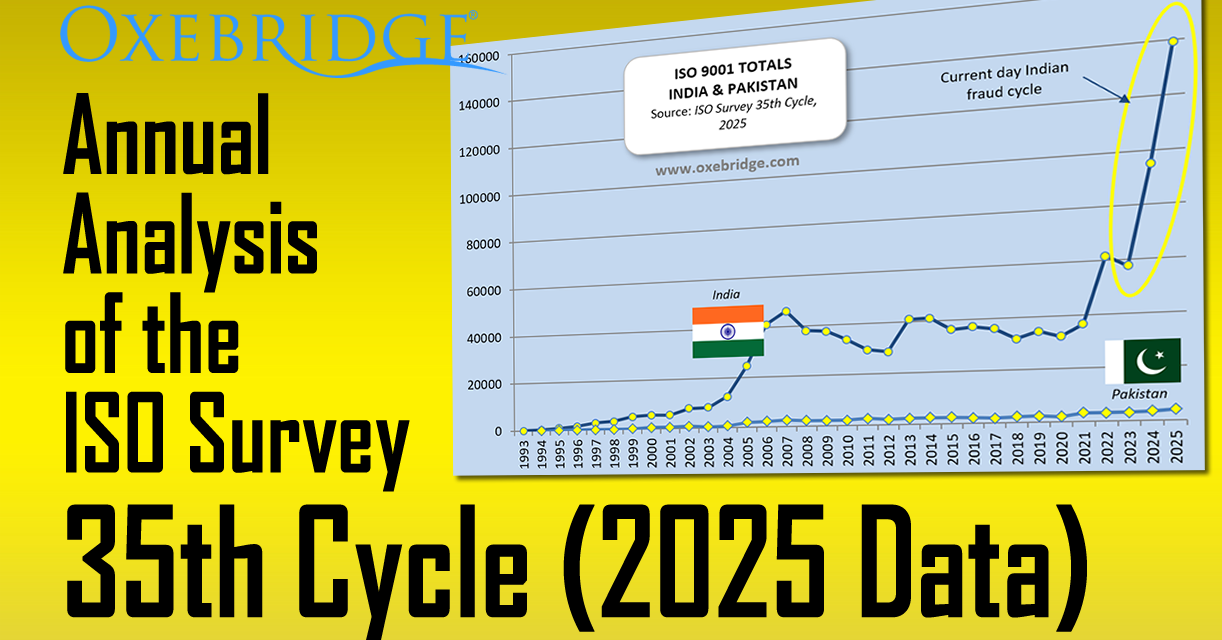
In 2022, we saw India embrace fraud and start reporting what are absolutely fake numbers. There was a slight dip in 2023, but the Indian scammers are back at it.
Well, the latest Modi administration said, “Hold my Kingfisher,” because India was absolutely not finished eradicating the little trust anyone has of that country.
This year, India reported a single-year growth of 47%, with a total of 139,303 certificates. Over the past four years, India has reported insane figures for three of them, with a spike of 69% in 2022 and 65% in 2024.
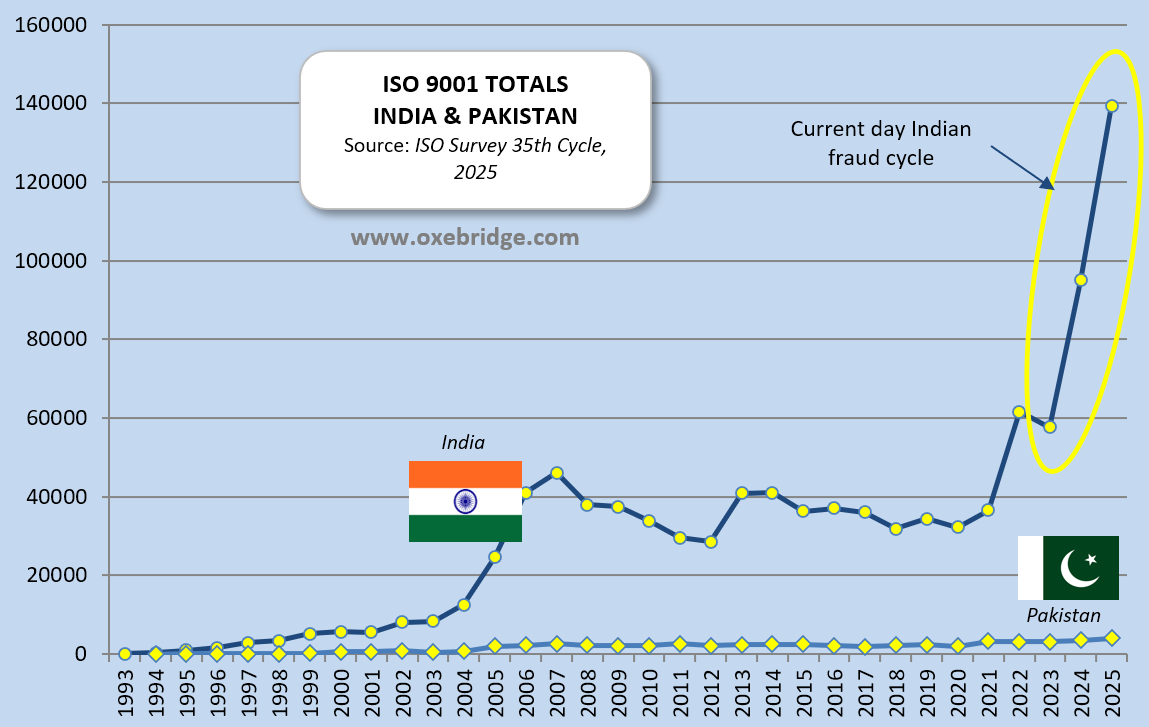
Considering that for a run of fifteen years (2007 – 2021), the annual growth rate averaged 0.16%, this latest pattern is only explained by two factors:
- Increased scamming in the Indian ISO market
- Abdication of accreditation rule enforcement by IAF (now Global ACI)
Some signs point to that country’s accreditation body, NABCB, trying to do something about it and just bungling it. But the new problem for India is that scammer Indians have opened up competing ABs outside of the country, using fake American and European addresses, and their certs are crossing back into India to infect the country itself.
The only thing Indians like better than scamming foreigners is scamming other Indians.
Look at that table and contrast it with India’s neighbor, Pakistan, and you’ll see a dramatic difference.
Meanwhile, here are the world totals, with and without India. I think we will see this chart become very compelling in the next few years, if India can’t stop its cultural sink into the cesspool.
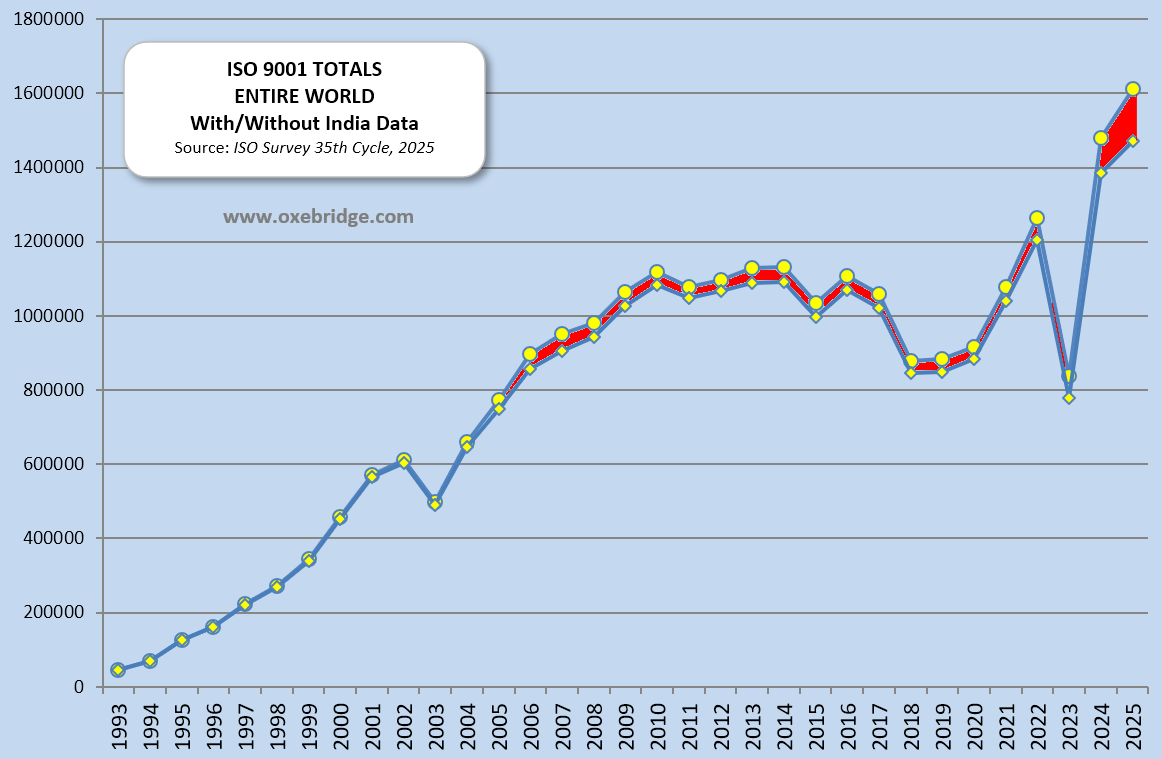
2025 Totals:
- India: 139,303 (+ 44,296 since 2024)
- Pakistan: 4,013 (+ 529 since 2024)

Japan
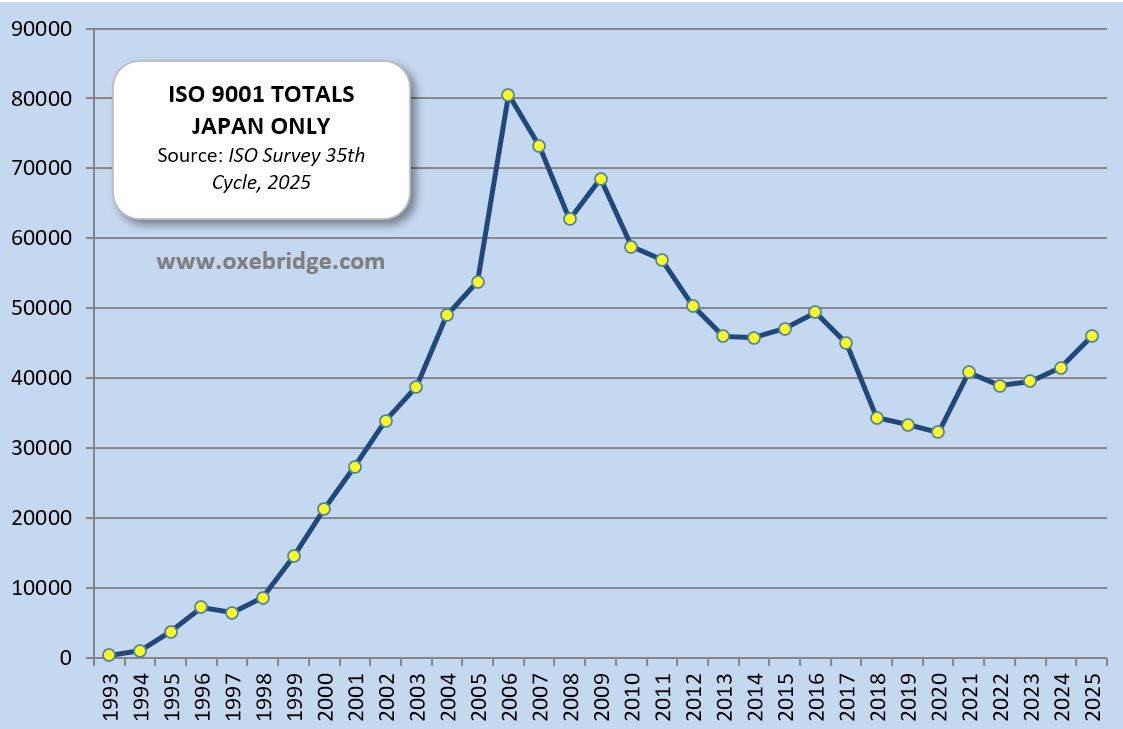
Japan’s numbers have flatlined. It’s something to notice, too, as China’s worldwide quality improves and Japan’s is now deteriorating under cultures of white-collar fraud that pollute its industries. The once lauded titan of quality has sunk far.
2025 Totals:
- Japan: 46,015 (+ 4,490 since 2026)
Middle Eastern Bellwethers
I like tracking key Middle Eastern countries, since so much of the fraud facing the ISO scheme comes from those nations. Here we track major abusers of ethics and peddlers of fraudulent certificates: UAE, Saudi Arabia, Qatar, and Egypt.
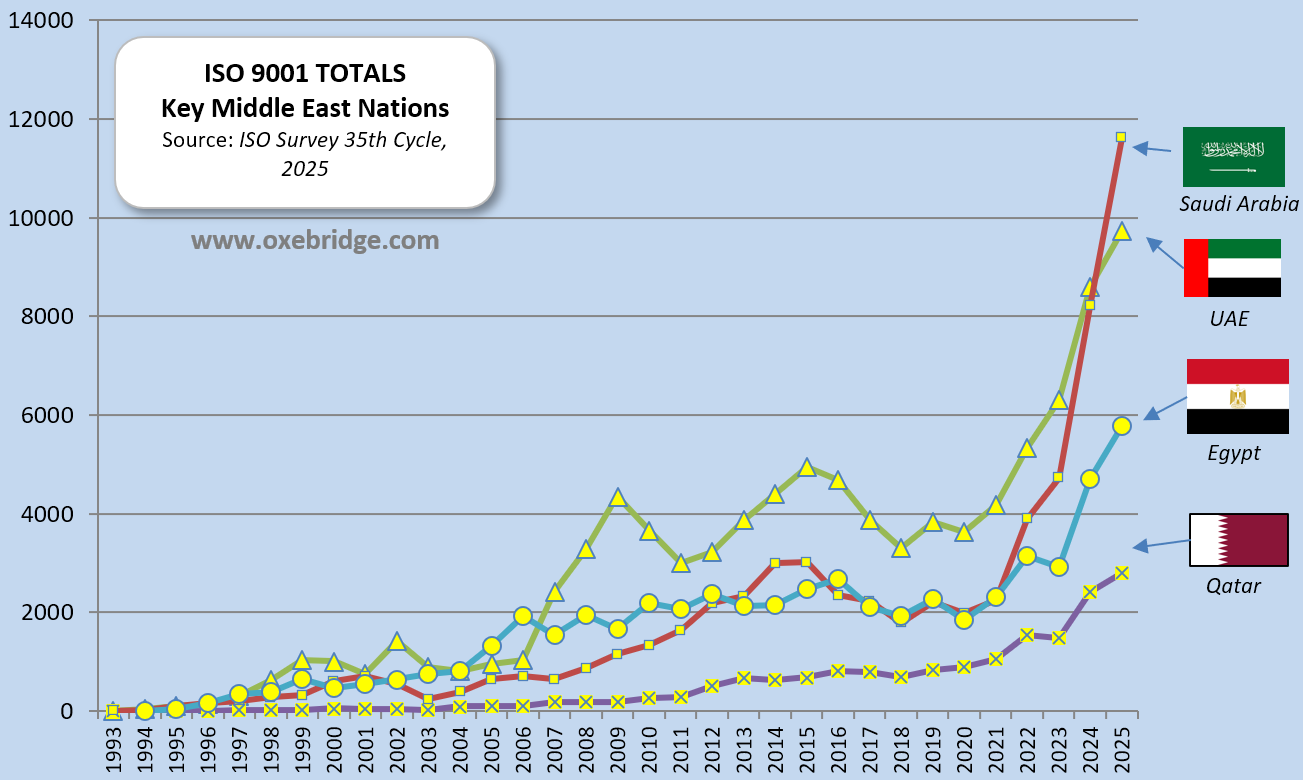
So much of this falls on the Egyptian accreditation body EGAC. That body not only sells rubber-stamped accreditations; it resists any and all complaints, in full violation of ISO 17011. EGAC-accredited CBs then issue fake certificates in bulk, resulting in the numbers you see above.
2025 Totals:
- Qatar: 2,794 (+ 385 since 2026)
- United Arab Emirates: 9,731 (+ 1,140 since 2026)
- Saudi Arabia: 11,627 (+ 3,408 since 2026)
- Egypt: 5,796 (+ 1,086 since 2026)
Russia
Russia is Russia.
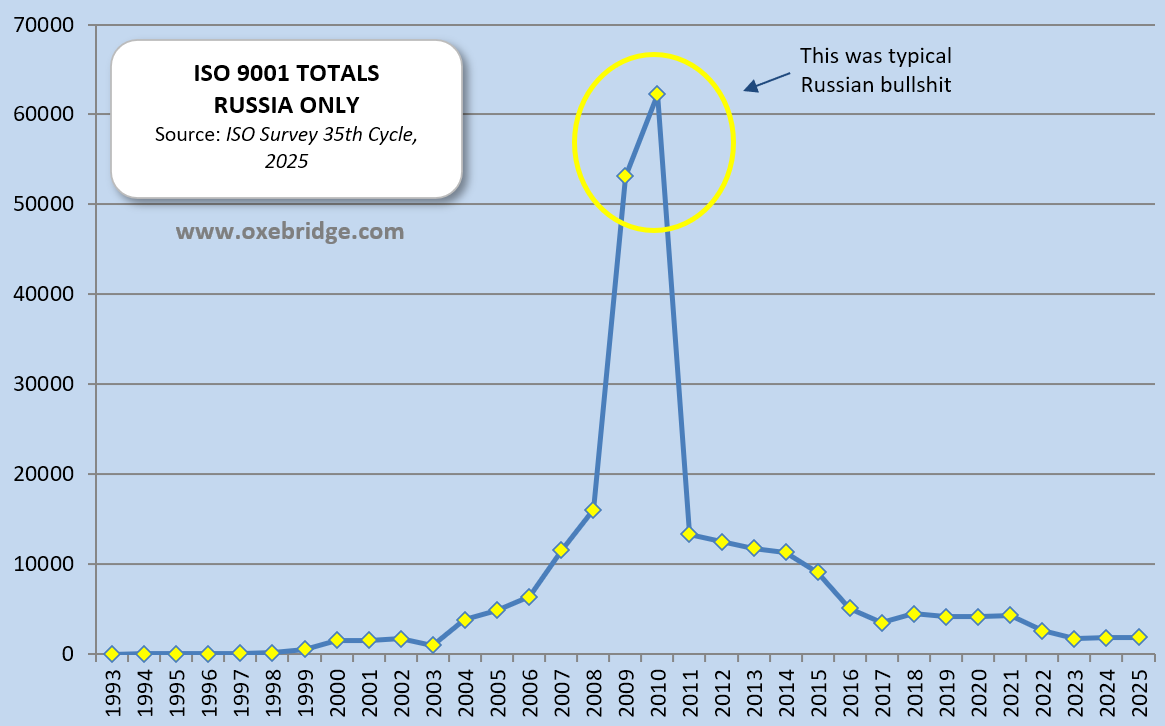
2025 Totals:
- Russia: 1,871 (+ 67 since 2024)
The Asian Bellwethers
For this region, I selected Malaysia, Thailand, Indonesia, Vietnam, and Singapore to track. Many of these are accredited by another IAF scammer member, the Korean Accreditation Board (KAB). Like UAF and EGAC, KAB allows anyone to become accredited and then flood the market with fake certificates, all bearing the IAF logo.
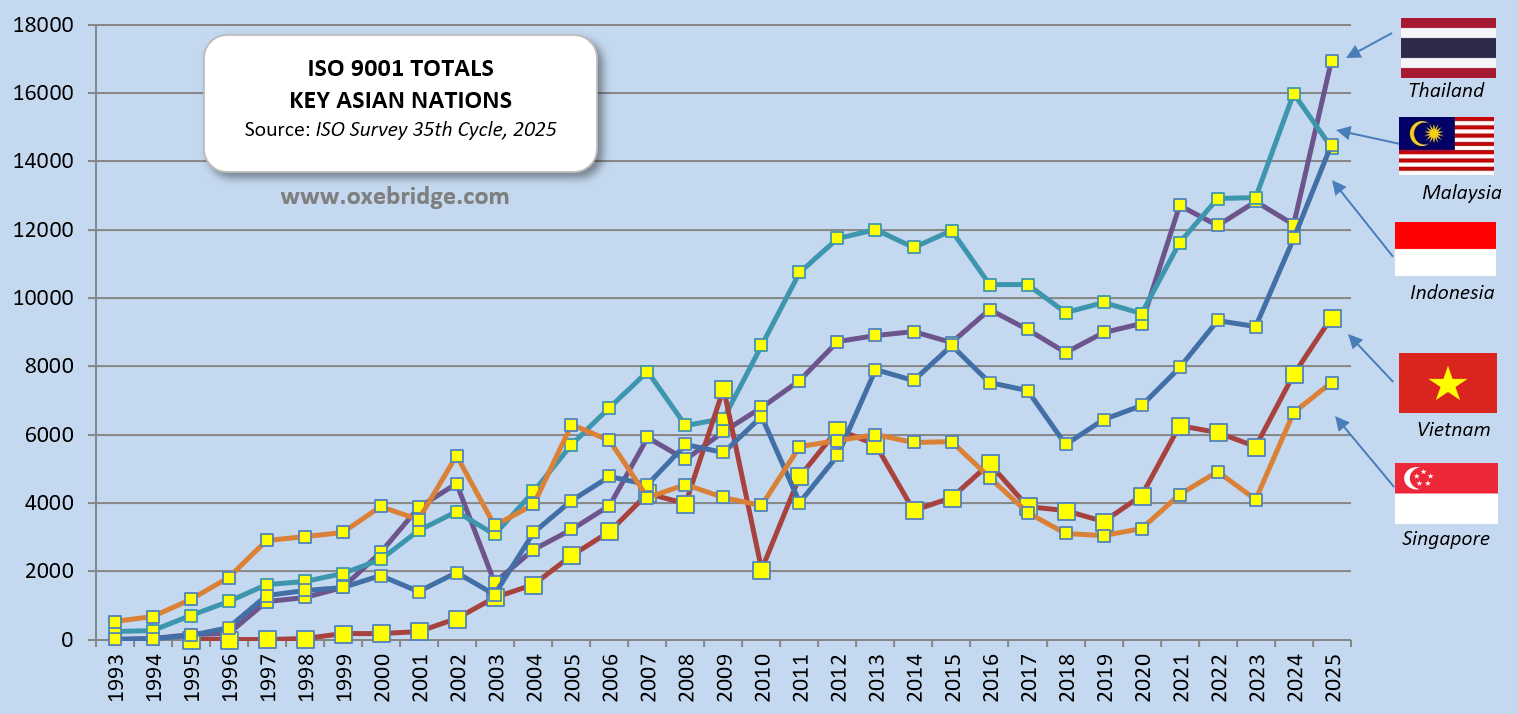
2025 Totals:
- Thailand: 14,401 (+ 2,252 since 2024)
- Malaysia: 16,943 (+ 970 since 2024)
- Vietnam: 9,415 (+ 1,653 since 2024)
- Singapore: 7,520 (+ 877 since 2024)
- Indonesia: 14,484 (+ 2,734 since 2024)

South Korea
Speaking of Korea, how’s that KAB corruption going? Pretty well, I’d say.
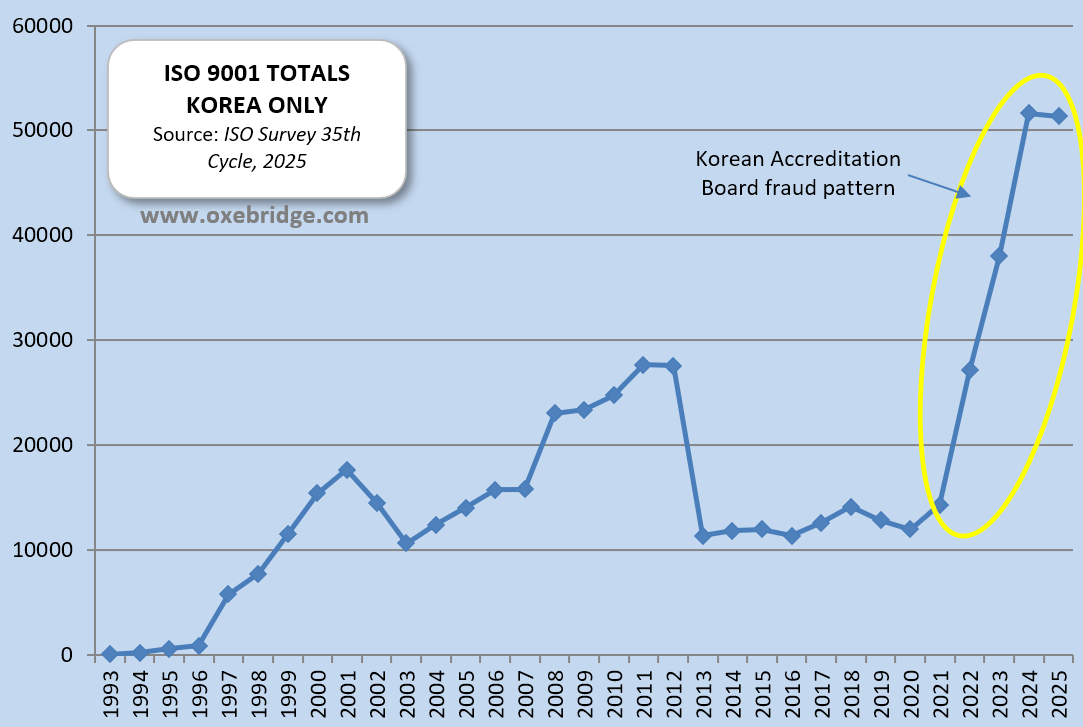
2025 Totals:
- South Korea: 51,362 (- 295 since 2024)
- North Korea: 127 (-39 since 2024)
Trinidad & Tobago
Finally, let’s look at Trinidad & Tobago. This is because one of ISO 9001:2026’s top authors (supposedly) was Devindra Chattergoon, a guy no one ever heard of who claims to have worked as an ISO consultant for nearly 20 years, but then only lists SEVEN (yes, as in a single digit “7”) ISO 9001 clients on his website. (Keep in mind, Oxebridge has had over 400 clients in 26 years, just to give some perspective. But, sure, Chattergoon is an “expert.”)
Chattergoon is positioning himself as the Next Big Thing in ISO, given his willingness to surrender his entire personality and critical thinking skills to Sam Somerville and ISO Sec-Gen Sergio Mujica. Because he’s such an insufferable twat, let’s see how he’s doing in his home country:
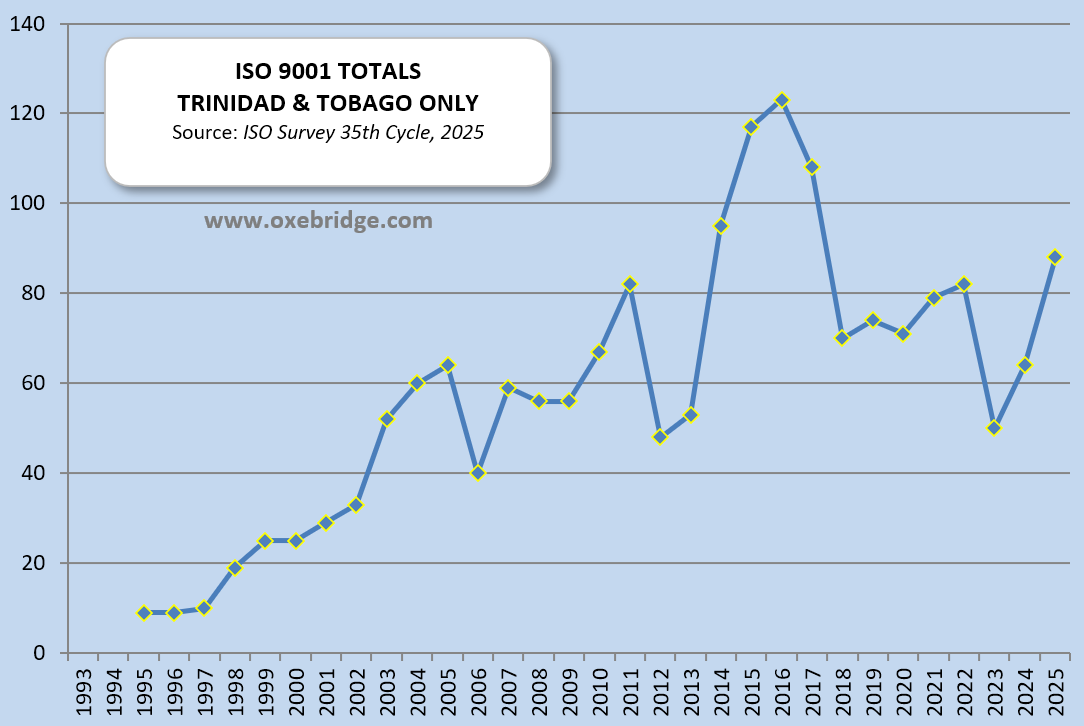
2025 Totals:
- Trinidad & Tobago: 88 certificates (+24 since 2024)
IAF Regional Body Analysis
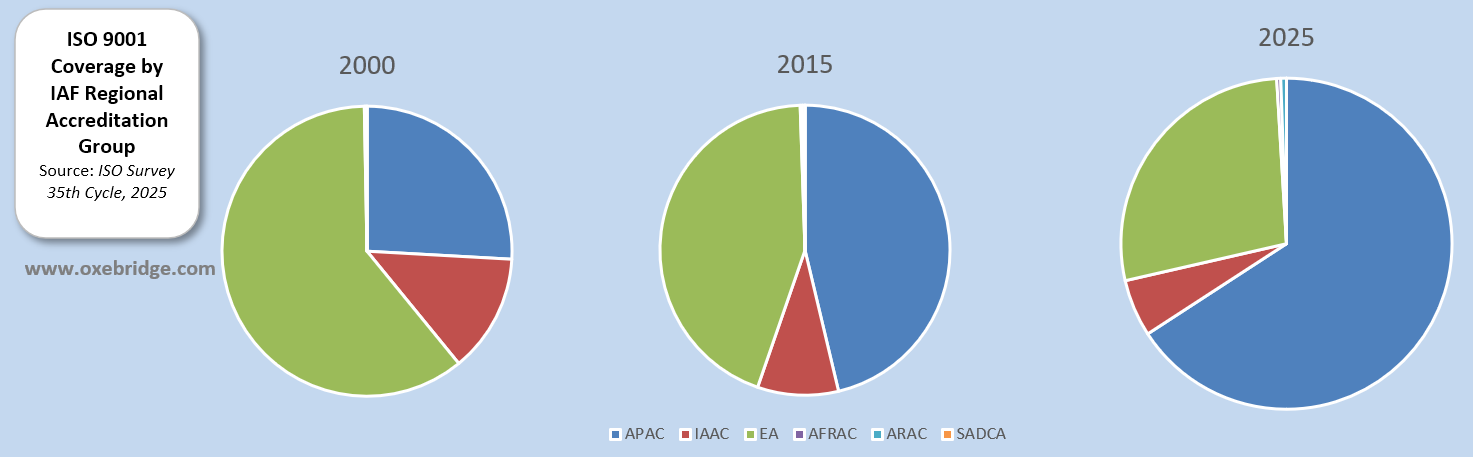
The IAF, now rebranded “Global ACI” (but no one calls them that), gave up doing accreditation body oversight and handed it off to a set of six “Regional Accreditation Groups,” or “RAGs.” These are:
- APAC (Australia, New Zealand, Asia, and Asia Pacific, but basically accredits anyone)
- IAAC (Americas)
- EA (Europe)
- AFRAC (Africa)
- ARAC (Middle East, but mostly Saudi Arabia; APAC does the rest of the region)
- SADCA (South Africa)
As I wrote last year, I wanted to test a theory: that Graeme Drake over at APAC had been gobbling up market share due to his tolerance for allowing any fly-by-night scammer to join the IAF under APAC’s banner. So, the following chart shows the breakdown of IAF RAGs over three annual reports (2000, 2015, and 2025). As you can see, APAC is now the major IAF regional body, with its members issuing the most certificates and, thus, generating the most money for ISO and IAF. That is why Drake is protected by them.
Sure enough, we see Drake’s APAC eclipsing other RAGs, suggesting that fraud does pay!
Sector Analysis
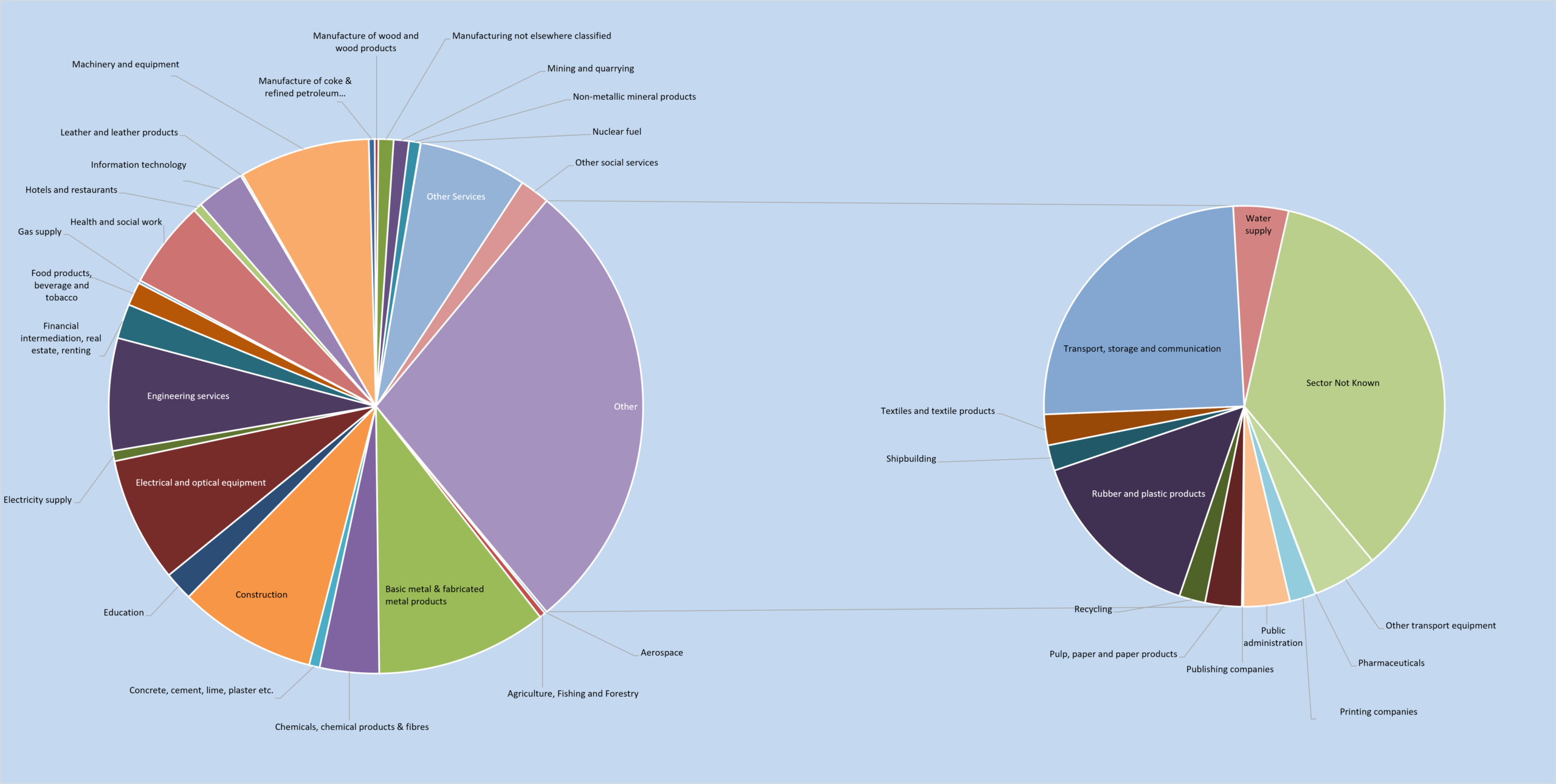
ISO and IAF still can’t measure sectors properly. This has been an ongoing joke for decades, and I’m not sure why it presents such a problem. For a while, they stopped reporting on this entirely. Then they fell back into it, and I thought they finally had consistent data again, and I reported it as such last year.
Now, IAF CertSearch has given us better data, but it might be too good. The numbers look much more accurate, but they also show just how bad every year before 2025 was. But it’s better than nothing. (Click to enlarge; it’s a big graphic.)
Winners and Losers
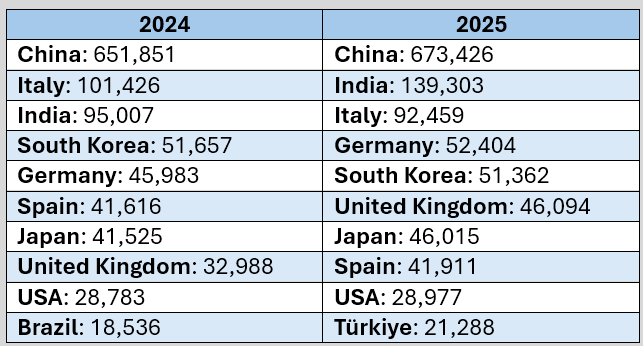
The top ten nations with the most certificates as of 2024 vs 2025:
And here is a comparison of the top ten nations with the highest single-year increase:
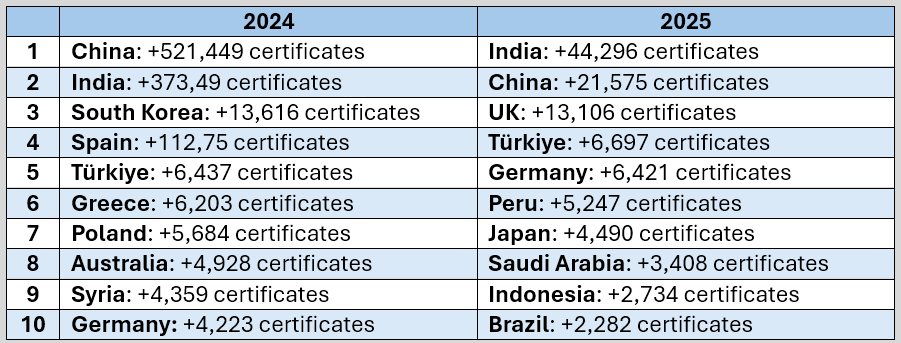
Keep in mind, the large UK spike is not actually as it appears; it’s only because UKAS bungled its numbers last year, reporting artificially low figures. In truth, the UK should not be on the list at all.
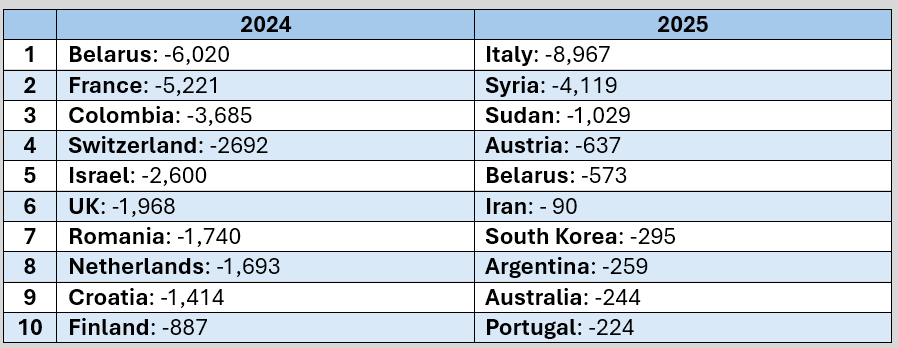
The top ten losers — representing the countries that lost the most certificates — are as follows:
Summary
It is difficult to know how many of the changes in certificate totals are due to legitimate growth, fraudulent growth, or merely the ever-shifting reporting and inconsistent data gathered by ISO and the IAF.
The numbers out of scammer countries like India, South Korea, and Saudi Arabia, however, suggest that the scammers are taking advantage of the IAF / Global ACI’s cessation of upholding accreditation rules, despite being obligated under both national and international law to do so. As long as Victor Gandy and Brahim Houla keep raking in money for doing nothing, fraudulent certificates will keep flooding the market, bringing distrust and disrepute to anyone holding an ISO 9001 certificate.
So much of this could be fixed if the Indian government did its job and threw the scammers in jail! But that would require winding back generations of Indian culture, which thinks this sort of thing is to be applauded, not penalized.
Here are a few of the prior Oxebridge analyses of previous ISO Surveys:
- Oxebridge Analysis of ISO Survey 2018: Facing 20% Loss of ISO 9001 Certs Worldwide, ISO Dismantles Data Trending
- Oxebridge Analysis of ISO Survey 2019: Bleeding is Slowing, But Patient is on Life Support
- Oxebridge Analysis of ISO Survey 2020: China to the Rescue
- Oxebridge Analysis of ISO Survey 2021: China, UKAS Corrupt the Data
- Oxebridge Analysis of ISO Survey 2022: IAF CertSearch Gunks Up the Works
- Oxebridge Analysis of ISO Survey 2023: China Has Left the Chat
- Oxebridge Analysis of ISO Survey 2024: IAF Takes Over Survey Data

Christopher Paris is the founder and VP Operations of Oxebridge. He has over 35 years’ experience implementing ISO 9001 and AS9100 systems, and helps establish certification and accreditation bodies with the ISO 17000 series. He is a vocal advocate for the development and use of standards from the point of view of actual users. He is the writer and artist of THE AUDITOR comic strip, and is currently writing the DR. CUBA pulp novel series. Visit www.drcuba.world