One of the symptoms of surrounding yourself only with your buddies is that you soon grow to disbelieve any information that doesn’t come from a guy buying you a beer. So it is with the certification and accreditation body folks, who violently resist all stakeholder feedback and isolate themselves so much from criticism that they smugly deny its existence when they encounter it.
This smugness loves to pop its head up over on LinkedIn, where CB and AB reps repeatedly inject themselves into conversations and always — always — make things much, much worse for themselves.
The other day, I noted that the so-called Anti-Bribery Anti-Corruption Center of Excellence (“ABAC”) was showing a bit of leakage in the area of anti-corruption. ABAC is a certification body that issues ISO 37001 certificates for anti-bribery management systems, and has built its marketing on how trustworthy it is. Their website miraculously claims they are accredited by UKAS to issue certificates in “over 170 countries,” which doesn’t leave a whole lot of the Earth’s countries left. The only problem is that ABAC’s scope of accreditation by UKAS only covered three countries: the UK, the United Arab Emirates and Malaysia.
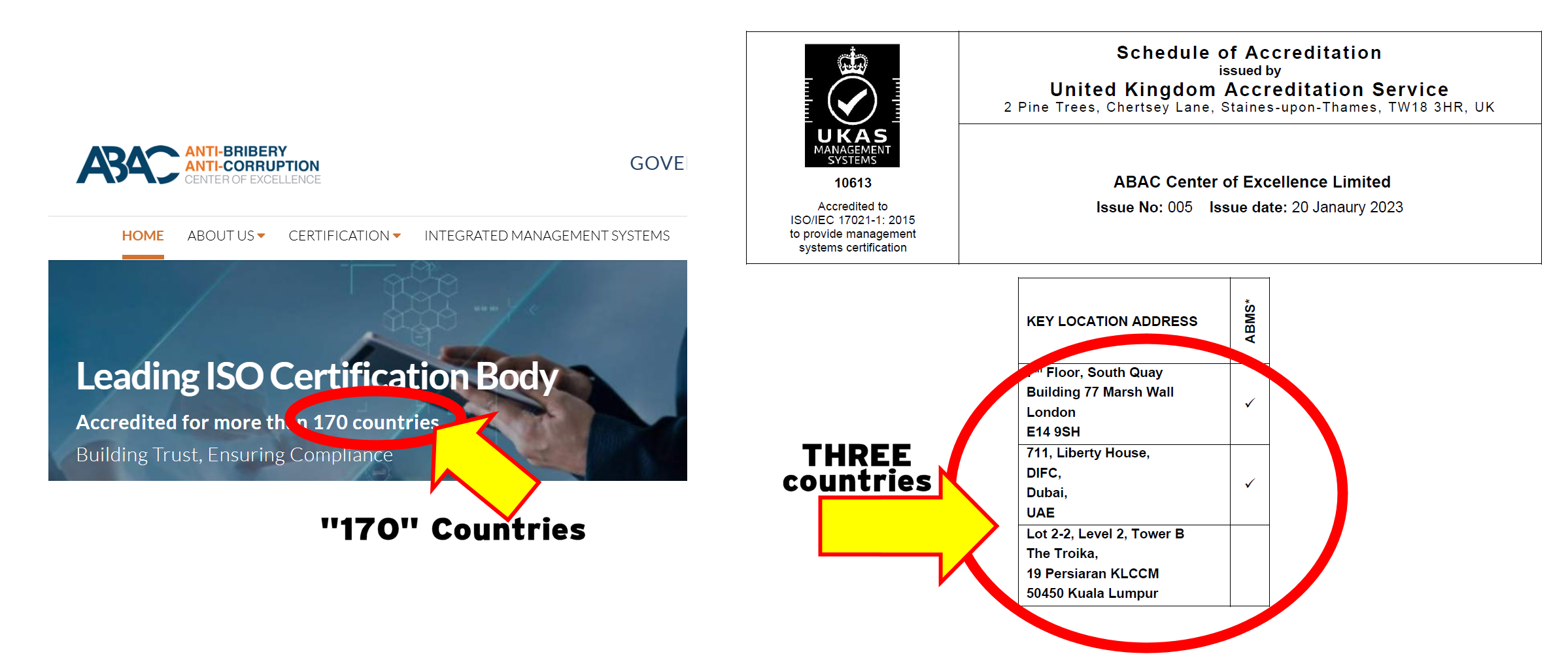
Now, I am no math whiz, but I think three is less than 170.
So I posted a bit on LinkedIn talking about UKAS and the IAF’s “rubber stamp accreditation” problem, where, despite rules prohibiting this in ISO 17011, they accredited one office in one country but then allow the CBs to magically claim accreditation in all countries, everywhere, all at once. It’s quantum!
I wrote about this problem here, and how the IAF has refused to fix it.
Then, because of that smug misplaced confidence I spoke of, the wrong people decided to step in and make the wrong argument. First was Martyn Cheesbrough, who sounds like the villain in a Wallace & Gromit movie but is actually an assessor with accreditation bodies like INAB and UKAS. He claimed not to even be aware of the accreditation rules preventing this, which is troubling because, like I said, he works for INAB and UKAS.
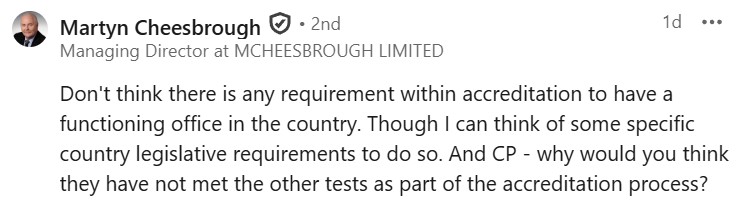
Again, an assessor with INAB and UKAS doesn’t know the accreditation rules and defaulted to a position defending rubber-stamp accreditation. That’s troubling.
Next was Ben Keene, a Technical Assessor with UKAS who insisted I provide more evidence even though UKAS is not really concerned with evidence when it comes to doing their assessments. I promptly provided him with evidence, and he scurried back underground.
But the “tough guy” in this story — there’s always one — is Amtivo’s Technical Manager James Gibb, who got himself into the pickle jar and thought he could drink his way out. Gibb — who has followed me around LinkedIn and taken a few potshots previously — thought he’d get one over by noting ABAC had been de-accredited by UKAS, per this notice.
So I noted it was an interesting development, and that should have been it. He had provided information I didn’t have, but I did point out that ABAC was still claiming accreditation. Gibb should have left it there.
But he didn’t.
Instead, he took a shot at me, saying, “That’s why you should always verify any claims on a website.” Oh, really, shitbird?
At which point I told him that it was irrelevant, since ABAC was only de-listed a few months ago (in November of 2025) and had been claiming the “over 170 country” accreditation for far longer than that. I then said this is a long-standing problem that doesn’t just affect ABAC, and pointed him to my articles on the subject here, here, and here. I then suggested that he might want to verify stuff, too.
He wasn’t done, because smug is a drug. Instead, he launched in with a fact-free assertion that UKAS had done its job and de-accredited ABAC specifically for these false claims, something some random dude at Amtivo could never know. Only UKAS knows why it withdrew ABAC, and the link he posted doesn’t publish those reasons. Also, UKAS has a responsibility to force ABAC to stop using its name fraudulently, and it hasn’t done that either.
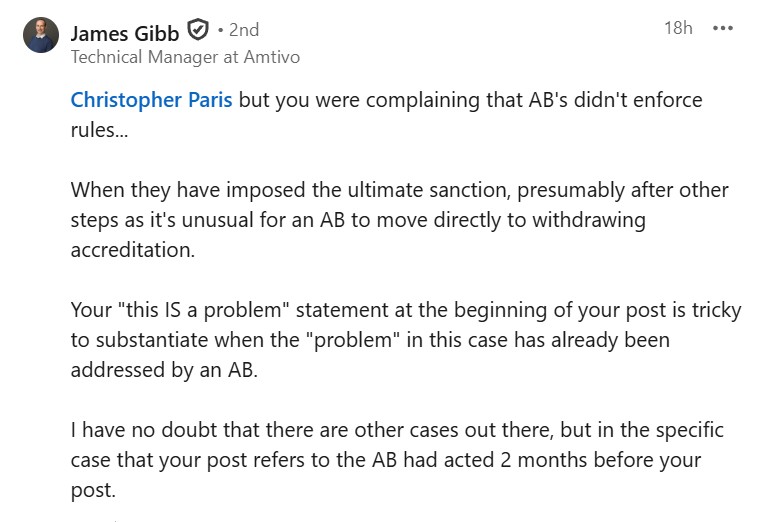 When I pointed out that he doesn’t know why ABAC was withdrawn, and that it wasn’t a good look for Amtivo, he accused me of making a “personal attack.” (Hint: Amtivo isn’t a person.)
So, because I have receipts ready in the chamber, I fired. I reminded Gibb that Amtivo doesn’t have clean hands, what with the selling of ActivCertify QMS software for over a decade, and how UKAS had ignored them for all that time. It was only after I filed a complaint that went viral that Amtivo yanked back ActivCertify, but during the process, they ignored the complaint and tried to delete all the evidence from different Amtivo websites all over the world. Meanwhile, as usual, neither UKAS nor INAB did anything about it, also ignoring the problem.
I also reminded him what a shithouse Amtivo is, with its US rep — David Gawlak — pulling a similar smug stunt and landing ass-first on his pants.
I ended by writing this:
So you have no moral high ground to take here. You should be THANKING people who bring up these incidents, as they intend to improve the trust in certifications. But the Amtivo and UKAS cultures are to toxic to the idea of impartiality, you’re here nipping at my heels like an annoyed puppy.
Left with nothing else, and not about to apologize for being a dipshit, all Gibb could do was remind everyone how Amtivo is toxic to the idea of impartiality and was nipping at my heels like an annoyed puppy. This is what he did:

So, yes, he proved every point I was making.
Meanwhile, Amtivo appears to be hemorrhaging clients because — who knew? — letting some venture capitalists who don’t know anything about accreditation buy up a bunch of poorly-run smaller CBs, in an attempt to become an international powerhouse overnight, isn’t a solid business plan.
Meanwhile, ABAC and its boss, Zafar Anjum, are still falsely claiming accreditation while selling anti-corruption services.

Christopher Paris is the founder and VP Operations of Oxebridge. He has over 35 years’ experience implementing ISO 9001 and AS9100 systems, and helps establish certification and accreditation bodies with the ISO 17000 series. He is a vocal advocate for the development and use of standards from the point of view of actual users. He is the writer and artist of THE AUDITOR comic strip, and is currently writing the DR. CUBA pulp novel series. Visit www.drcuba.world