The ANSI National Accreditation Board (ANAB) was not always the corrupt, conflict-laden monstrosity it is now: issuing accreditations without proper oversight, providing “cover” for companies that break the law and commit fraud, and battling against maintaining the integrity of accredited ISO certifications. ANAB was also never intended to be a training organization, and owes its formation to the fact that the world rejected this role when it stumbled into the field. Now, however, ANAB — and so many other accreditation bodies — have shifted their focus to the provision of training and credentials rather than accreditation, despite that being the role they claim in order to gain not-for-profit tax status.
So when did this all go wrong? Let’s go back and look at the history of ANAB.
RAB Days
The organization began as the “Registrar Accreditation Board” (RAB) in 1989 and was actually formed by the American Society for Quality Control, which would later rebrand as ASQ. Its sole role was to act as the United States’ quasi-official accreditation body and accredit certification bodies (CBs) operating in the US. It would quickly expand to accreditation of non-US bodies, too.
I say “quasi-official” because the US worships at the foot of private enterprise, and the government did not want to form an official, government-led AB. Instead, it gave soft recognition to ASQC and, thus, RAB. But there was always the risk that, someday, another AB would rise up and compete with RAB on its home soil, since the government did not want to grant them monopoly status.
In those days, as I said, RAB only provided accreditation services. Here’s the RAB website (rabnet.com) from late 1998:
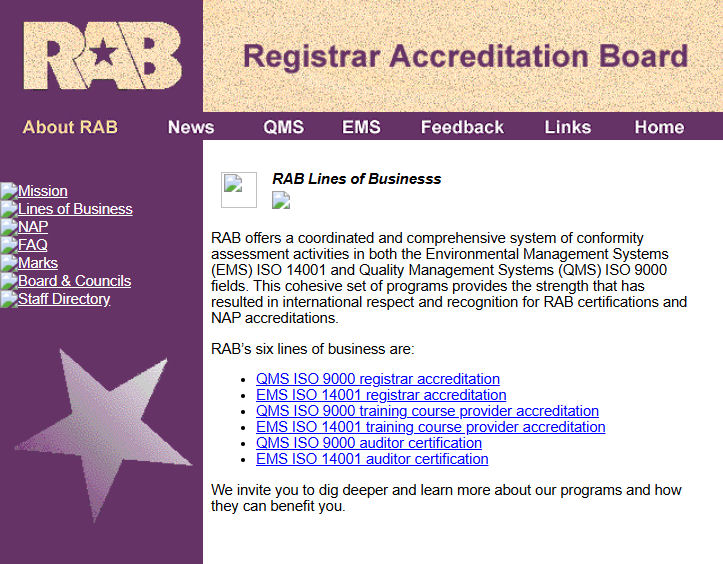
Here we see the main line of business being “registrar accreditation,” which had been the case for the years. The accreditations, in those days, were issued against ISO Guide 40, ISO Guide 48, and ISO 10011. There were no ISO 17000 series standards for accreditation back then.
The Forced Breakup
Now, around 1994 or so, RAB began offering “auditor certification” on top of accreditation; I don’t have screenshots of the website from that period, however, so the exact date isn’t clear. But this proved problematic. The world — rightly — flagged RAB as engaging in a conflict of interest: RAB could “write up” a certification body for having poorly-trained auditors and then conveniently provide them a solution: RAB’s own auditor training services. AT the time, the governing documents for accreditation bodies were ISO Guide 61 and the associated IAF GD1: Guidance on the Application of ISO Guide 61. Essentially, an accreditation body had to comply with the IAF GD1 to gain international recognition. That document prohibited ABs from providing training to anyone other than their own staff.
RAB was under a lot of pressure to fix this, and international competitors were accusing RAB of ethical violations. So, in 2004, RAB sold off the training and credentialing activity to the Quality Society of Australasia, which formed the training body RABQSA. The remaining accreidation work would be done under a new brand name, ANSI-ASQ National Accreditation Board (ANAB.)
Ironically, RABQSA’s new CEO was Mike Carmody, who immediately got himself into hot water and began scamming, but that’s another story entirely. Carmody eventually quit, and RABQSA was reformed as Exemplar Global.
But, yes, ANAB literally owes its existence to pressure to stop violating conflict of interest rules.
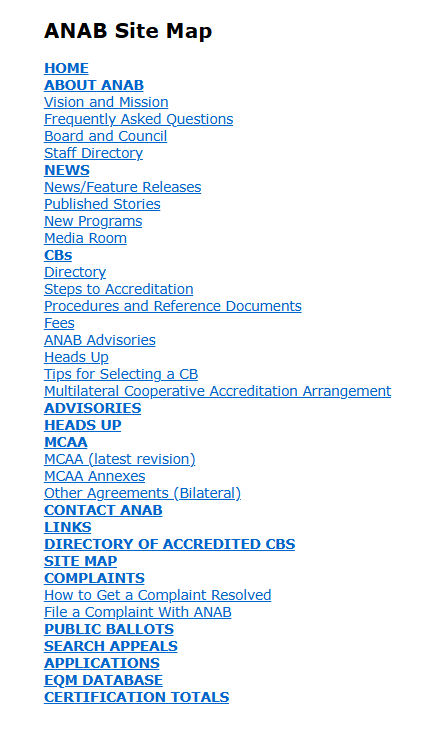
Here’s a shot of the ANAB website from 2006, without any credentialing or training services:
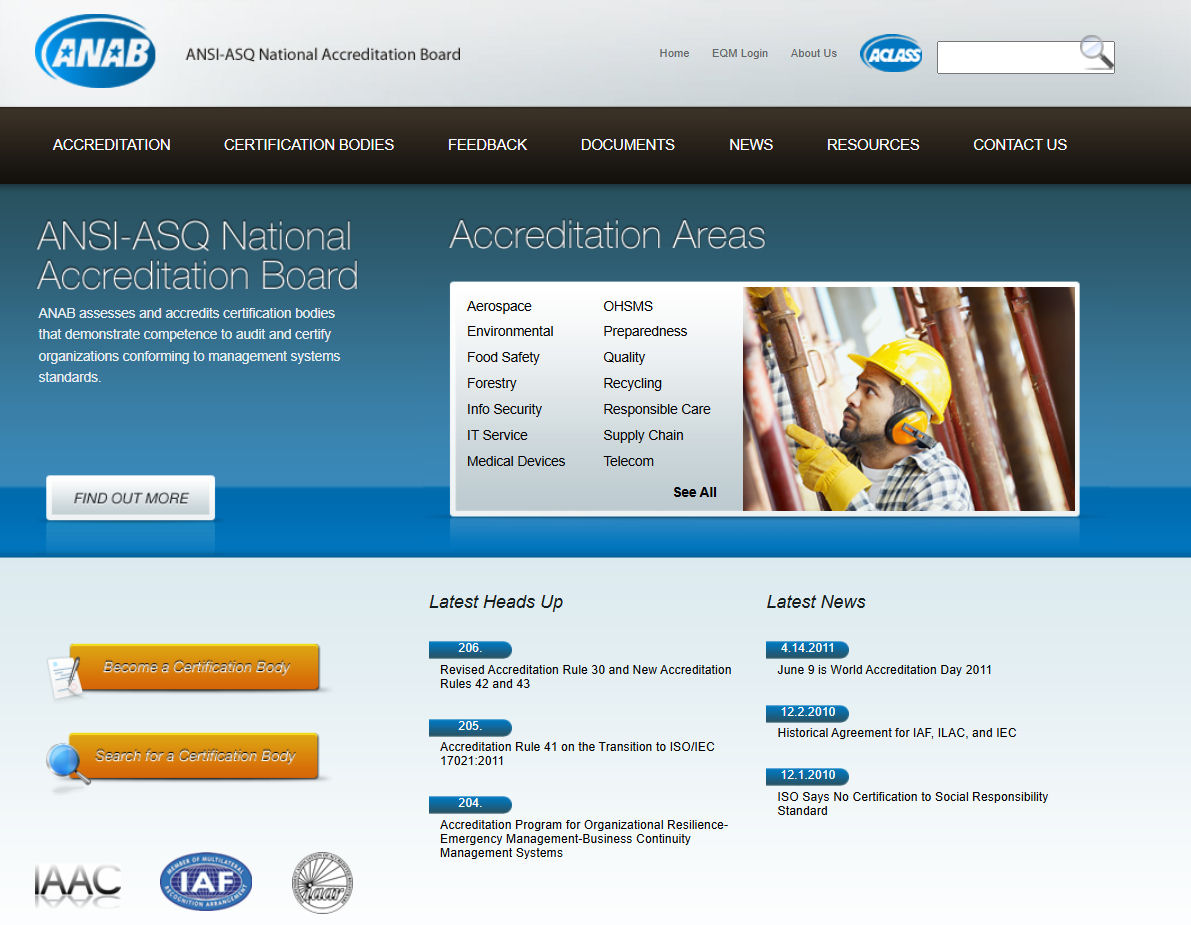
And here it is again, a bit updated, for 2011. Still without any training or credentialing services:
Daugherty Exits
And, so, things went along fine, with the main controlling influence at ANAB being its VP, Randy Daugherty. Under Daugherty, who also led the IAF at the time, ANAB generally held its CB clients accountable, withdrawing and suspending accreditations when necessary, and performing (somewhat) rigorous accreditation audits. But under pressure to expand by ANAB’s CEO John Knappenberger, and warnings by yours truly that his name was all over everything — which was starting to become problematic — Daugherty quit silently in 2016. Few even noticed until a year later.
Knappenberger, meanwhile, was left to his worst impulses. Adopting a for-profit mindset, Knappenberger orchestrated the acquisition of multiple other entities while ignoring the rules governing conflicts of interest. In 2016 — yes, the same time Daugherty had left the field — ANAB merged with the laboratory accreditation company ACLASS and, more importantly, Forensic Quality Services (FQS). That company provided accreditation and training for forensics labs.
ANAB was back in the credentialing business, and Knappenberger did not have Daughterty around to tell him to stop.
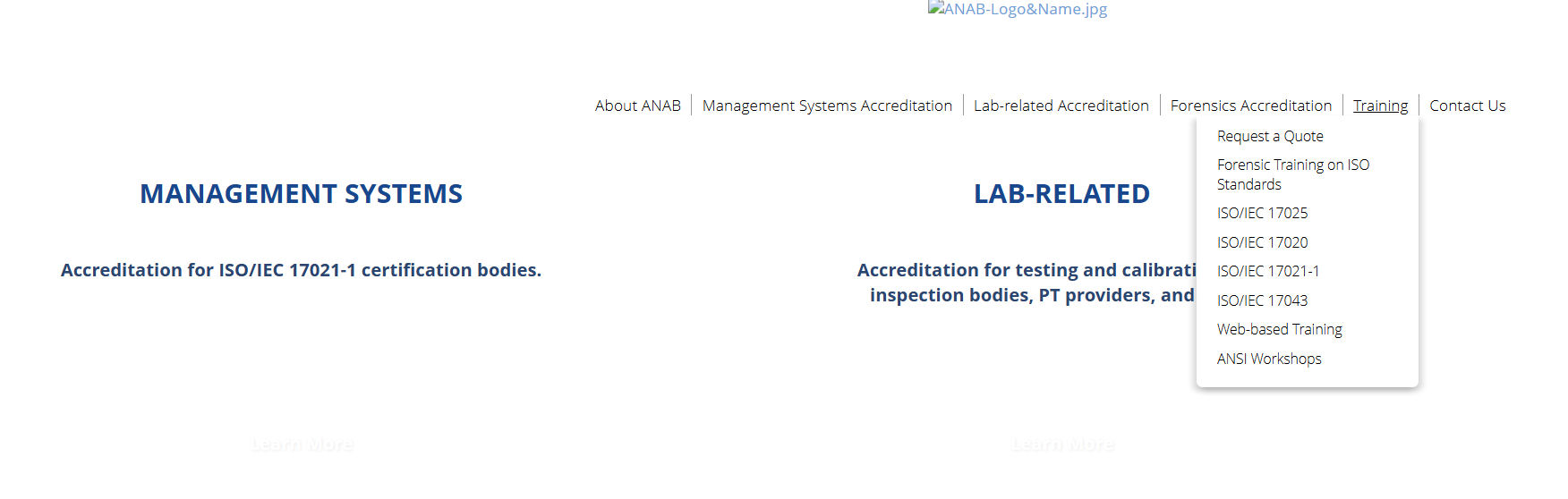
Here is what the ANAB site morphed into in late 2016 / early 2017. Now, an entire page was dedicated to training services:
The IAF had been taken over by China’s Xiao Jianhua, who, for some reason, let ANAB get away with this. Everyone just pretended the entire RAB split never happened.
ANAB was back in the credentialing business.
Market Pressures
ANAB then faced two different problems, only one of which, however, would they actually view as a problem. The increasing laxity of the IAF to actually do its job and hold accreditation bodies to conformity with the rules (at this point published as ISO 17011) was a problem for the world, but ANAB enjoyed the benefits. They were certainly not complaining as the IAF slid into corruption and fraud.
The rise of the Indian-led International Accreditation Service (IAS) was the problem that plagued ANAB and Knappenberger. IAS had begun competing with ANAB in 2013, but had largely been isolated to offering accreditation in India and the Middle East while using a California office address. In the beginning, IAS was seen as a joke, not a possible threat to ANAB. By 2017, however, Knappenberger had to face the inevitable: the US obsession with free markets and refusal to make ANAB the nation’s sole accreditation body had led to the rise of IAS, which was now eating into ANAB’s sales. The IAS services were (and remain) more than half the price of ANAB while being equally recognized under the IAF multilateral agreement. Soon, CBs realized there was no rational basis for choosing ANAB over IAS, and ANAB began to lose market share.
Knappenberger couldn’t crack the case on this, and his age was limiting his abilities anyway, so he quit in 2018. He had intended to resign in 2016, but held on for the additional time to let ANAB find a replacement. In 2018, ANAB — now addicted to the heady rush of conflicts of interest — hired the son of one of its own clients as the new CEO. Keith Greenaway would head ANAB while he accredited EAGLE Certification Group, led by his dad, Skip Greenaway.
You can’t make this shit up.
Greenaway quit shortly after that, and ANAB gave up the search for an executive entirely. Instead, an army of eight to ten Vice Presidents would lead the organization, without a single CEO to manage them. It worked out about how you’d expect. Recently, one of the VPs — R. Doug Leonard — was given the title of “Executive Director,” but they won’t grant him CEO powers. Sources say he has no actual control over the VPs.
Worse, Daugherty’s former secretary, Lori Gillespie, was given prominent roles in the IAF and ANAB, despite having no understanding of accreditation standards or conformity auditing.
Fraud is Cool Now
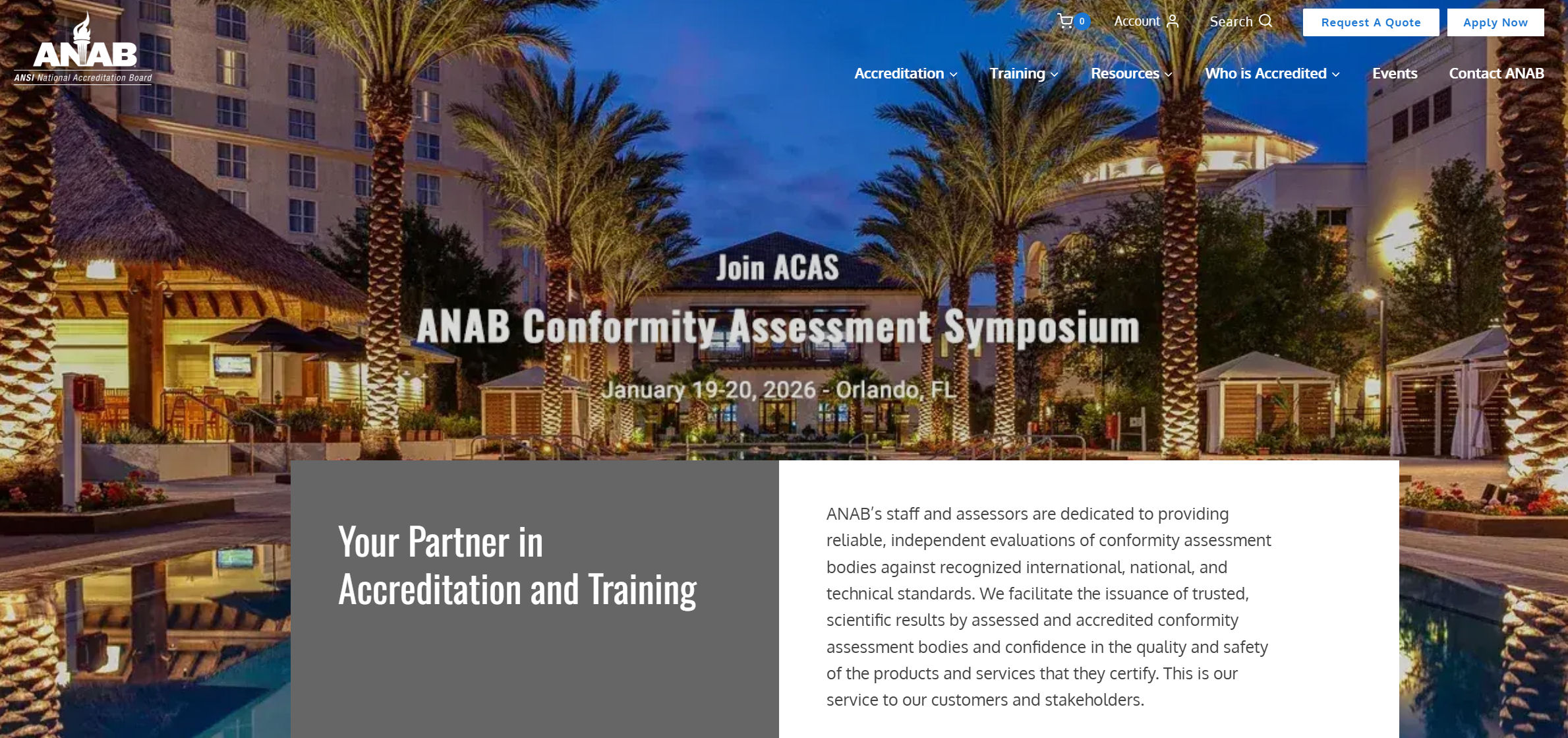
Where are we at now? ANAB has shifted so that, by my estimate, the majority of its business is now training and credentialing, with accreditation being a side hustle. Have a look at their website now, in 2025, and how it has rebranded as a “credentialing” organization:
Let’s zoom in on the important parts:
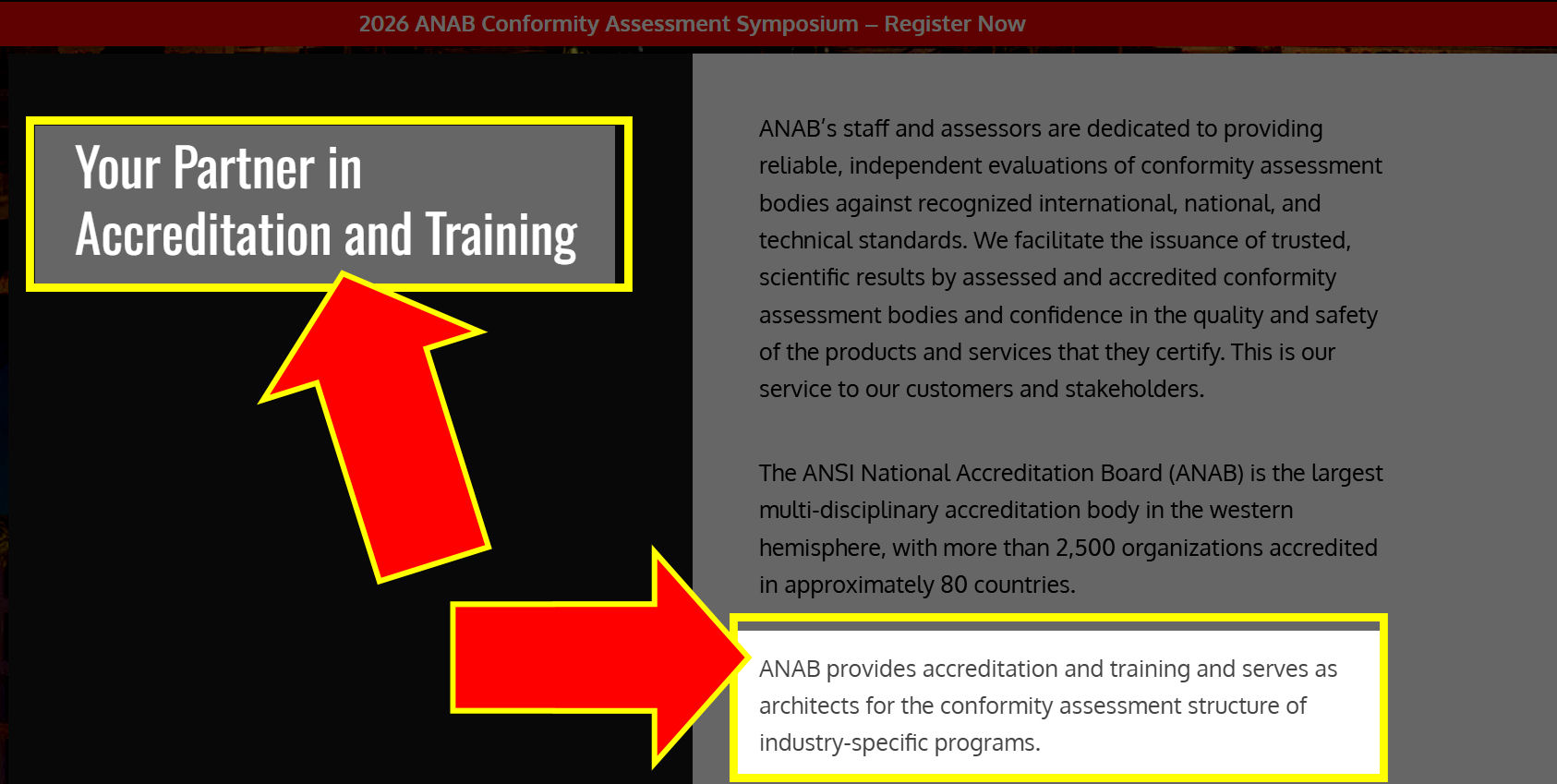
In fact, ANAB is now hosting its first annual “Conformity Assessment Symposium” which — it says — will include “ANAB Professional Development Training” courses on measurement uncertainty, verification and validation, and risk-based thinking.
Worse, ANAB is openly violating ISO 17011 by offering customized training to its own accreditation clients. Per the ANAB website:
All ANAB courses can be private. ANAB’s modular course design allows us to tailor courses specifically to the training needs of organizations requesting training.
ANAB also offers completely custom courses on conformity assessment standards and related topics, such as AOAC requirements in the laboratory or improving your internal auditing skills.
We live in a post-consequences world where private companies like ANSI and ANAB can be granted tax-exempt status, saying they do a thing only to the exact opposite and act as de facto for-profit companies with impunity. The IRS could shut these scams down, but can’t be bothered.
In the end, this means ANAB is drowning in conflicts of interest and fraud, but no one is left to hold them accountable. If forensics labs falsify test results, they can do it proudly with an ANAB logo. If a CB certifies a manufacturer of defective products that kill people, the ANAB logo is there to protect them.
But at least you have the full picture now.

Christopher Paris is the founder and VP Operations of Oxebridge. He has over 35 years’ experience implementing ISO 9001 and AS9100 systems, and helps establish certification and accreditation bodies with the ISO 17000 series. He is a vocal advocate for the development and use of standards from the point of view of actual users. He is the writer and artist of THE AUDITOR comic strip, and is currently writing the DR. CUBA pulp novel series. Visit www.drcuba.world