Back in 2015, the ISO 9001 standard was repackaged, and no one noticed. It was an old-school, Madison Avenue, breakfast cereal advertising trick. They sold the same exact product, but added new packaging to make people think they were buying something entirely different.
Here is what the goal of ISO 9001 was in 2000, as published in section 0.1 of that year’s version:
This International Standard can be used by internal and external parties, including certification bodies, to assess the organization’s ability to meet customer, regulatory and the organization’s own requirements.
But in 2015, the goal became this, and few ever noticed:
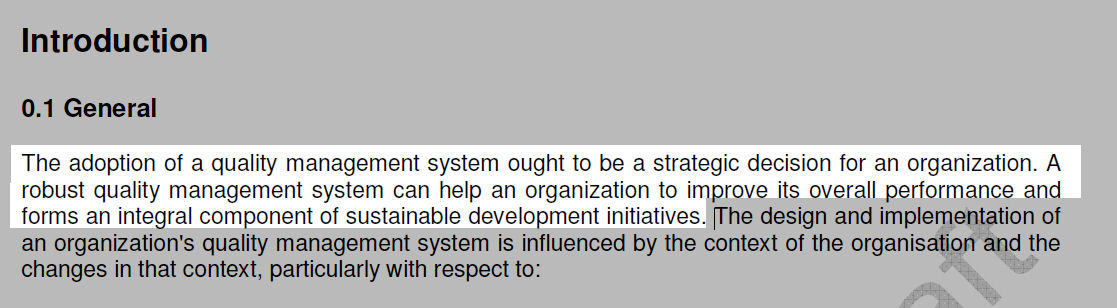
The adoption of a quality management system is a strategic decision for an organization that can help to improve its overall performance and provide a sound basis for sustainable development initiatives.
There’s been a lot of talk about ISO trying to re-form itself into a publication wing of the United Nations, but much of that — my reporting included — began long after the 2015 standard was developed. It was not, in fact, a 2026 thing.
The Design Plan
During the development of ISO 9001:2015, however, this was not part of the original plan. I mean that quite literally. The official Design Plan for ISO 9001:2015 said nothing about sustainable development. Take a look:
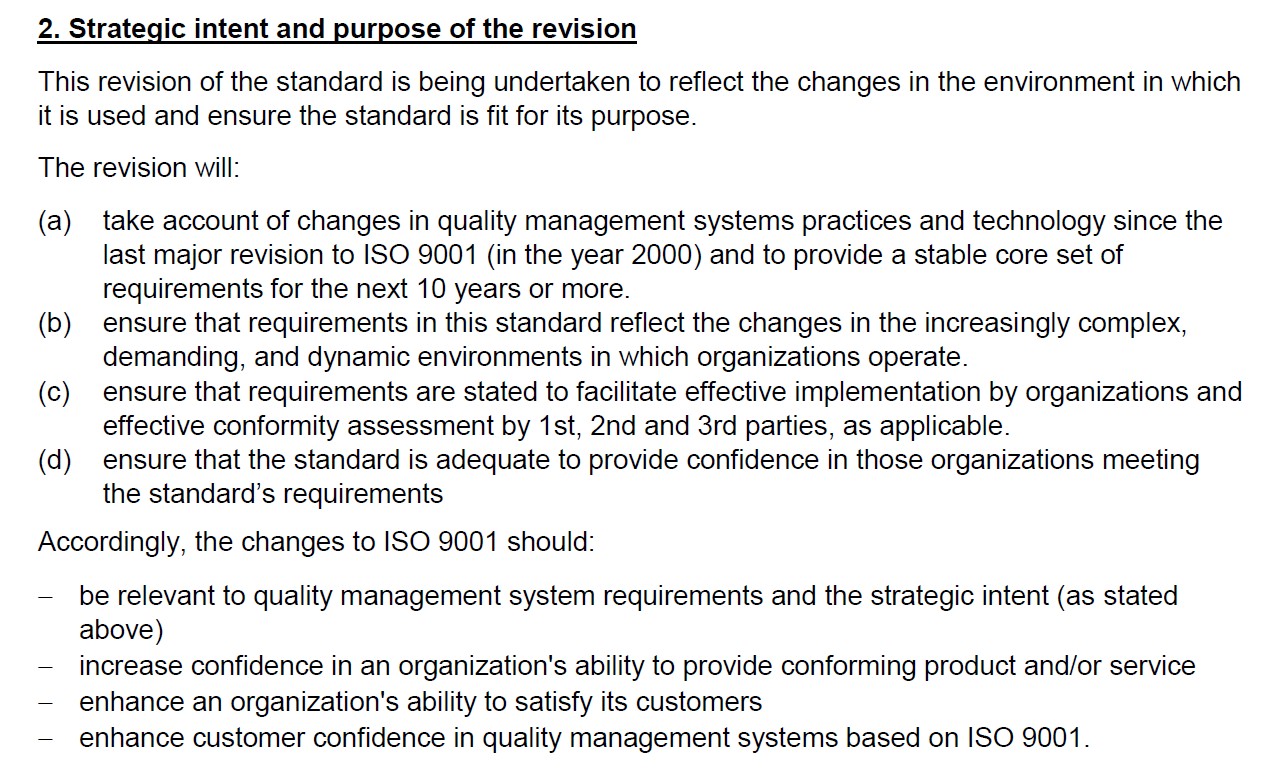 Nevertheless, the first Working Draft of that standard (from January 2013) injected language on sustainable development, dramatically changing the scope of ISO 9001 from what was approved in the Design Plan, and arbitrarily redefining the purpose of a QMS entirely:
In the next draft, the June 2013 Committee Draft (CD), section 0.1 was left out entirely, replaced with a note that said:
This introduction is specific to this committee draft (CD) and it is not intended for incorporation to the final version of the standard. The introduction to ISO 9001:2008 has not been included in this committee draft. It will be revised as part of the response to the CD comments and ballots and incorporated into the draft international standard (DIS).
Without the actual text (including the “sustainable development” language), it wasn’t clear how anyone would respond to the text. I am not sure if that was an error or an intentional omission.
I don’t have the comments file of the CD, but I do have it for the DIS version (from June of 2015). Here we see the ISO members debating the usage of the term, and clearly not understanding its full meaning.

The comments came from Stegan Tangen (Sweden), Nigel Croft (Brazil), and unknown representatives from Mexico and Ireland. The comments marked with TN were then rejected outright, with the last comment (from Ireland) marked as “TAP” for “Accepted in Part.” Those decisions were made by the Secretary of TC 176 at the time, Charles Corrie.
The most telling rejection was that of Mexico’s comment. Mexico wanted to clarify that ISO was not intending for ISO 9001 to address the world’s sustainable development initiatives, but rather the “organizational” sustainable initiatives. This was rejected outright by Corrie, who was carrying BSI’s water with the full intent of, yes, suggesting a QMS can solve all the world’s problems.
Regardless of the confusion over the term, nothing was changed at all, and the text remained in place for the next FDIS draft and, of course, the published version of ISO 9001:2015. Once again, all comments were ignored and ISO pushed ahead.
Where Did This Come From?
Where did it come from? How did the idea of a quality management system, something dating back to the 1950s, suddenly get redefined to include “sustainable development”?
It has the fingerprints of Nigel Croft, yes, as he was already sneaking around the halls of the United Nations, trying to get consulting work with UNIDO. (He eventually did, and made a bit of money at it, too.) This “sustainable development” language popped up after the TC 176 meeting in Porto. Croft, who made his money by marrying a Brazilian steel heiress, was trying to rebrand himself as an environmental warrior, given all the bad press his father-in-law’s company and industry had. So it makes sense he would suck up to the UN and add their language here.
But Corrie would never have rejected Croft’s comment above (line 188). Croft was The Golden Child of both ISO and BSI, so this business might not have come from Croft.
Tangen, of Sweden, is the guy who added the language in ISO 9001 requiring an “emotionally protective” work environment, so this also sounds like him. But we don’t have any proof.
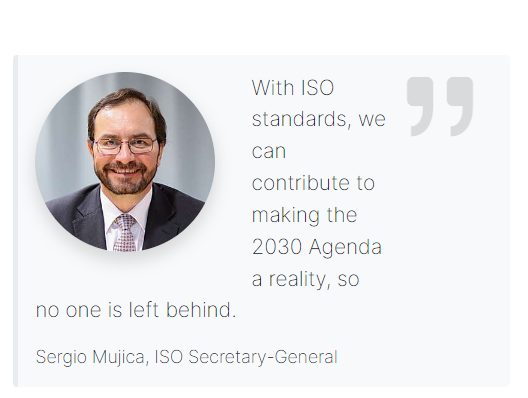
In all likelihood, this came from ISO Secretary-General Sergio Mujica himself, as he began positioning himself for a future gig at the UN. But this was very, very early, and he had not yet developed his post-ISO career plans.
For the next edition, however, Mujica was more overt in his personal directives regarding ISO 9001 content. Mujica forced the release of the 2024 “Amendment 1” to ISO 9001 that included requirements for climate change consideration. That was pushed through without any voting at all, violating all of ISO’s development procedures and the World Trade Organization’s Technical Barriers to Trade regulations. As I have reported, Mujica did that because he was very worried about his post-ISO job, with his term limit coming in 2026… the same year as the election for the new United Nations Secretary-General.
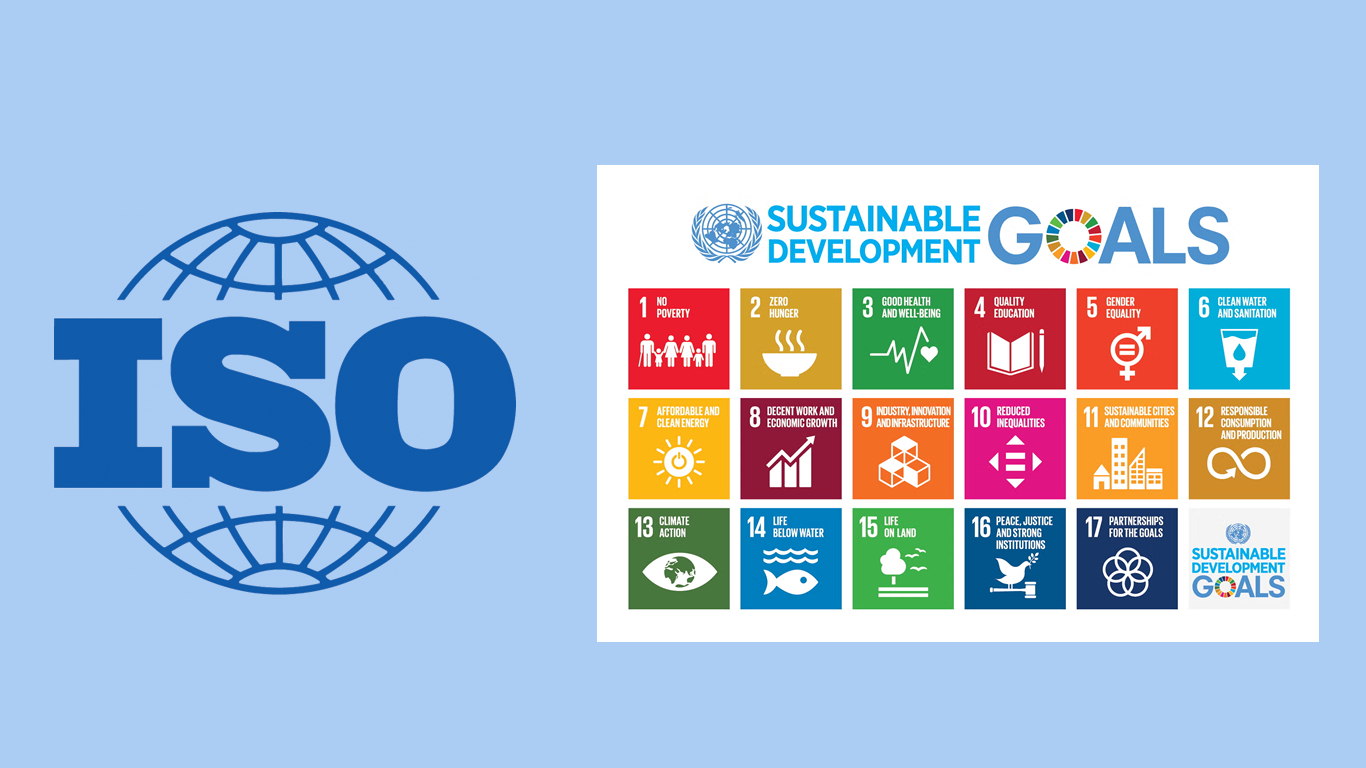
It was Mujica who rebranded ISO as the enforcement arm of the United Nations’ 17 “Sustainable Development Goals,” not because a private publishing company has any actual enforcement powers, but so he might get nominated for the Secretary-General position. (He didn’t.) So if Mujica had a role in the injection of the words “sustainable development” in the 2015 edition, it was muted or well hidden. Not so with his more ham-handed attempts in 2024 and 2026.
The next edition of ISO 9001 will not only continue to claim (falsely) that a “quality management system provides a sound basis for sustainable development initiatives,” but ISO and BSI are making a lot of noise about it. Post after post from the two of them insist that this new standard will emphasize sustainability.
Is it true?
The short answer is no. The long answer is no, too, but let me tackle the short one first.
The Short Answer
First, what does “sustainable development” actually mean?
According to the UN, it is everything, everywhere, all at once:
Sustainable development is how we must live today if we want a better tomorrow, by meeting present needs without compromising the chances of future generations to meet their needs. The survival of our societies and our shared planet depends on a more sustainable world.
It’s a bit of a juggling act. Three different balls must be kept in the air at once: economic growth, social inclusion, and environmental protection.
Notice how none of those things have anything to do with quality management. But, too bad.
So if Clause 0.1 insists a QMS is to be used as a basis for ensuring “sustainable development initiatives,” does that translate into any actual requirements in clauses 4 through 10?
Of course not. The actual requirements clauses of ISO 9001:2026 have been left nearly entirely untouched from the current 2015 version. This means there are no actual requirements related to sustainable development at all, with the minor exception of the 2024 Amendment language on climate change. This is the cereal box rebranding trick: they are marketing ISO 9001:2026 as new and improved, when the actual cereal is still tasteless and soggy.
What are the UN SDGs Anyway?
So, what’s the longer answer? Here is a summary of all seventeen UN Sustainable Development Goals, which ISO insists it is helping to roll out worldwide. While not explicitly named in ISO 9001, this is the direction Sam Somerville, BSI, and ISO want to take ISO 9001:
- No Poverty. Eradicate extreme poverty for all people everywhere.
- Zero Hunger. Create a world free of hunger,
- Good Health and Well-Being. Achieve universal health coverage and provide access to safe and affordable medicines and vaccines for all.
- Quality Education. Free primary and secondary schooling for all boys and girls; provide equal access to affordable vocational training; eliminate gender and wealth disparities; achieve universal access to quality higher education.
- Gender Equality. Achieve gender equality and empower all women and girls; close the gender gap and ensure equal opportunities for all.
- Clean Water and Sanitation. Universal access to safe and affordable drinking water for all; achieve universal coverage of essential water, sanitation and hygiene
- Affordable and Clean Energy. Ensure universal access to affordable electricity by investing in clean energy sources such as solar, wind and thermal; expand infrastructure and upgrade technology to provide clean energy in all developing countries.
- Decent Work and Economic Growth. Promote sustained economic growth, productive employment and decent work [by] creating quality jobs, promoting entrepreneurship, and fostering economic growth that benefits everyone.
- Industries, Innovation and Infrastructure. Build resilient infrastructure, promote sustainable industrialization and foster innovation.
- Reduced Inequalities. Empower and promote the social, economic and political inclusion of all, irrespective of age, sex, disability, race, ethnicity, origin, religion or economic or other status.
- Sustainable Cities and Communities. Implement inclusive, resilient and sustainable urban development policies and practices that prioritize access to basic services, affordable housing, efficient transportation and green spaces for all.
- Responsible Consumption and Production. Achieve the sustainable management and efficient use of natural resources; halve per capita global food waste and reduce food losses along production and supply chains, including post-harvest losses; achieve the environmentally sound management of chemicals and all wastes throughout their life cycle, and significantly reduce their release to air, water and soil.
- Climate Action. Transform the world’s energy, industry, transport, food, agriculture and forestry systems to ensure that we can preserve a livable planet.
- Life Below Water. Conserve and sustainably use the oceans, seas, and marine resources; stop pollution of the oceans.
- Life on Land. Protect and restore terrestrial ecosystems, sustainably manage forests, combat desertification; halt and reverse land degradation and stop biodiversity loss.
- Peace, Justice and Strong Institutions. Promote peaceful and inclusive societies; provide access to justice for all; build effective, accountable and inclusive institutions at all levels. Ensure people everywhere are free of fear from all forms of violence and feel safe … whatever their ethnicity, faith or sexual orientation.
- Partnerships for the Goals. Universal call for action by all countries – developed and developing – to ensure no one is left behind revitalizing the global partnership for sustainable development.
That’s a tall order, and ISO 9001 is now claiming your Quality Management System can work on all those things at once. So, according to ISO, a QMS is no longer about ensuring you have a system that works to produce a quality product and which meets customer requirements, you are required to use your QMS to literally solve world hunger. And human trafficking. And ensure universal healthcare. And overthrow tyrannical governments.
Got it?
Now, in defense of the United Nations, even they don’t think Joe’s Machine Shop is going to solve these problems. The UN understands this is a gigantic lift, and is not calling on individual companies to implement the SDGs, but entire nations. It calls on governments to work together to achieve these goals. The UN never suggested that the SDGs should be flowed down to machine shop workers or underpaid middle managers like the Quality Manager.
No, that was ISO’s idea. It is overtly craven, performative, and purely aimed at enhancing the reputations of a few key ISO executives. It has zero chance of succeeding because a machine shop’s QMS cannot influence vaccine development, cannot clean up the ocean floor, and cannot ensure free elections in every country on the planet.
Of course, ISO 9001 only talks about one SDG — the one on climate action — and only by adding wishy-washy language in clause 4 that everyone can ignore. But the marketing by ISO and BSI will hammer down hard on the idea that a QMS can solve the world’s problems.
In reality, a QMS has nothing to do with any of the sustainable development goals. But ISO jumped from “nothing” to “all of them” in a poorly-planned, whiplash decision.
It’s clear that a combination of factors has led to this:
- The grotesque manipulation of world standards by Sergio Mujica for his personal career and political goals, once he prepares to leave ISO.*
- The “go-along” attitude of consultants, like Nigel Croft and Sam Somerville, who are trying to boost their own position on the world stage by playing along with Mujica’s madness.
- A Quality Profession that has lost its way, with its elder statesmen and prominent thinkers now long since dead, replaced by two or more generations of poorly-educated, overconfident noobs who have spent nearly no time on the shop floor and have published exactly zero papers or peer-reviewed articles on the subject matter.
The irony, of course, is that by taking their eye off the ball of quality, ISO 9001 has become even less likely to ensure a functioning, effective quality management system for anyone. The next edition will confuse and distract quality managers even more, with the inclusion of the batshit-crazy theme of “opportunity-based thinking.”
So long as you sound like you are helping solve world hunger, if you build airplanes that fall out of the sky and set an orphanage on fire, you will maintain that precious ISO 9001 certificate!
(* Although, with his goal of getting a job at the UN apparently scuttled, don’t be surprised if he tears up the rules and permits himself to stay on for a third term. Third world autocrats love that sort of thing.)

Christopher Paris is the founder and VP Operations of Oxebridge. He has over 35 years’ experience implementing ISO 9001 and AS9100 systems, and helps establish certification and accreditation bodies with the ISO 17000 series. He is a vocal advocate for the development and use of standards from the point of view of actual users. He is the writer and artist of THE AUDITOR comic strip, and is currently writing the DR. CUBA pulp novel series. Visit www.drcuba.world