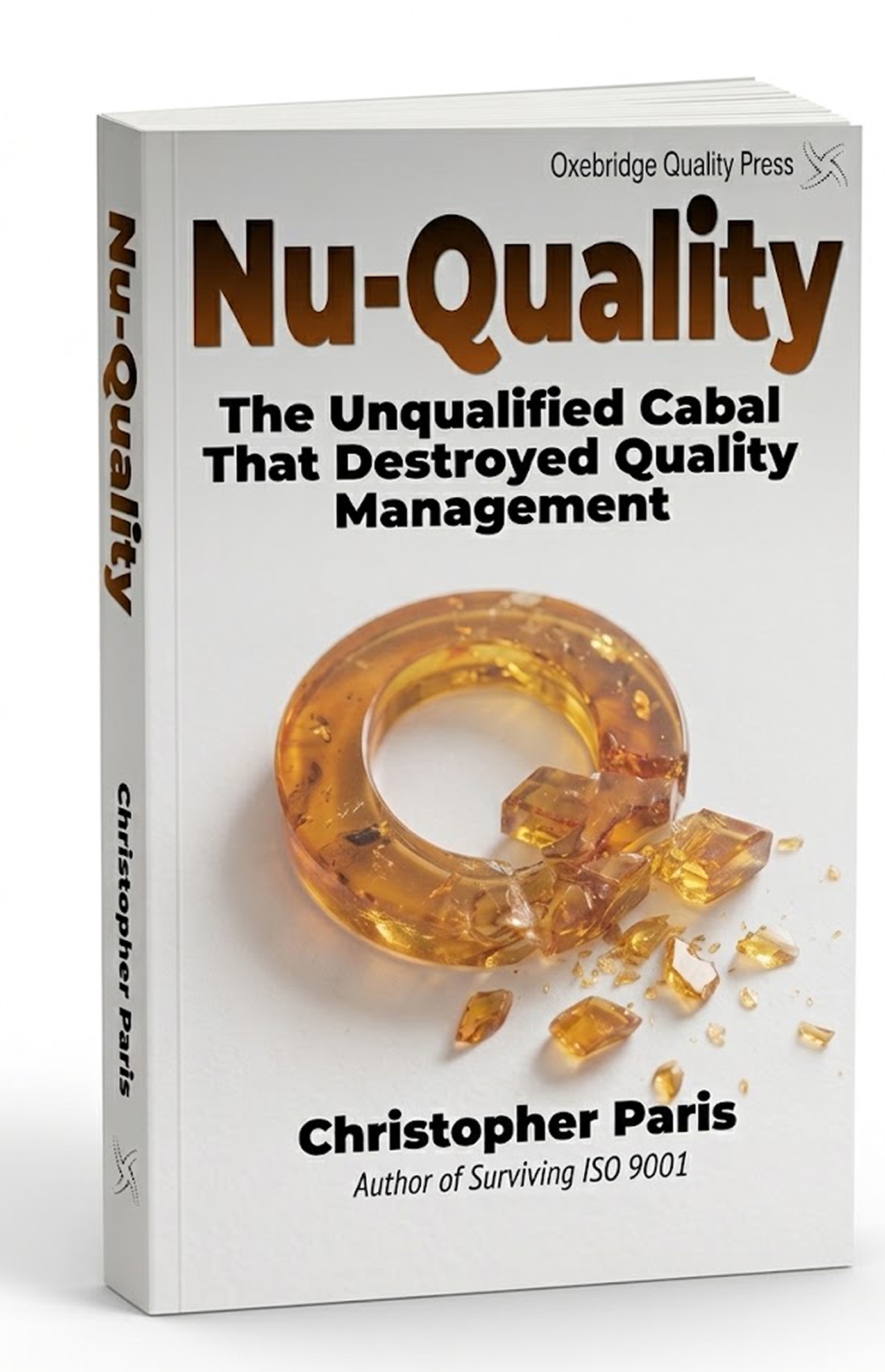
 Below is a sample chapter from my new book, Nu-Quality: The Unqualified Cabal That Destroyed Quality Management.
You can order the Pre-Release Edition right now for only $15. This is a digital-only edition of the book prior to final publication. It is still undergoing editing and some final tweaks, so the Pre-Release Edition will not represent the same version as the Final Edition, but it contains extra bonus content as a reward for early purchase. The Final Edition is due for publication on Amazon in about two weeks and will cost $25 for the Kindle e-book edition and $45 for the paperback.
You can order the Pre-Release edition here.
Enjoy the free chapter!
(NOTE: the actual chapter is much longer, and this is only a portion of it.)
Chapter 6: Zombies Using Spell-Check: Rise of the Consultants
There are two heralds for the decline of any profession: the rise of the consultant class and the takeover by private publishing companies. Let’s tackle the first one.
A Case of Single-Shingles
In the 1980s, the American private consulting industry within manufacturing and related fields was, at best, worth a few billion dollars per year. Much of this was centered around the big shops: McKinsey, Booz Allen Hamilton, and a tiny handful of others. The “single-shingle” consulting company, where one person would launch their own practice, was uncommon.
Consider, though, the technical and economic landscape at the time. The internet did not yet exist, and computing was centralized around physical, disconnected servers. This constrained communication within the internals of a company and greatly limited the ability for consultants to advertise. Marketing a consulting company would have required running ads in print magazines (an expensive option) and hoping someone found your listing in the Yellow Pages phone directory.
On the economic side, the Reagan-era uprooting of political and financial institutions had not yet taken hold, and companies operated according to older structural approaches. Employees expected to work at the company for their entire lives, and benefits were offered to them in order to keep this arrangement in place. Investments were made in labor, equipment and facilities, with a longer-term view of success. As a result, companies relied on in-house talent to drive their improvements. They favored permanent headcount growth, building massive internal departments to handle specialized functions.
The quality experts were not, in the beginning, consultants; they were employees of the organizations they helped revolutionize. Deming worked for the US Dept. of Agriculture and US Census Bureau; Shewhart worked for Bell Telephone Labs; Crosby for the Martin Company[1]; Juran for Western Electric.
With Reaganomics, deregulation, the dismantling of a balanced, free press, and a new anti-worker sentiment becoming mainstream, everything shifted. Keeping employees happy so they stayed with the company was no longer a priority; benefits were gutted, labor unions destroyed, pay stalled. People were now induced to stay with the company through threat: if they did anything, anything at all, they could easily be replaced by someone off the street. Reducing payroll and benefits became an obsession for the in-house accounting teams.
Soon, the idea of maintaining permanent headcount to perform some functions was dropped in favor of hiring temporary workers—and consultants—who would, in theory, perform the same functions at a reduced overall cost. They also required less investment: a consultant might work on a project for months and then be released; full-time employees required a constant flow of new projects and tasks. Consultants required no benefits, no medical, no pension, no training. Plug-and-play contracting became the norm. Calling up on-demand external consultants allowed companies to turn fixed labor costs into flexible, project-based operational expenses.
This led to a need for private consultants outside of the few big firms, and the newly underemployed, or underpaid, professionals noticed. By the 1990s, millions of people were posting on America Online (AOL) and other gateways, making the marketing of one’s business a more affordable option. Launching a single-shingle consulting firm became a viable option.
Better still, launching an overnight consulting company required no special qualifications or expertise. Whereas working for an employer required surviving an interview process and having one’s qualifications and education vetted, simply calling yourself a “consultant” took nothing more than creating a website that, in bold HTML text, declared you one.[2] You were granted instant credibility while limiting the public’s ability to verify your actual credentials.
The nascent internet also brought with it levels of anonymity, resulting in the famous meme, “on the internet, nobody knows you’re a dog.” Underemployed folks found out that on the internet, nobody knows you’re incompetent.
By the time I launched Oxebridge in January of 2000, the field was starting to get crowded. While I am honest about my abilities (as you will see later) and started my practice by offering low-cost (and even free) services so I could build my expertise, others were scamming from the start. The famous operator of the Elsmar Cove quality management website, Marc Smith, was already a permanent fixture on early Usenet Newsgroups, selling his consulting services by outright lying about his qualifications and credentials. Smith’s consulting practice was so non-existent that within a few years he silently stopped consulting entirely, and shifted to running his forum board full-time, even as that site’s duped users continued to treat him as an “expert.”[3]
Soon enough, the QMS consulting field had shifted away from the huge, expensive firms and towards the cheaper—albeit more nimble—smaller consultancies. Such was the trend that some large firms abandoned QMS consulting, shifting over to other areas (like cybersecurity) or dropping management system work entirely.
The argument was always that if a consultant lied about their qualifications or exaggerated their experience, “the market” would weed them out. This magical thinking presumes that end users of such services are, first of all, suspicious of consultants (they are not) and that they actually vet the people they hire (they don’t). Consultants with made-up qualifications and padded resumes flooded the field and quickly rose in stature.
I will go over some of the Nu-Quality consultants from around the world shortly, but we must first start with two individuals who set the stage for the rise of Nu-Quality.
Jack West
While not a Nu-Quality cabalist himself—he was already fading as Nu-Quality was emerging—John E. “Jack” West created the blueprint for the Nu-Quality grifters. West is most famous for two accomplishments in the quality management field: his leadership of the US TAG to TC 176 and his endless number of books on ISO 9001, written alongside his joined-at-the-hip-implant antediluvian co-authors, Charles Cianfrani and Joseph Tsiakals.
West had what appears to be a brief stint at Tenneco Automotive, and a briefer stint as its “Director of Operations and Quality Systems.” I say “what appears to be” because, as usual, it’s very hard to verify his actual role. When I contacted Tenneco, they claimed they never heard of West and had no records of him. I continued to dig and found it was likely a records error, but there was still no evidence he held the actual titles he would later claim. Other than Tenneco, there is no evidence at all of where he may have worked nor what expertise he had in quality management.
On West’s official biography at Silver Fox Advisors, his QMS consulting company, West claims to have held the title “Director Total Quality Management.” The same site then says West was “Director of Quality for European operations” for two years, which is yet a third title. Of course, it’s possible his title kept changing as they shifted him around to different roles. Regardless, it proved impossible to verify just how many years West worked at Tenneco or what his actual job there was. I was also entirely unable to verify if Tenneco ever held ISO 9001 certification.
What is clear is that West, at some point, used his role at Tenneco to begin participating in US TAG work, and then, after the group’s leader Donald Marquardt died, West took over. At that point, West shifted his entire career trajectory and used the role to build his QMS consulting practice. Propped up by the American Society for Quality, West became, nearly overnight, an “ISO expert” despite not having any demonstrable qualifications other than his (unverifiable?) stint at Tenneco.
West’s work at the US TAG was unremarkable on the international stage. He had little influence, and his Texas swagger and self-promoting fat mouth were seen as off-putting to the Europeans. But actually representing US industry interests to ISO—you know, the thing he had been elected to the TAG to do—was not interesting to West. He was using his TAG role purely to sell books and consulting services.
At the same time, he enabled some who would form the Nu-Quality movement. Within the TAG, West surrounded himself with females: Lorri Hunt, Alka Jarvis, Denise Robitaille, and (much later) Sheronda Jeffries. There was nothing untoward going on; West only traveled to TAG and ISO events with his wife at his side. Instead, West appears to have identified weak personalities who would obey his barked orders. Having less success bullying men, West appears to have instead found women he could dominate.[4]
West himself never advocated for Nu-Quality positions and seemed a fairly down-the-middle, if run-of-the-mill, consultant: he promoted ideas that had already existed for years and for which he had no role in developing. But he nevertheless created the international blueprint for the movement’s future leaders: obfuscate your past, exaggerate your abilities, and latch tightly onto publishing companies to get yourself promoted into positions of power.
Nigel Croft
If there is a Patient Zero for the Nu-Quality plague, it is Nigel Howard Croft from the United Kingdom. Anyone operating within the modern quality profession will immediately recognize the name.
Whereas Jack West was not a Nu-Quality progenitor, Croft most certainly was.
Croft has become one of the most famous and influential people within global quality management and the inner circles of the ISO itself, using his connections and fame to land gigs for the United Nations. And yet, the most rudimentary, objective review of his professional qualifications reveals a staggering truth: his rise was the product of wealth and family connections, propped up by an incurious industry that elevates unqualified dummies to positions of leadership because checking someone’s CV is, apparently, too much hard work.
According to his own official biography, readily available on Wikipedia and across his various corporate websites, Croft has worked with a number of organizations and consulting companies over the decades, allowing us to glean a fairly complete picture of his career trajectory. Croft attended Nottingham University and, later, Sheffield University, where he graduated with a degree in metallurgy and materials science before subsequently earning a Ph.D. in that exact same field. To be fair, metallurgy and materials science are incredibly complex, demanding scientific disciplines that should not be casually dismissed; it is certainly not easy to obtain a degree in metallurgy.
His academic prowess in this area even earned him a prestigious Harkness Fellowship award from the Commonwealth Fund, which facilitated research he conducted at the University of California, Berkeley. However, this fellowship was strictly awarded in the field of metallurgy. Today, that specific award is frequently (and intentionally?) misrepresented by his supporters as some sort of quality management credential but is entirely unrelated to the quality profession. Metallurgy is not quality management, and quality management is certainly not metallurgy. The fact that I had to type that last sentence is a sad condemnation of how far we have fallen as a profession.[5]
Following his academic pursuits, Croft utilized his connections to secure employment at a steel mill in South Yorkshire owned by the British Steel Corporation. According to his Wikipedia entry, he allegedly began his tenure there working in the quality control department as a “student apprentice,” but he later transitioned to working as a full-time metallurgist. The exact timeline and gap between these roles are not entirely clear, but if he possessed any genuine quality control experience during this period, it would have been relegated to the 1970s, long before his primary work as a metallurgist began, and only as a “student apprentice.”
He eventually moved on to another firm, J.P. Kenyon Partners, continuing his work as a metallurgist. There is no current record at all of that firm, so it’s not clear at all what its focus was. During this stint, Croft was reportedly involved in “supplier evaluations.” Now, while supplier evaluations can theoretically imply quality audits, one must ask a critical question: if he was employed strictly as a metallurgist, what specific training or background qualified him to suddenly act as a supply chain quality evaluator or an auditor? The answer is entirely unclear, as his verifiable expertise throughout the entire decade of the 1980s remained stubbornly anchored in metallurgy. But the term “supplier evaluations” is vague enough that it can be construed to be related to quality management, even when such evaluations might be wholly unrelated.
The true pivot in his career occurred in 1984, when he married a Brazilian steel mill heiress and permanently relocated to Brazil. There, he went to work for his new father-in-law at Electrometal SA, a prominent Brazilian steel mill. According to his published bio, this is the precise moment when his supposed interest in quality management magically materialized. In the mid-1990s, he implemented ISO 9001 at Electrometal.[6] This timeline is damning. From the 1970s straight through the 1990s, he was working almost exclusively in metallurgy, with perhaps a brief, unverified stint as a quality control “student apprentice” (so, you know, an intern) and a handful of metallurgical supplier evaluations which may or may not have had anything to do with quality management. His first—and perhaps only—experience in quality management came from a single assignment handed to him by his father-in-law.
Presumably as a direct result of these lucrative family connections, the nation of Brazil granted him a highly coveted role on ISO Technical Committee 176. So, despite being a British citizen—or perhaps precisely because he was a British citizen—he was now sitting on the committee crafting ISO 9001, representing the country of Brazil.
Again: after having implemented one QMS. Not five. Not ten. Not 100.
Just one.
Electrometal itself was not without scandal during Croft’s tenure. According to Brazilian news reports, a massive controversy erupted when it was discovered that the Brazilian military had partnered with the mill to make steel for a covert project aimed at enriching uranium outside the view of the United States. At the time, Brazil had ties with Iraq, raising eyebrows in Washington. Undeterred, the Brazilian military installed a specialized furnace in an Electrometal plant in Sumaré to manufacture motor casings for Sonda rockets. The secret operations were later uncovered and debated in the Brazilian Congress, which found Electrometal had intentionally circumvented international embargoes on nuclear program operations.
In the 1980s, the US Dept. of Commerce found that Electrometal had been illegally exporting steel below fair market value and imposed sanctions. In the 1990s, Electrometal was barred from selling in North America due to dumping its products into the market.
As Croft has rebranded himself as a climate warrior, dutifully carrying out Sergio Mujica’s orders to reboot ISO 9001 as a climate change standard, examining Electrometal’s history related to the environment is appropriate. The company was cited by Brazil’s own national environmental agency for improper storage of “Class I hazardous solid waste,” including highly toxic hexavalent chromium.[7] In an official report published by the Instituto Socioambiental, entitled “Riscos Técnicos Coletivos Ambientais na Região de Campinas,” Electrometal was cited for improper industrial waste disposal in the Nova Veneza and Sumaré regions.[8]
Nevertheless, Croft remains touted as a climate change expert and was used by ISO to ensure “climate change” was inserted into all ISO management system standards. As recently as March of 2024, the incurious editors at CQI’s Quality World published an article by Croft on “ISO’s climate change considerations,” without mentioning that at least a portion of Croft’s personal success was at a company that polluted the Brazilian environment.[9]
Finally, in 1994, Croft’s father-in-law lost control of the company when curbs on spending were imposed, and the company could not pivot.[10]
Escaping the family financial disaster in Brazil, and no doubt because of his British roots, Croft was then able to seamlessly leverage his geopolitical connections to ingratiate himself with powerful UK-based organizations like the British Standards Institution (BSI) and the Chartered Quality Institute (CQI). From that unearned platform, he spent the next several decades contributing to both the 2000 and the disastrous 2015 versions of ISO 9001, aggressively injecting Nu-Quality principles and corporate-friendly ideas directly into that standard, thus infecting the entire planet.
The level of Croft’s practical contributions to the standards is contested by people who actually attended meetings. He appears to have had no role in writing the requirements sections of either ISO 9001:2000 or ISO 9001:2025, but instead worked on the supporting front matter and back matter, along with supporting guides and standards, which have become manifestos for the Nu-Quality movement. Nevertheless, the various Croft biographies that appear online make it appear he had a far greater role in writing the standard.
To be clear: Croft did not, and does not, possess a deep, practical background in quality management. He did not, and does not, possess a long, battle-tested history of performing rigorous ISO 9001 implementations across diverse global industries. By the admission of his own Wikipedia entry, he completed exactly one ISO 9001 implementation, in exactly one industry. And yet, despite this glaring lack of foundational experience, he became the undisputed global voice of ISO 9001 for over a decade.
But even with this massive institutional megaphone, he experienced very limited actual success outside of the artificial noise generated by ISO, BSI, CQI, and ASQ, who continuously propped him up and promoted him as a luminary. In truth, Croft has experienced an unbroken string of failures. At one point, he attempted to consolidate his power by forming the Croft Global Alliance, a grand scheme designed to bring all independent quality management consultants to work directly under his leadership. That ambitious effort lasted for about a year before it completely fell apart. He was desperately trying to brand himself as the ultimate kingmaker of quality management consultants, and the market soundly rejected it.
Now, a decade or so later, he is at it again, with a new management systems consulting company called CroftSpurr. This venture is a partnership between Nigel Croft and a much younger consultant named Matthew Spurr. Croftspurr now offers not only ISO 9001 consulting, but also consulting related to AI (ISO 42001) and cybersecurity (ISO 27001), neither of which Croft has any experience in, but for which he now claims expertise.[11]
But after I asked around, I found out that—and you probably saw this coming—Spurr is actually Croft’s son-in-law. So, yet again, Croft is relying on his family’s connections to prop him up, this time using a younger generation rather than an older one. [12]
What remains conspicuously absent is any verifiable evidence of Croft’s actual clients. While it is true that some consultants keep their client lists close to the vest, the vast majority do not; successful consultants loudly brag about their high-profile clients to build credibility. They post testimonials and provide verifiable references. Croft publishes none of these, and we see absolutely no evidence of any corporate clients in Croft’s portfolio. It’s reasonable to assume that, given his fame, someone would take credit for having hired him.
The only publicly known entity he worked for is the United Nations Industrial Development Organization (UNIDO). He reportedly received a paid contract to act as a consultant for UNIDO, for which produces white papers. To date, these include:
- Quality Policy: Guiding Principles & The UNIDO “Quality Policy Trilogy” [13]
- Tackling Climate Change: Fostering Trust in Climate Action through Quality and Standards [14]
- Remote Conformity Assessment in a Digital World [15]
- Bridging Languages, Building Standards [16]
Of these, the paper on Quality Policy—co-published by UNIDO and the International Network on Quality Infrastructure (INetQI) —is the most damning from a Nu-Quality perspective. The paper presents the idea of nations developing a Quality Policy; as a result, we see Croft pushing Nu-Quality beliefs onto the international political stage, a terrifying idea made all the more terrifying due to its author being wholly unqualified to make it:
In general, any national policy can be seen as a guiding set of principles, decisions, and actions adopted by a national government through laws and regulations to achieve specific national objectives, such as economic growth, public welfare, or environmental protection.
By applying this rationale mutatis mutandis to countries, we can see that a NATIONAL QP should express the country’s intentions and strategic direction in terms of its approach to quality, and be approved at the highest levels of government. It should promote an overall Culture for Quality, be aligned with other high-level national policies (including, for example, the country’s overall sustainable development goals and other international commitments ) and provide a framework for its deployment, with clearly defined objectives.
As we will see in the upcoming chapter on risk, Croft then single-handedly injected a lethal dose of made-up nonsense into the entire quality management profession with “risk-based thinking.” Overnight, Croft had become a risk management expert, despite no formal training or experience in the field.
When we step back and look at the totality of his career, a deeply troubling picture emerges. We have a man who formally studied metallurgy, worked his early career in metallurgy, married a wealthy steel heiress, and performed exactly one quality implementation for his father-in-law’s company. Because of the sheer luck of his family connections, he was handed a seat on ISO’s TC 176. From that seat, and endorsed by conflicted publishing companies, Croft became one of the loudest voices dictating the future of ISO 9001 and the global quality management profession, going so far as to inject his misbeliefs into international politics.
No one ever checked his actual credentials.
Propped up by West and no doubt inspired by Croft, the first generation of Nu-Quality “experts” arose, hewing to the ascent model West had provided for them, while bringing in their own host of bad ideas.
[1] Later known as Lockheed Martin.
[2] In those days, you could create an entire website in a simple text editor, like Notepad.
[3] Smith once claimed that a “process is just a procedure with a map in it,” revealing just how little he understood of the most fundamental basics.
[4] This is not to say there were no strong women at the US TAG; they simply did not stick around. But it’s worth pointing out that men were given very little power under West. Even Cianfrani and Tsiakals, his co-authors, did nearly nothing on the committee when they even showed up. Paul Palmes was one of the only males to have any success under West, and his entire posture during meetings was weak, deferential, and nearly lapdog-like submissive to West. It was, frankly, humiliating to watch.
[5] Mind you, I did work in metallurgy, too, as I will discuss in the section on my own work experience. So, I understand the difference between the two professions because I’ve been in both.
[6] At the time, it was ISO 9002, which excluded design, but I don’t want to confuse the reader. It’s known simply as “ISO 9001” nowadays, and 9002 is an entirely different document.
[7] https://smastr16.blob.core.windows.net/portalnovomedia/2012/01/modulo_solo.pdf
[8] https://acervo.socioambiental.org/sites/default/files/documents/S4D00009.pdf
[9] https://www.quality.org/article/managing-changing-climate
[10] https://www.gov.br/fazenda/pt-br/central-de-conteudo/pareceres/2001/industrial/bens-duraveis/parecer-tecnico-sobre-o-ato-de-concentracao-no-08012-002998-2000-68-emitido-em-01-06-2001
[11] I’m a fan of Godzilla movies, but that doesn’t make me a paleontologist.
[12] One wonders if Croft might have ended up selling pencils in The Bowery while wearing a plastic bag for a coat if he had never gotten married.
[13] https://hub.unido.org/news/revised-quality-policy-trilogy-launched-drive-sustainable-trade-and-industrial-transformation
[14] https://www.unido.org/news/tackling-climate-change-quality-and-standards
[15] https://www.unido.org/news/implications-remote-conformity-assessment-developing-countries
[16] https://hub.unido.org/news/new-unido-guide-helps-countries-break-language-barriers-standards-adoption

Christopher Paris is the founder and VP Operations of Oxebridge. He has over 35 years’ experience implementing ISO 9001 and AS9100 systems, and helps establish certification and accreditation bodies with the ISO 17000 series. He is a vocal advocate for the development and use of standards from the point of view of actual users. He is the writer and artist of THE AUDITOR comic strip, and is currently writing the DR. CUBA pulp novel series. Visit www.drcuba.world