For the past few years, we were led to believe that AS9100 would be updated to “IA9100” and that the delays were largely due to the fact that the new standard was still waiting for the ISO 9001:2026 core document to be updated. It appears now that may not have been true, and that the IAQG — under the control of Textron’s Eric Jefferies — has converted itself into a de facto for profit entity and is pursuing both profit and power at the expense of nearly every other stakeholder in the aerospace scheme.
Before we get to the (weird) rumor mill, let’s review a few disturbing facts that are backed up by evidence.
SAE Sues IAQG
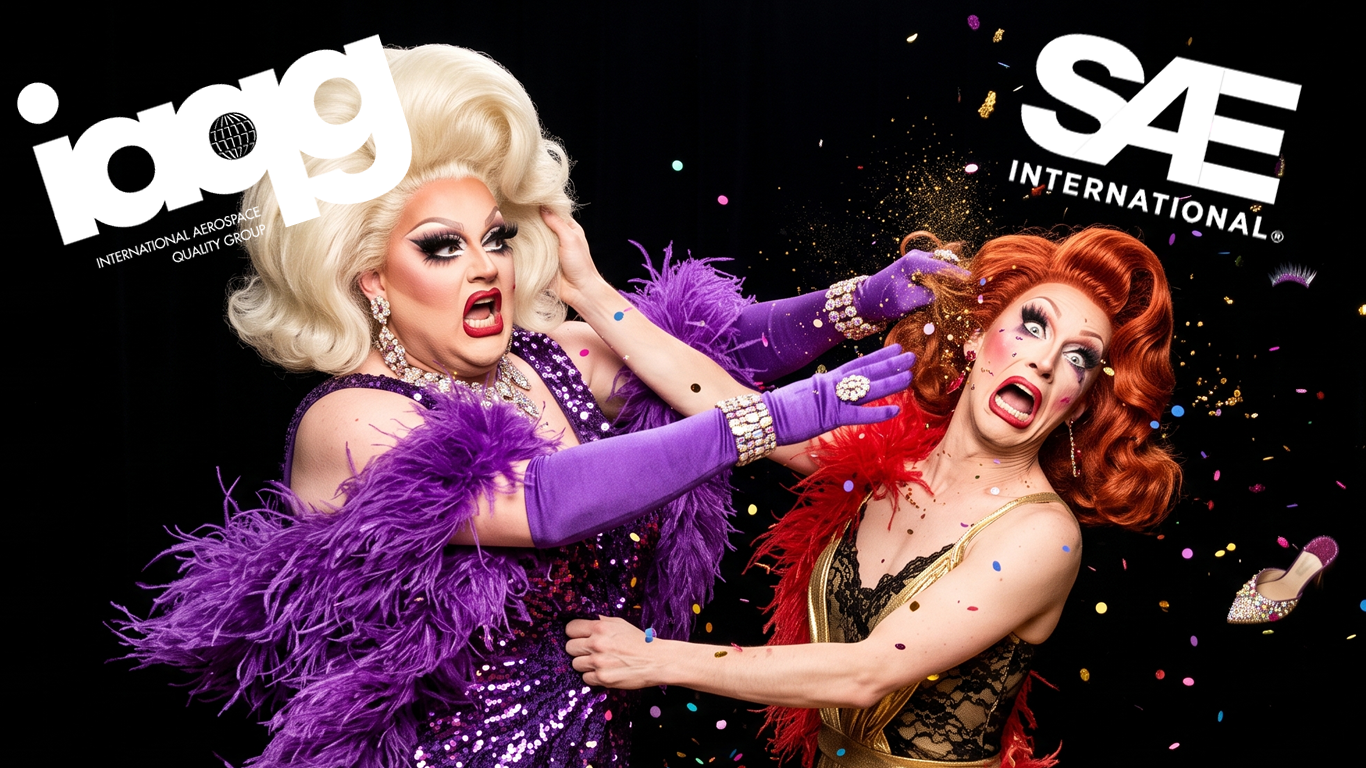
IAQG is undergoing a very, very nasty divorce from its publishing partner, SAE. If you recall, IAQG develops the AS series of standards, and SAE publishes them. The partnership has existed since the very first edition of “AS9001” in 1998, before it was rebranded as “AS9100.”
In February 2025, SAE sued IAQG in US Federal court under case number 2:25-cv-00268-WSH over the IAQG’s ham-fisted — and shockingly sudden — decision to take over auditor authentication activities. In its complaint, SAE argued that it, alongside its own auditor authentication body, Probitas Authentication, was harmed by IAQG’s power grab, revealing that the IAQG barred SAE’s participation.
In violation of this trust and years of partnership with SAE, IAQG began creating its own IAQG Authentication Program without any opportunity for involvement or collaboration by SAE. Every effort by SAE to participate in this new program has been effectively shut down.
SAE has now learned that IAQG has instead partnered with a third-party servicer to implement the IAQG Authentication Program, apparently in an effort by IAQG to monopolize the industry and push out SAE and the eight (8) other Auditor Authentication Bodies from the market.
SAE demanded injunctive relief, asking the court to block the new program unless SAE was given “right of first refusal,” citing an agreement between the parties that granted SAE rights to “commercialize” the AS series of standards “through 2032.”
Somewhat hilariously, one of SAE’s complaints was that Probitas’s head, Rich DeMary—my dear pal—was “blocked” from submitting a job application for the IAQG’s new auditor certification scheme. Essentially, DeMary suddenly found out firsthand what I’ve been saying for some time, that Eric Jefferies is kind of a dick.
In November 2024, Mr. DeMary began a dialogue with Mr. Jeffries regarding how SAE and IAQG could work together towards IAQG’s anticipated authentication program. However, on or about January 23, 2025, Mr. Jefferies informed Mr. DeMary that the IAQG Authentication program would be launched in partnership with a third-party servicer – neither SAE’s Probitas Program nor another existing AAB – which has no history or experience in the field of assessment and qualification of individuals for auditor certification.
I love watching scammers scamming scammers, and the idea of DeMary having to submit a job application as if he were a would-be fry cook at McDonald’s just makes me happy.
The case was dismissed for lack of jurisdiction, however, after IAQG reminded the court that it is registered in Belgium, a convenient arrangement that the IAQG no doubt foresaw when it, you know, registered in Belgium. In addition, IAQG argued that the SAE filings had failed to provide any evidence that the “amount in controversy exceeds $75,000.”
Whether SAE refiled the case in Belgium since then, I can’t know for sure as I don’t have access to court filings in that country.
IAQG Sues SAE
Jeffries and IAQG were not about to let this slight go. In June of 2026, IAQG suddenly forgot they are registered in Belgium and filed suit against SAE in the US District Court for the District of Columbia (case number 1:26-cv-02210-CJN). In that filing, IAQG demands declaratory judgment while alleging “breach of contract” by SAE over a bungled copyright matter.
IAQG alleges that, yes, SAE had the right to publish the AS series of standards, but this required them to maintain an active license with ANSI, which holds the US rights to ISO 9001. Recall that AS9100 includes ISO 9001, so they have to pay ISO — through ANSI — for the right to use that content. IAQG’s filing alleges SAE somehow bungled that license and lost it, making it impossible for them to publish any updates to AS9100 at all:
Under the terms of the License Agreement, SAE was responsible for Intellectual Property and Copyright Management, and in particular was responsible for negotiating, and administering, and paying requisite royalties to ANSI / ISO so as to ensure that the Standards containing ISO content could be published.
In the Spring of 2026, the IAQG was informed that SAE no longer had the license from ANSI to publish work containing ISO content which would have made it impossible for SAE to publish a number or critical standards.
On April 28, 2026, IAQG sent SAE a demand for adequate assurance of SAE’s ability to perform under the License Agreement.
Rather than provide the adequate assurance, SAE responded by declaring the License Agreement a “nullity”, arguing that that the License Agreement had “lapsed”, “due to disappearance of the subject,” and that IAQG had materially breached the License Agreement.
IAQG went on to accuse SAE of continuing to “commercially exploit” twenty-one related AS standards without IAQG’s permission.
By arguing copyright matters, IAQG claims the US courts do have jurisdiction in this case, highlighting the glaring weakness in the SAE’s initial lawsuit against IAQG. Had SAE included copyright matters in their 2025 case, it might not have been thrown out.
The filings reveal that the next AS9100 update, coded as “IA9101,” had already been completed as of April 2026, meaning (as I had written previously) they used the draft ISO 9001:2026 text to create the AS9100 revision. The filing also claims that the standards IA9104/2 and IA9104/3 are already completed and ready for publication.
In a petty move, the IAQG filing then hammered SAE on its 2025 lawsuit, pretty much telegraphing that IAQG is being very, very pissy.
Per the docket files, the two parties exchanged some letters, all of which were filed under seal and are not available, but which show arguments between IAQG’s Jefferies, SAE Executive VP Peter Doty, and SAE Senior Dir. of Aerospace Standards, David Alexander.
SAE then made things much, much worse by issuing a “Public Statement” on the matter—which has since been withdrawn and was also filed under seal—and which IAQG claims contained “material misstatements of fact.” In response, Jefferies fired SAE and terminated their agreement entirely.
The drama queens did not stop there, however. In June of 2026, IAQG claims that SAE’s Chief Legal Officer, Gregory Bradley, wrote to the CEO of Boeing demanding the “return of any original or modified AS91XX standard, claiming that SAE owns them both.” IAQG claims:
Mr. Bradley went on to gratuitously and falsely state in that letter that Eric Jefferies had been recruiting and unwitting individuals employed by the companies that permitted their employes to volunteer for the IAQG, and further stated the unauthorized appropriation was part of a scheme by Mr. Jefferies to exploit SAE’s underlying copyrighted content.
IAQG’s final demands include judgments in IAQG’s favor, award of “costs of suit,” an order compelling SAE to transfer all standards materials to IAQG, and … most astonishingly … cease all publication of AS standards immediately.
Damn, son!
IA9150 – AS9100 For Dummies?
In what may be a related story, SAE and IAQG announced the intended publication of a new standard, IA9150, which is a “streamlined” version of AS9100. (How they managed this joint announcement during their breakup is not clear to me.)
IA9150 is called a “Foundational Quality Management System Standard,” and essentially strips out the ISO 9001 language entirely in what appears to be an attempt to
In the SAE announcement, which nevertheless mentions IAQG, the move is defended thusly:
Up to 10% of the ASD Supply Chain uses ISO 9001 instead of 9100 since, in some cases, 9100 is seen as too burdensome/costly to implement. This standard will provide an improvement opportunity for these suppliers while bringing greater visibility to industry through mandatory use of OASIS. The level of customization available within 9100 is not suitable for many of these smaller suppliers. This standard will provide greater flexibility and allow for fine tuning in the application of requirements (targeting a specific segment of the supply base rather than forcing a “one size fits all” approach). Since it will not be based upon any other standards (such as ISO 9001), there will be greater flexibility in updated or changing the requirements to meet specific industry needs.
The financial angle appears to be the real factor, though, as the announcement admitted key stakeholders like NASA, “told the IAQG that they intend to develop this type of standard on their own if the IAQG will not do so collaboratively.”
Per an SAE webinar, which you can hear in its entirety here, IA9150 is targeting make-to-print machine shops, startups, or “small series suppliers.”
More telling is that IA9150 will apparently jettison nearly all the concepts provided in the current standard’s clauses 4, 5, 6, 7, 9, and 10, and focus largely on what is now housed in clause 8. Per Lockheed Mark Rodriguez, “its focus is on essential elements that influence product quality and minimize complex and excessive requirements.”
Said one highly-placed source, they are now “essentially dumbing down quality.”
There’s no update yet on when this might be published or how the IAQG/SAE ware will affect it. Worse, keep reading, because the next bit may hose this up, too.
“IA” Standards May Be Dead
Now we enter deep rumor waters, so take the following with huge grains of sea salt. IAQG has locked down its information sphere tightly and is not even revealing its plans in official meetings. One CB representative said that any questions about the various dramas are answered with a standard reply, “We’ll tell you later.”
On that point, if true, I want to emphasize that neither the CBs nor even the ABs, like ANAB and UKAS, know what is going on. They think they do, but they are in the dark as much as everyone else.
A source reported that the Europeans are now rejecting the IA branding entirely, in what may be another move to assert copyright and trademark control over the standards and further isolate SAE. I am told the next edition of AS9100 will not be called “IA9100” at all now, but instead released as “AS9100 Rev E.” Whether they intend to create some other prefix in the future, I have no idea.
Next, I am told that the next updates will be released in two stages: a mini update (AS9100 Rev E) that simply incorporates the new ISO 9001:2026 text and some minor tweaks, and a major rewrite, presumably issued as AS9100 Rev G or under whatever new name they come with later. This two-stage process was published by AS910 consulting firm Cavendish Scott a while back, but another source told me the bulk of that article is largely untrue. (Specifically the bits about PPAP, APQP, and “zero tolerance counterfeit parts” being made mandatory. I would not rule it out, though.)
If this three-step thing is true —and I can’t confirm it at all, so it may not be—then users will have to contend with three updates in a very short period of time: the update to ISO 9001 and then two updates to AS9100. How they will manage the traditional “three-year transition” for each sounds like a logistical nightmare.
But IAQG cares very little for the actual users of standards and audits, so that attitude is on-brand for them.
IAQG Taking Over Certification?
Finally, we get into some real tinfoil hat stuff, but it’s worth reporting anyway just in case we find out the aliens really are reading our minds through all those 5G cell towers after all.
Many years ago, I wrote an article that, at the time, I admitted was a wacky conspiracy theory, and framed it as such. I said it made little sense why OASIS exists unless it was to collect data to—someday —allow IAQG to take over certification duties.
Now comes word that it might be time to rip off the tinfoil. At least one CB meeting, the IAQG said IA9150 certificates will be issued by the IAQG itself. When asked what that meant, the IAQG reportedly dodged the question.
As I said, that’s some crazy stuff. If true, it means that IAQG does intend to break away from all its partners and take over the entirety of the AS certification scheme, from standards (by divorcing itself from SAE) as well as auditor accreditation bodies (which it has done already), but also the CBs and ABs. If the first two divorces hadn’t happened, I couldn’t have imagined this last one, but now anything is possible.
Suddenly, OASIS makes sense. OASIS was allegedly a platform the primes, like Boeing and Lockheed, could use to assess their suppliers. But OASIS’s actual functionality doesn’t lend itself to that, and managing data in bulk—as the primes would need to do—is difficult and half-assed. The automated data feed used by OASIS to send bulk data to primes is antiquated and (reportedly) pretty lousy; it’s not based on modern API methods. Worse, the “validation” feature in OASIS—which is supposed to verify that all data was entered before it is sent out—doesn’t work at all. I have seen fully validated entries that lacked audit report data and where entire sections of OASIS were blank. So even if they are sending the data to the primes, the data is largely incomplete.
No, it was more likely that OASIS was intended to give IAQG the entire dataset of everything, everywhere, all at once related to AS certification for its own internal use. And the only use that made sense was taking over certifications or, at least, accreditation.
I would guess that IAQG intends to eject the ABs, like ANAB and UKAS. This idea is supported by the IAQG’s memo earlier this year, which announced they no longer trusted the ABs and were putting them on notice, too. That memo, as reported here, announced that the IAQG was taking over witness auditing of AS9100 certification bodies, leaving the ABs with very little to do. For now, it’s a random sample and not a full takeover, but it looks like a shot across the bow.
Meanwhile, Gravity Still Exists
Is any of this to improve aircraft safety and improve quality in the aerospace scheme?
It appears the answer is a resounding, “No, of course not, dummy.” It seems to be a way for Jefferies and IAQG to consolidate power and rake in more profits for their executive team. Remember, a not-for-profit still pays salaries and bonuses to execs.
Meanwhile, IAQG remains steadfast in its refusal to acknowledge a series of blunders, fraud, and incompetence. It is ignoring the global AS9100 auditor shortage, it allows its own team members to (at least attempt to) personally profit from insider information, it continues to hold onto a potentially illegal policy of demanding “nonconformity quotas,” and deletes and ignores formal complaints, even those alleging fraud and potentially deadly aircraft problems. Jefferies himself may be at least partially, if not entirely, responsible for that last one, which could result in the death or injury of pilots and the public.
I tried to file an ethics complaint against Jefferies at Textron, but they told me Jefferies could do whatever he wants while working for IAQG, and Textron doesn’t care. I later found out that Jefferies’ role at Textron may actually put him in charge of the ethics hotline. Sigh.
It’s clear that the IAQG under Jefferies is a far worse animal than it was under his predecessor, Andy Maher. Maher was incompetent and stupid, but Jefferies appears calculating, greedy, and power-obsessed.

Christopher Paris is the founder and VP Operations of Oxebridge. He has over 35 years’ experience implementing ISO 9001 and AS9100 systems, and helps establish certification and accreditation bodies with the ISO 17000 series. He is a vocal advocate for the development and use of standards from the point of view of actual users. He is the writer and artist of THE AUDITOR comic strip, and is currently writing the DR. CUBA pulp novel series. Visit www.drcuba.world