
Back in the days of the Old West, when valuable cargo was being hauled by stagecoaches, the front two seats of the coach were occupied by the driver, who managed the horses, and a guard armed with a shotgun to fend off would-be robbers. And so, the modern-day habit of calling “shotgun” to claim the front passenger seat of a car was born. Whomever says “shotgun” first gets to sit up front, and the slowpokes sit back in the rear seat or, in extreme cases, the trunk.
If this sounds infantile, it’s because it is. And yet, we now see entire professions crying “Shotgun!” in a pathetic and entirely useless attempt to get themselves into the corporate suite, sitting next to the CEO. Trust me: after you read this, you are going to realize just how sad and weak the modern generations of middle managers truly are.
Quality Consultants Started This
For years, I’ve been criticizing the quality management field for calling shotgun and making themselves look absolute losers. In the old days — and by that, I only mean a few decades ago, not when we had stagecoaches — it was understood that a company is made up of departments. Those were then led, at the top, by the CEO. It was the boss’ job to make sure all the departments were rowing the boat in the same direction.
When ISO 9001 first came out in 1987, it was based on a 1950s era standard from the US Dept. of Defense called MIL-Q-9858. The ISO 9001 standard knew its place: it was aimed at defining quality management system rules, while a sister standard, ISO 14001, would define environmental management system rules. Both standards stayed in their own lanes.
As the standards went through periodic revisions through the 1990s and 2000s, there was a growing call to merge them into a single standard. This, thankfully, was dismissed by ISO, who was protecting not only the professional guardrails between the standards, but also its own pockets. ISO stood to make more money by selling two standards rather than one.
Over time, more standards on different subjects emerged: OHSAS 18001 (now ISO 45001) for occupational health and safety; ISO 27001 for cybersecurity; ISO 31000 for risk management. Each stayed within its own lane.
Quality managers, meanwhile, were desperate for the CEO’s attention. The quality profession in general is populated by disgruntled folks who get beaten down until they are flat as pancakes. This is because the role of the Quality Manager is to act as customer advocate, which puts them at odds with nearly every other department in the company, and often at odds with the CEO. It’s a thankless job, and leads to a lot of quality professionals with bad self-image.
To counteract this, ISO’s TC 176 began layering in more and more requirements for “Leadership” in the ISO 9001 standard. The clause 5.1 now reads like a list of grievances of disgruntled ex-Quality Managers because, in reality, that’s what it is. Frustrated that they couldn’t get what they wanted when working in the Quality department, the consultants who populate TC 176 thought they could force their way into the C-suite by adding demands of top management into the ISO 9001 standard itself. Any boss that disagreed would face formal nonconformities.
It didn’t work, but TC 176 is still at it, adding even more requirements in the upcoming ISO 9001:2026 version. Sad.
The start of this began with the 2000 edition, which triggered a few quality experts to start repeating, ad nauseum, that ISO 9001 shouldn’t be called a “quality management system” at all, but a “business management system.” They were going to force their way into that C-suite if it killed them.
(I wrote about this originally in 2017, and that piece still holds up.)
The idea, which has become a veritable internet meme now (see here, here, here, here and here), never made sense. But it set the stage for a rewriting of the entire quality management profession, which now thinks it has the answers to everything. As I spoke about in this video, today’s quality professionals insist that the Quality department is crucial to establishing corporate objectives, ensuring sustainability, and even curing climate change.
As I quoted in a recent video (here), lead ISO 9001:2026 author Sam Somerville now insists that ISO 9001 provides a “holistic governance framework” essential for “world trade and sustainability.” This, coming from some rando that no one has ever heard of and who has never been published anywhere.
Over at the AS9100 standard, the updates to that aerospace standard are expected to begin merging quality with cybersecurity and occupational health and safety.
The guardrails have been obliterated. Subject matter is no longer a fixed thing, but a single standard can define everything, everywhere, all at once. Call them “quantum standards,” if you like, given all that spooky entanglement.
So, it looks like it’s a quality problem, right?
Nope.
The Sickness Spreads
I have watched as, now, the entire current generation of middle managers has adopted this delusion of grandeur psychosis, with each profession asserting dominance over the other. As far as I can tell, no one has yet put all of these wacko claims in one place, so strap in.
When ISO 31000 came out, and ISO tried to convince everyone that “risk is hot right now,” the risk managers began parroting the quality managers, nearly stealing their talking points. Suddenly, it was the Risk Manager who was to ride shotgun and get the keys to the corporate washroom. Emboldened by ISO 31000, Risk Managers began claiming that it was risk, not quality, that really deserved to be treated as a “business management” tool.
The Quality guys fought back, trying to co-co-opt risk management by creating “QRM,” or Quality Risk Management. That fizzled quick, but the battlefield was starting to assemble.
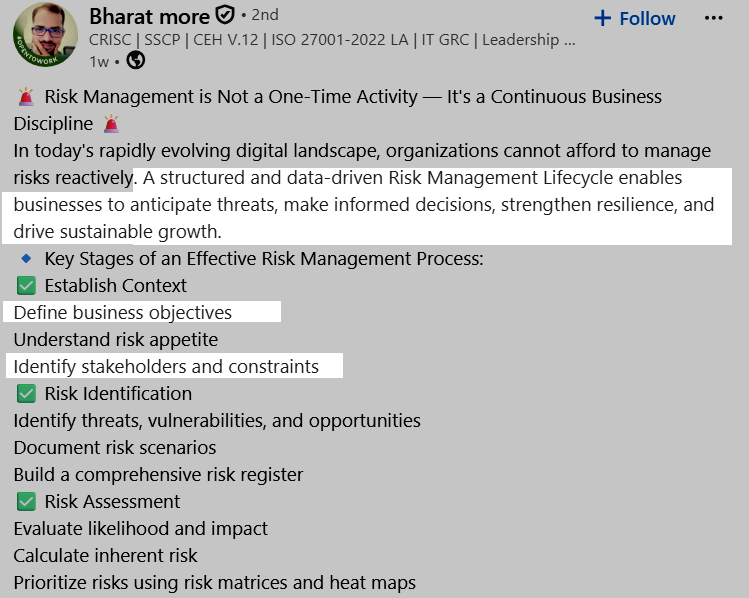
The risk dudes are still at it, though. Here’s a post from this week that suggests Risk Management is the thing that “enables businesses to anticipate threats, make informed decisions, strengthen resilience, and drive sustainable growth“:
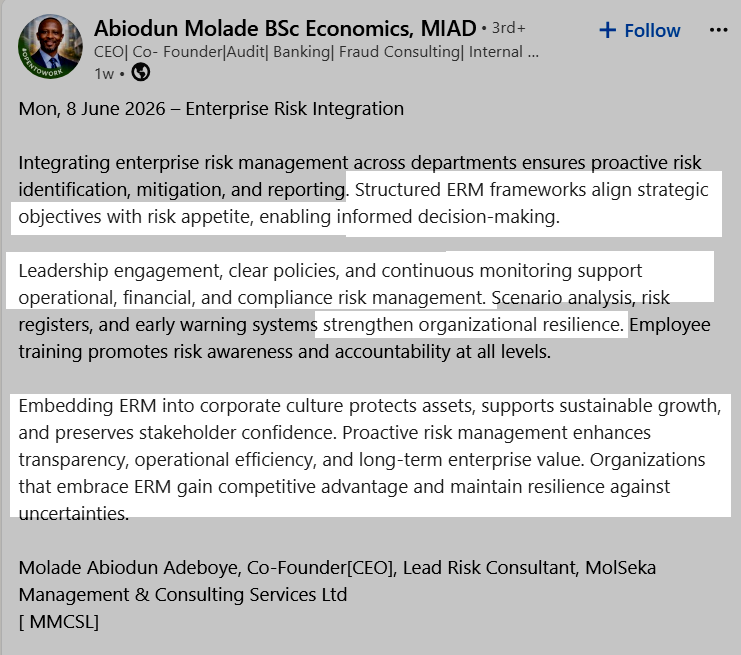
Not to be outdone, this next risk consultant claimed “Enterprise risk Management” (ERM) is not only helps the company enable “informed decision-making” but also supports operations, finance, compliance, and organizational resilience. Not having yet switched to decaf, he keeps going, and you have to read this to believe it:
And, finally, this risk dude claims that Risk Management is a “business capability that enables growth, protects investments, and improves decision quality at every level of the organization.”
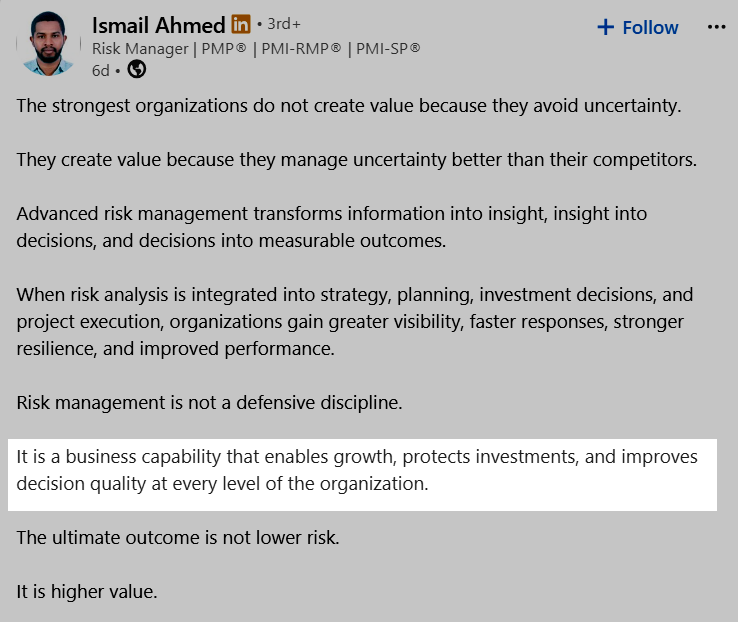
You can see what is happening. Both the Risk Guys and the Quality Guys are so desperate for attention by the CEO, they make impossible claims about their respective professions.
But they are not alone. Many other middle managers are trying to steal the limelight too.
Here is a post from a Supply Chain Manager, who insists “procurement and Supply Chain Management is no longer a support function, it has become a driver of business success.” Well, no, it hasn’t and, sorry, it is still a support function, but you do you.
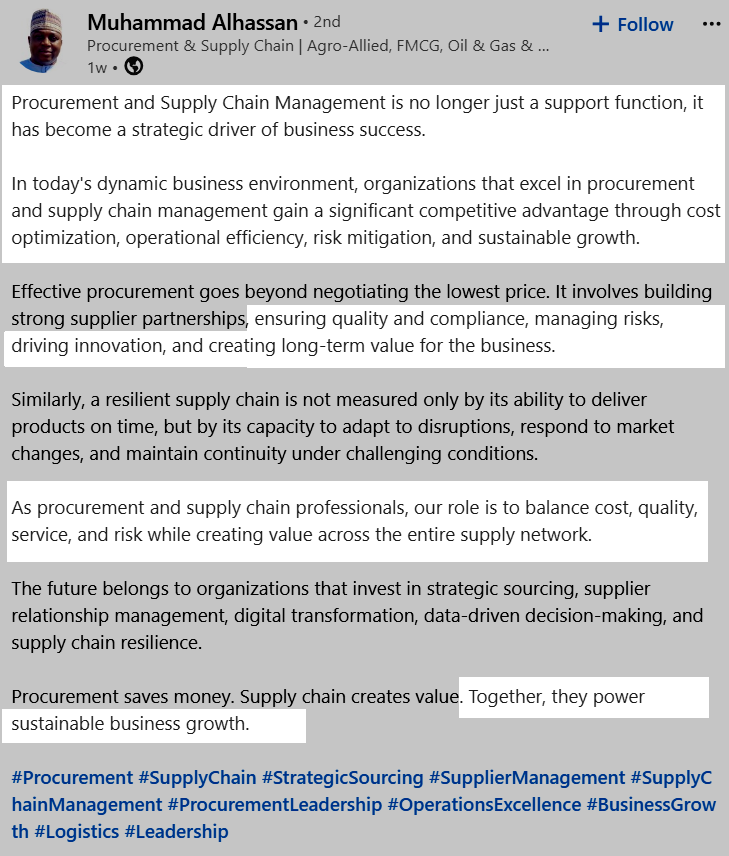
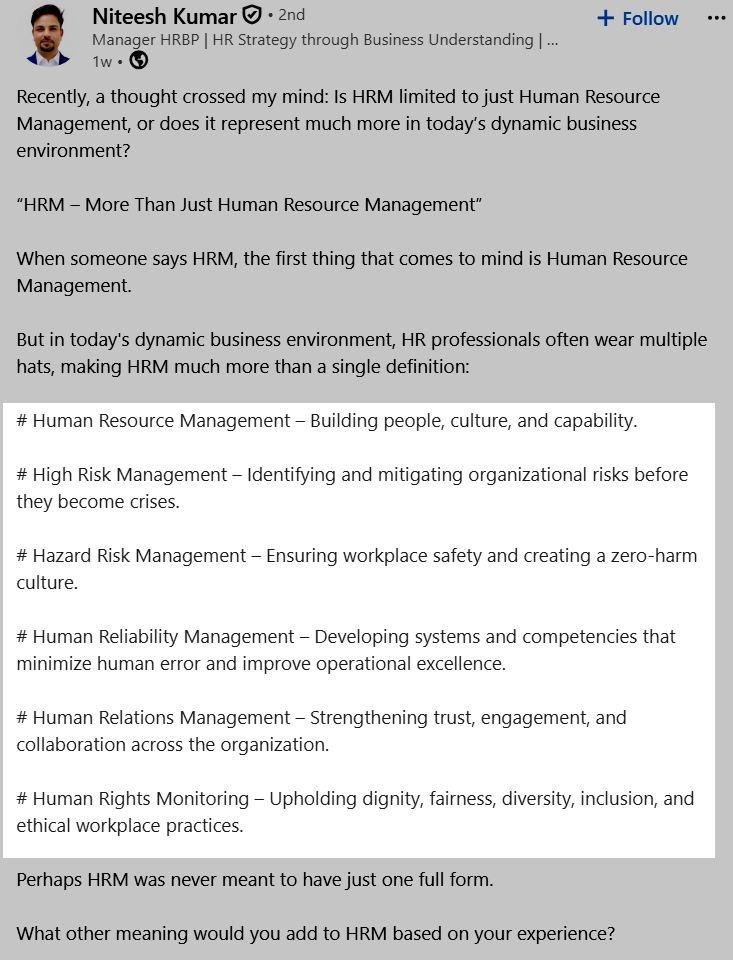
But, wait, aren’t their other departments in a typical company? Like Human Resources? Sure, and they want to claim magical powers, too. This HR dude claims that Human Resources Management (HRM) should be understood as responsible for pretty much everything. It’s a menu of ways to anger every other department in your company, from the Risk Management team (HRM can “identify and mitigate organizational risks“) to the Safety team (HRM can “ensure workplace safety“) to the Quality team (HRM can “minimize human error and improve operational excellence.”)
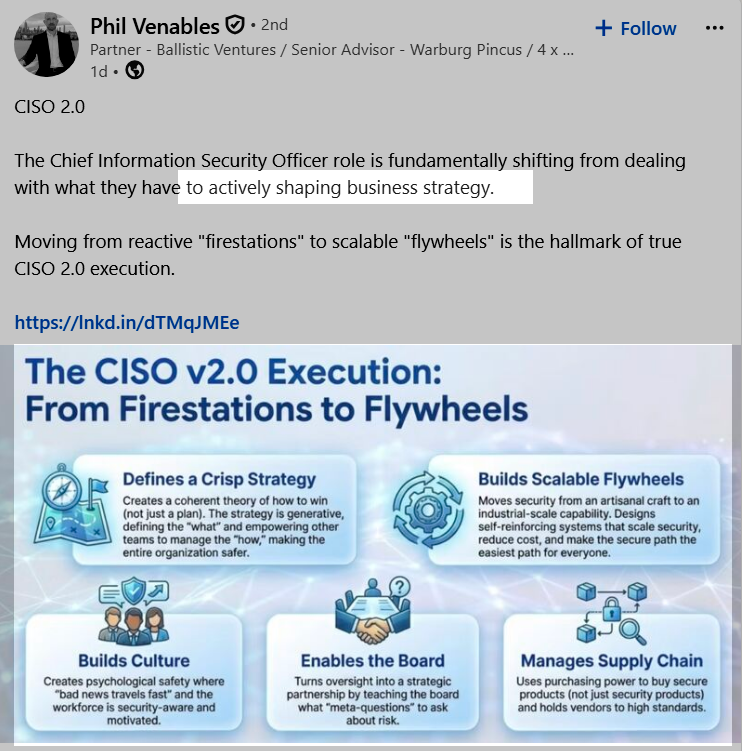
If you’re on LinkedIn, then there is no way you can avoid the frothing gripes from the cyberbros, typified by the “Chief Information Security Officer“(CISO) role. They have turned pathetic whining into near art (near, but not quite) and are on track to be as annoying as your local HOA board.
Here we see someone cooking up an entirely made-up concept called “CISO 2.0” that will finally empower these cyberbros to “actively shape business strategy,” despite the fact that most CISOs can’t balance a checkbook or bathe regularly. This guy claims that cybersecurity management now includes responsibilities for developing entire corporate strategies which will be followed by all the “other teams” in the company, create a “psychological safety culture,” take over from that Procurement guy and “manage the supply chain,” and — finally — just literally take over the boardroom by “enabling the Board.” Oh, I am sure they will love that.
So, from just the posts from last week alone, we see the battlefield populated by a slew of flailing armies: Quality Management, Risk Management, Safety Management, Information Security Management, Human Resources Management.
Now, imagine you’re the CEO and you have to listen to all of these people. Each one, pathetic and desperate, clawing at your office door insisting that it is they — not those other guys! — who have all the answer.
So, basically, that finale of The Boys where Homelander is on his knees. Once confronted with their limitations, some folks will promise anything.
Enter Watermeloning
But the reality is that none of the professionals in one profession know what the others are saying in other professions. They each think they are being unique. They’re all making the same exact arguments, but since they only read information that supports their view, they never see the big picture.
But, again, from the CEO’s position, it’s all noise. A bunch of sad lunatics promising things they can’t possibly deliver.
The end result is the exact opposite that each of these groups want: a reduction in top management’s trust. This leads the CEO to shut the door and go back to managing by his “gut,” since he can’t trust anyone in his middle management team.
Much of this can also be blamed on AI. No doubt, many of the people above just used ChatGPT to craft their post, and the AI models are just shoehorning the same platitudes into their arguments, swapping out “Quality” for “Safety” or some such.
In fact, just to test this theory, I promoted ChatGPT to generate text for a LinkedIn post that made the corporate case for a fictional management practice called “Watermeloning.” I needed to come up with a word to reflect everything and nothing, something that made no sense but which would prove just how ridiculous this phenomenon has become. watermelons also grow in patches, and each one probably has no idea its surrounded by others, so it works. *
In short, “watermeloning” can be used to define the modern practice of claiming your department or profession can replace all the other departments, while at the same time, those other departments are making the same claim about yours.
Now, I did not edit this text at all, but you can see it regurgitating the same business case talking points as all the others. Here is what ChatGPT came up with:
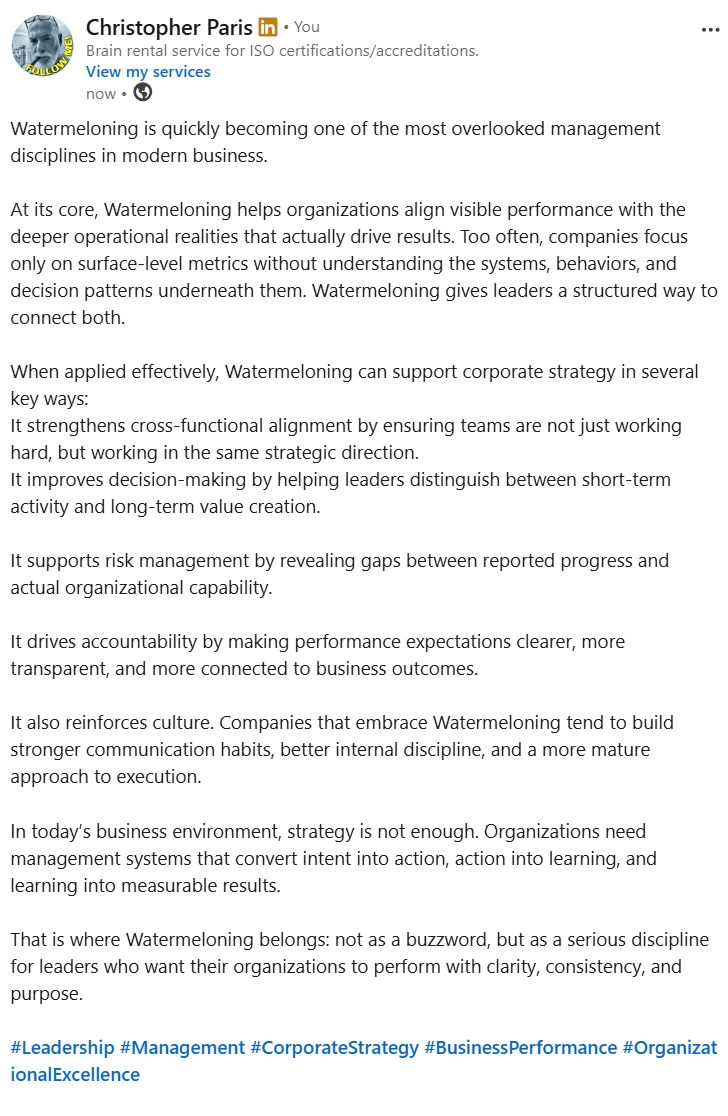
I guess watermeloning will now become an entire profession.
* Apparently watermeloning” has has a dirty meaning which I didn’t know about until after I did this, but I actually don’t care and think it make it even more on point, as well as funnier. And, hell, my ISO 9001 books come with f-bombs in them, so I’m not about to get all Puritanical. But, anyway, every made-up term has some dirty meaning somewhere, so there’s no winning that battle.

Christopher Paris is the founder and VP Operations of Oxebridge. He has over 35 years’ experience implementing ISO 9001 and AS9100 systems, and helps establish certification and accreditation bodies with the ISO 17000 series. He is a vocal advocate for the development and use of standards from the point of view of actual users. He is the writer and artist of THE AUDITOR comic strip, and is currently writing the DR. CUBA pulp novel series. Visit www.drcuba.world