
The AS9100 certification scheme is facing a global crisis for which the IAQG seems wholly unprepared to tackle, and which their grotesque profiteering is going to make much, much worse. Short version: we are already at the limit of AS9100 auditors to carry the current certification workload, and most certainly do not have enough to handle the coming rise in companies pursuing that certification. It’s really bad in the United States.
Data Crunching
First, let’s understand the two grades of aerospace auditors for the AS scheme (which includes AS9100 for manufacturers, AS9110 for repair stations, and AS9120 for stockist distributors.)
“AEA” grade stands for “Aerospace Experienced Auditors,” and these have the highest level of requirements for both prior professional qualifications and practical auditing experience. AEAs can act as Lead Auditors, and every single AS audit requires at least one Lead… thus, one AEA. If an audit team is comprised of a single auditor, that auditor must be an AEA.
“AA” grade stands for “Aerospace Auditors” and this is an entry-level role and has lower requirements. AAs can only participate as audit team members, but cannot act as Lead Auditors. So AAs only show up when an audit team is comprised of more than one auditor.
Using the IAQG OASIS data, there are currently 1,323 AEAs in the entire world. Of these, 450 are in the United States. Alongside that, there are another 380 AAs in the world, with about 150 of these in the USA. This leaves us with a breakdown as follows, as of July 2026:
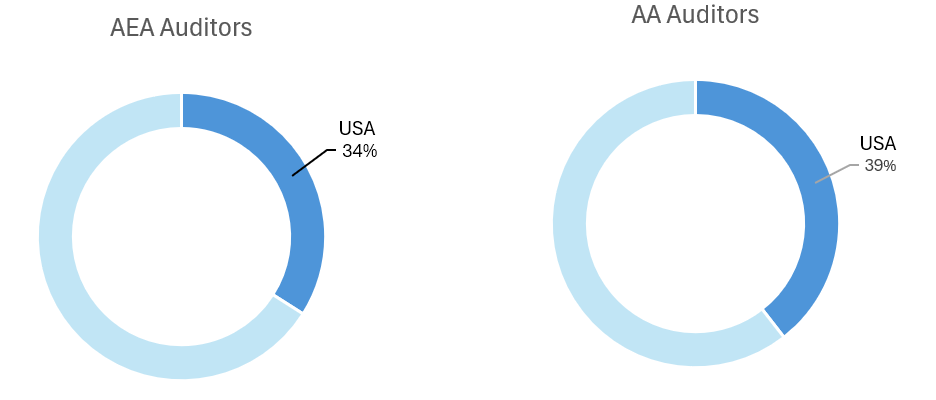
We can see that the percentage of AEA auditors — again, required for every single AS audit — is lower than the number of support AA auditors. This is, no doubt, due to the additional qualification requirements (and costs) associated with obtaining AEA level certification.
Meanwhile, looking at how the US stacks up in AS certifications vs. the rest of the world, we see this (again, as of July 2026):
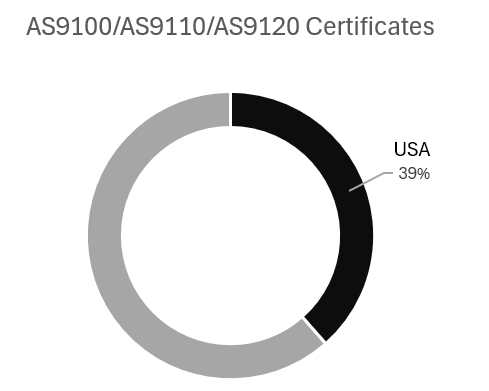
So, the US holds 39% of the world’s AS certs, but only 34% of qualified AEA auditors to perform them.
It’s not entirely apples and oranges, but gives us a rough sense of the problem: these numbers are not in our favor, and (partially) explains why US certification bodies are increasingly relying on non-US auditors (usually from third world countries) to perform domestic audits.
Audit Planning
AS9100 audit duration is determined largely by employee count but then adds in additional factors like the number of sites and distance between those sites. (There are some other factors, like risk, but I am simplifying.) Thus, a large company will require a long audit, and small companies will require a short audit. No matter what, however, every audit requires an AEA Lead Auditor.
Typically, CBs try to keep the total audit time for a single “audit event” down to a week. So if an audit requires 10 days, they will send two auditors for five days. For very large companies, the total weeks may be longer, but the size of the audit team will likewise be larger. Huge companies could see audit teams of 5 auditors working for weeks on end.
Now let’s look at more data. Per OASIS, there are only 90 certification bodies (CBs) accredited to perform AS9100 audits in the entire world, with 30 of those in the US. Most of the auditors are private contractors, working for whichever CB they can get work from. Only a few of the larger CBs have a set of full-time employees acting as auditors. Thus, CBs in the USA must compete between each other to poach AEAs from that pool of 450.
Next, we must recognize that AS9100 auditing is a secondary career. Auditors must have an extensive work history in aerospace before even qualifying to apply for AEA status. This means the average AEA has already retired (or quit) from their original job, and (for many) the AS9100 work is a post-retirement gig. This, then, leads to another reality that few want to discuss: the AS9100 auditor pool is shrinking due to natural causes: auditor retirement and death.
It is not ageist to point out that the average age of AS auditors is very, very high. To find an auditor under the age of 50 is nearly impossible, with most much older than that. The advanced age of the auditor pool then adds in other complicating factors, like the need to juggle audit dates to accommodate for auditors’ medical concerns.
Meanwhile, there is no campaign or outreach underway to attract new auditors to the scheme. Even if there was, younger folks could not enter the scheme anyway, as they usually lack the increasingly strict prior work experience requirements for AEAs. Some older folks are limited, too, since that work history must be recent. Then, many consultants, such as myself, are outright prohibited since consulting work doesn’t count.
We must also acknowledge those numbers in OASIS represent total persons holding AEA status, but that doesn’t mean they are either working as CB auditors at all. Many obtain this credential for their employer, such as Boeing or Lockheed, and only perform internal audits. Many others are former aerospace workers who now act as consultants, and who use the credential as a marketing tool, but who never perform any third-party CB audits at all. So the actual available pool of AEAs in the US is smaller. We can’t be sure by what percent, however.
Breaking Point
So, we already have a very low number of auditors. OASIS reports that, in the United States, there are over 12,000 companies certified to AS9100, AS9110, or AS9120. We can’t be sure how many of those are multi-site facilities, but we do know that each one of those requires at least one annual surveillance audit. Many of those will be one-day audits (many of the companies are small), but others may be huge, requiring massive audit teams.
Let’s make some assumptions in order to give as much favor to IAQG as possible. Assuming that all 450 auditors work for CBs, and assuming they work every single possible workday on the US calendar (250 days per year), then the total available auditor days per year is 112,500. Now we assume that each audit requires travel time to and from the client, and the number actually drops to around 37,500 possible audit days per year.
Next, that would assume each individual auditor is performing a sole, one-person audit. In reality, that number drops far further, since many audits are comprised of teams which may include more than one AEA.
We cannot know for sure that an average audit duration is for all US comapnies, but we are dangerously close to the limit. If the average audit duration is 3 days, we have already approached the absolute limit.
Of course, not all AEAs are working for CBs, they physically cannot work all work 250 days a year, travel time can be higher, and we haven’t even discussed the time burned up with the endless paperwork and administrative tasks. Much of the latter stuff is not ever counted in audit duration time at all, such as when AEAs have to work on nonconformity closure, OASIS data entry, completing expense reports, etc.
Factor in that AEAs are already double-tasked to perform ASA-100 audits. Every day they do an ASA audit, that’s one less day available for AS9100 audits.
The system is nearing a breaking point or, if my personal experience is right, has already smashed through it. More and more, CBs are quoting six-month lead times for audits. This frustrates my clients who want a 2-3 month AS9100 implementation, only to be told they have to wait an additional three months or more for their CB to show up.
Let’s also talk about CB greed. Currently, the rate for AS9100 audits is around $1,500 – $2,000 per day, as charged by the CB. But that money does not go to the auditor. Instead, the CB keeps the bulk of that, giving a far smaller nibble to the actual auditor. Sometimes they are paid for travel time, but often they are not. All those hours in airplanes and in rental cars might go unpaid, making the job even less attractive to newer auditors.
Accreditation Bodies (ABs), like ANAB, then impose made-up requirements that extend the amount of unpaid work expected of CB auditors. Some have demanded that Stage 1 audits be done on-site, which is not supported by any actual standard. This requires the AEA to travel just to perform a document review and readiness check, burning up more travel time. Every day an auditor is on an airplane or driving is one less day that auditor is available for Stage 2 and Surveillance audits, which generally must be done on-site.
This results in auditor burnout, high turnover, and disgruntled auditors. (That disgruntlement ends up in your lap, when you’re being audited, and is why so many of them are surly and unprofessional.)
The best we can hope for is a wave of new retirees who meet the stringent work experience requirements and have an interest in picking up CB work as their post-retirement side hustle. But they baby boomers are gone, and the other generations are shrinking. This means less retirees in general, forcing US certification bodies to have to rely on third world auditors — who often can barely speak English and have no experience in US FAA regulations — to audit US companies.
IAQG Has No Plan But Money
What is the IAQG doing about it? Focusing solely on how it can put money in its own bank account, of course.
Fiddling while Rome burns, the IAQG, certification bodies, consultants, and others are aggressively marketing AS9100. They want more companies to buy standards, buy training, buy seminars and, most of all, buy certification audits. But IAQG has no plan on how to offset the declining number of auditors to compensate for coming growth.
It’s as if the IAQG is solely fixated on making this situation entirely apocalyptic. While technically a “non-profit” registered in Belgium (so we have no insight into their financials), IAQG acts like the other modern-day “charities” by operating as a de facto for-profit company. That means turning every administrative task into a financial transaction, extracting fees from everyone at every turn. What would typically be treated as back office activities covered as expenses become, instead, profit centers.
AS9100 end users have seen how IAQG recently added various OASIS fees, which CBs are forced to collect on their behalf. Those fees are both increasing in number and cost. Any possible activity related to OASIS is eventually paid for by end users, who the IAQG does not even consider being the “customer” of AS9100 certification.
Worse, the IAQG is rebranding the entire AS series of standards — 24 in total — under the “IA” prefix instead, which will force end users to buy a whole set of new standards just because the name changed. This will result in hundreds of millions of dollars in overnight revenue to IAQG’s publishing partner, SAE.
You’d think SAE would be happy about this, but the snakes can’t stop biting each others’ heads off either. The IAQG has launched a new plan to take over more of the auditor authentication, showing its contempt for its other partners, the training bodies. In doing so, the IAQG has had to use standards to carry out its duties, but wasn’t paying SAE any licensing fees. SAE sued the IAQG claiming copyright infringement, but the case was thrown out of court for lack of jurisdiction. (That suggests that SAE will refile somewhere else, so the drama isn’t over.)
In short, the IAQG is so greedy, it wasn’t happy just ripping off AS audit customers and the entire auditor pool, it’s grabbing money from its own partners.
Finally, IAQG is increasing the experience requirements for auditors, but leaving the (lackluster) classroom training intact.
Right now, an auditor must have some fairly extensive aerospace industry experience and it must have been obtained in the past ten years or so. Then, that auditor is qualified to take a ridiculously simple 36-hour “Lead Auditor” class, the content of which is lacking in crucial details such as how to identify objective evidence and how to write nonconformities. With this painfully inadequate class certificate in hand, the auditor must then clock an increasingly large number of audit days, alongside an existing AEA.
The problem is that the CBs won’t pay for this, so AEA candidates must beg a CB to let them tag along and then pay their own expenses. That’s for each required ride-along audit, too. Between the costs for the 36-hour class, OASIS fees, mandatory IAQG trainings, and paying for one’s own qualification audits, a candidate can easily spend $20,000 for an AEA credential. They then must hope to get hired afterward, and hopefully recoup all those costs at some point, even as the CBs rip them off with low pay.
So, IAQG continues to go all-in on emphasizing the wrong thing — prior experience in aerospace — while continuing to roll out the weakest, most inept training in actual AS9100 auditing. You can be the world’s best airplane mechanic, but that won’t make you a good auditor. IAQG has it all backwards.
The Fix
As usual, I will suggest a fix, but it would require IAQG to stop trying to make a nickel off of every possible transaction and back office task, and actually pretend to be a non-profit that cares about aviation safety.
What needs to happen:
- IAQG must loosen the work experience requirements for AEAs, in order to broaden the pool of candidates.
- Then, IAQG must require more stringent training requirements for candidates, increasing the training from the current 36-hour class to at least 80 – 100 hours.
- CBs must increase auditor pay. If that results in an overall increase in AS9100 certification costs, so be it. Aerospace and defense companies should not be hoping that certification audits will be cheap. This is not a Wendy’s.
- IAQG must develop and pay for a campaign for attracting new auditors in key economies, like the US, where the crisis is likely to hit sooner.
- IAQG must not charge for training when it updates standards like AS9101 or AS9104. Currently, IAQG and SAE only update these standards in order to increase revenue by bilking auditors for “mandatory” training and selling standards. Then, IAQG does nothing to enforce the actual standards, making them moot in practice. There is no reason in the world why non-profits like SAE and IAQG need to profit from every single minute of administrative training. Instead, these training courses must be offered to all AA and AEA auditors at exactly no charge.
- IQAG must change its bizarre, self-serving position that only the members of IAQG itself are the “customers” and “users” of AS9100. The actual users are the people paying for audits, and their opinions must be put front and center. It doesn’t mean they will be right, but prohibiting their participation entirely only leads to crises like this one.
As you can see, this would require IAQG and its partners to forego profiteering, which is unlikely to happen. Instead, I am not sure how the industry will process the coming flood of organizations seeking AS9100 certification. When CB lead time for audits becomes 12 months or more, perhaps the IAQG will wake up from its profit-obsessed fever dream.

Christopher Paris is the founder and VP Operations of Oxebridge. He has over 35 years’ experience implementing ISO 9001 and AS9100 systems, and helps establish certification and accreditation bodies with the ISO 17000 series. He is a vocal advocate for the development and use of standards from the point of view of actual users. He is the writer and artist of THE AUDITOR comic strip, and is currently writing the DR. CUBA pulp novel series. Visit www.drcuba.world