As reported yesterday, CMMC consulting firm NeoSystems imploded last week, firing its entire staff on Friday and shutting down all operations. It has still not alerted clients, many of whom were using NeoSystems to house their controlled unclassified information (CUI).
I’ve now obtained a copy of the actual termination letter sent to employees on 1 May, and have redacted the ex-employee’s name. The letter is interesting, to say the least, in that it reveals the company knew about their imminent demise long before the mass firing. In the letter, NeoSystems President and CIO Jeff Huckle writes, “Please note that the Company is in the process of selling certain assets to a third-party purchaser.” Such asset sales don’t happen overnight, so negotiations with potential buyers and the actual sale of assets must have been done long before the termination letter.
Click the image to enlarge:
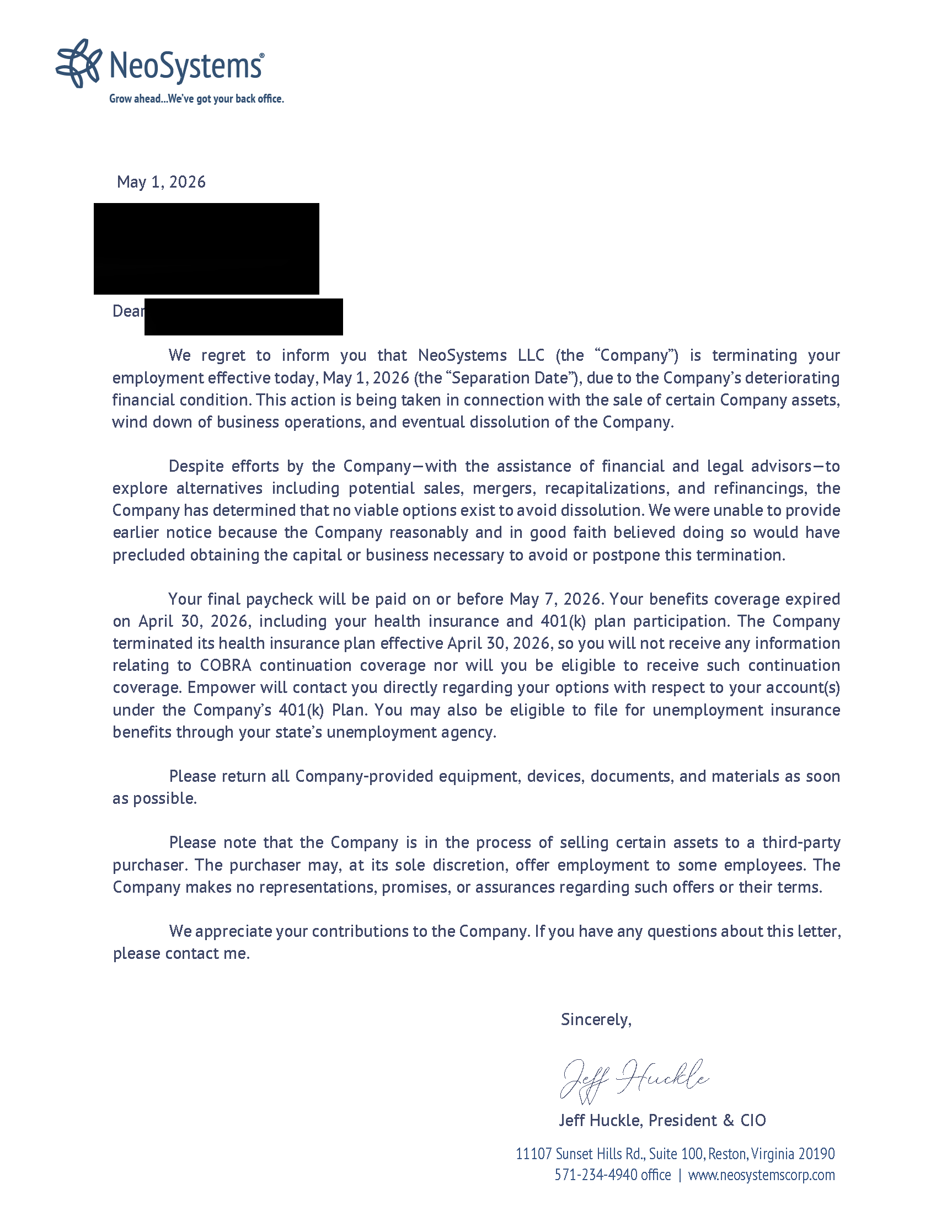 Huckle also says they already canceled employees’ insurance, another thing that would not have happened overnight.
One source told me that things may be much, much worse:
They were signing new clients and new contracts as of Monday last week. You don’t sign new clients with 12 month contracts knowing you are shuttering your doors, without intentionally trying to defraud the client.
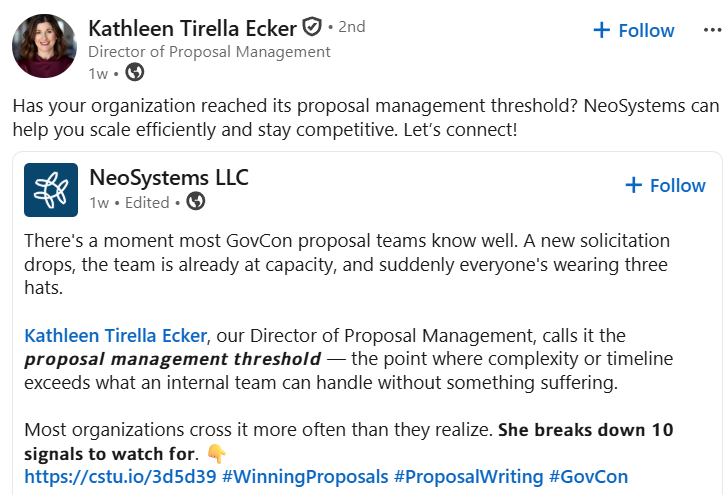
This appears supported by a post dated a week ago (the same week of the company shutdown) in which NeoSystems’ Director of Proposal Management, Kathleen Tirella Ecker, was still selling NeoSystems stuff on LinkedIn:
This will almost certainly end in full-on Federal investigations and, most probably, arrests for the NeoSystems executive team.

Jeff Huckle on a beach, writing termination letters.
Worse, there is no word on what happened to the sensitive CUI data belonging to the customer on the “assets” that NeoSystems is now selling to some unknown party. This will likely lead to a massive class-action lawsuit, though I suspect any attempt to recover money will be moot, since bankruptcy is clearly in NeoSystems’ immediate future.
All of this was predicted, of course. But the CMMC cult has shunned whistleblowers in favor of photoshopping Katie Arrington as a superhero and gifting her off-brand Captain America shields, even as they now find themselves out of work and without health insurance.
On another note, I checked and found that NeoSystems’ former CEO, Brad Mitchell, previously worked at QinetiQ. If that name sounds familiar, it should, as it seems to be the original incubator for much of the CMMC scheme’s fraud.
If you recall, Arrington cooked up the idea to create the CMMC Accreditation Body (later rebranded as The Cyber AB), using the Federal acquisition rules as a way to get around the pesky fact that the US government cannot create private companies without the passage of an actual law, approved by Congress and signed by the President. She then handed control of the Cyber AB to her former boss and political donor, Ty Schieber, with whom she had worked at Dispersive Technologies before working for the government. Arrington then managed to create what is effectively a law requiring the entire DIB to buy stuff from Schieber or face permanent debarment from all Federal defense contracting… again, all without Congressional approval.
Before working at Dispersive, Schieber worked at QinetiQ, alongside Stacy High-Brinkley. High-Brinkley would go on to work for Cask, and received one of the earliest Cyber AB credentials, and Cask received fast-tracked C3PAO approval from the Cyber AB.
Now we find that NeoSystems’ disgraced CEO was there, too, and NeoSystems also received RPO credentials from the Cyber AB.
Cask, meanwhile, has its own problems, as its CEO, Mark Larsen, is facing a decade or more in a federal penitentiary for allegedly bribing government officials. Schieber was forced to resign from the Cyber AB after he and Mark Berman cooked up a pay-to-play scam whereby donors of $500,000 could get special “diamond” status from the AB, along with special treatment.
Berman runs FutureFeed, which includes Stuart Itkin, another CMMC shill, Arrington apologist and… more importantly… a former NeoSystems executive.
The entire CMMC scheme is filled with scammers, grifters, and criminal fraud. No one should be surprised by the NeoSystems debacle, although hopefully they will face consequences, like Cask and Larsen have.
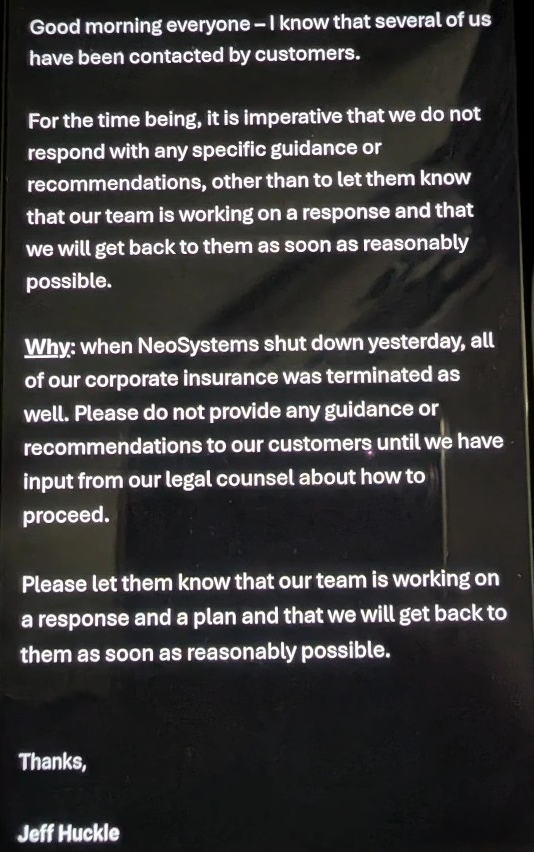
7 May 2026: Oxebridge has obtained multiple internal documents and details surrounding the NeoSystems crash, and I will update the reporting shortly. In the meantime, I received a copy of a message sent by Huckle, alerting staff not to reveal anything to clients. The message also appears to show that NeoSystems cancelled its insurance before fully thinking out the wind-down.
I have also learned that the systems holding customer data were purchased by Bluestreet, and that the deal closed this past Tuesday (May 5) at 3PM Eastern. Access to those systems has been locked down. Bluestreet doesn’t seem to have any CMMC experience, so this may prove to be another self-prompted stumble.
UPDATE 19 May 2026: Clarified that Brad Mitchell was NeoSystems’ former CEO. See this article for a more accurate timeline of events.

Christopher Paris is the founder and VP Operations of Oxebridge. He has over 35 years’ experience implementing ISO 9001 and AS9100 systems, and helps establish certification and accreditation bodies with the ISO 17000 series. He is a vocal advocate for the development and use of standards from the point of view of actual users. He is the writer and artist of THE AUDITOR comic strip, and is currently writing the DR. CUBA pulp novel series. Visit www.drcuba.world