
The new ISO 9001:2026 standard, currently at the FDIS stage (so unlikely to change at this point), is an exercise in self-imposed attention deficit disorder. Where the standard is supposed to constrain itself to defining a quality management system focused on the customer and producing quality products and services, that focus has been lost by the crop of private consultants who have been rewriting the standard since 2015. We are now officially in the “oh, look, a squirrel!” era of quality management standards.
Blame Hortensius, That Hack
Much of this falls at the feet of ISO’s Technical Management Board (TMB), which was originally granted the very limited task of coming up with a single “high-level structure” (HLS) for ISO management system standards. This was so that standards like ISO 9001 and ISO 14001 shared a common paragraph and clause format. But the TMB, led largely by the Netherlands’ Dick Hortensius, quickly reached for more power and demanded the right to craft a universal “core text.” ISO, seeing a way to circumvent the endless debating and voting by Technical Committees, granted the TMB this right, and things went sideways.
Now, huge portions of the text of every single management system standard are written by a Dutch guy who, prior to working for the Dutch standards body, never had a job in any one of the industries he now writes standards for. His text has been forced into standards dealing with manufacturing, medical devices, environmental management, occupational health and safety, cybersecurity, artificial intelligence, aerospace, automotive, petroleum and gas, food, railways, education, local governance, shipping, and even “adventure tourism.”
Think about that: a guy with no experience in any of those things writes “mandatory text” for all of them. Then, ISO and the TMB set rules that the text may not be edited or excised without special dispensation — which ISO does not grant.
Because the TMB is attracted to whatever shiny thing they see — or a squirrel outside their window — that stuff inevitably gets put into the standards, like ISO 9001. As I wrote here, the Australians convinced TMB to put “risk” in all their standards. Then, some random guy from Sweden convinced them to put “emotionally-protective” language in the standard. Then Sergio Mujica told them to put in “climate change” and “sustainability initiatives.” Now, BSI and Sam Somerville have inserted language that shifts the focus from the customer to random “organizational strategy” concerns, as well as adding new language on “opportunity-based thinking” (which is not something that actually exists).
Enter Nu-Quality
The entire new generation of quality professionals, whom I call “Nu-Quality,” has lost the plot. They are no longer acting as customer advocates and are concerned with producing a product that meets requirements. Now they have to concern themselves with multiple distractions, all at once, many of which may run counter to the customer’s requirements.
Now, the Nu-Quality folks will insist this is a feature, not a bug, because that is how they were raised. They are the TikTok generation of quality management professionals; they don’t like to read, they don’t want to study, and they wallow in Dunning-Kruger all day long. They will insist that the role of the Quality Manager is no longer limited to ensuring the delivery of quality products and services, but instead to meet some unseen “organizational strategy” and to solve all world’s problems.
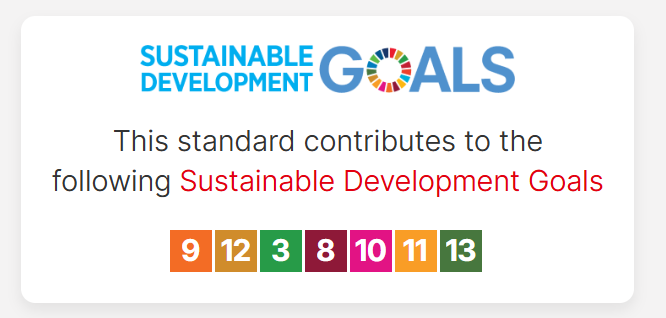
Technically, ISO 9001 only wants them to solve seven of them, so I stand corrected:
Color-Coding ISO’s ADHD
To show this shifting focus, I color-coded the FDIS standard—only the clause sections—according to each sentence’s main focus. I found that the standard, while still largely worried about customer requirements and quality, has added a lot of material that could well contradict the traditional focus of quality management professionals.
Specifically, the standard now has five varying themes, or foci, that ensure the Quality Manager will be running around like a decapitated chicken. These are:
- Quality: traditional concepts that are mainly focused on customer satisfaction and/or producing a quality product or service.
- Risk: ISO’s added focus from 2015, a watered-down version of risk management
- Opportunity: ISO’s attempt to soften “risk” by presenting a positive variant, now emphasized in the new draft
- Company objectives and goals: a new focus on having the Quality department obey whatever goal-of-the-week top management dreams up, even when they may conflict with the customer’s requirements.
- ISO / Other: language imposed purely because of ISO’s own desires or instincts, or other stuff not otherwise categorized.
Any uncolored text was because the concept spanned over multiple categories above, so it couldn’t easily be quantified.
I’ve blurred the text so ISO doesn’t get all pissy about revealing their super-secret, confidential, top state secret info.
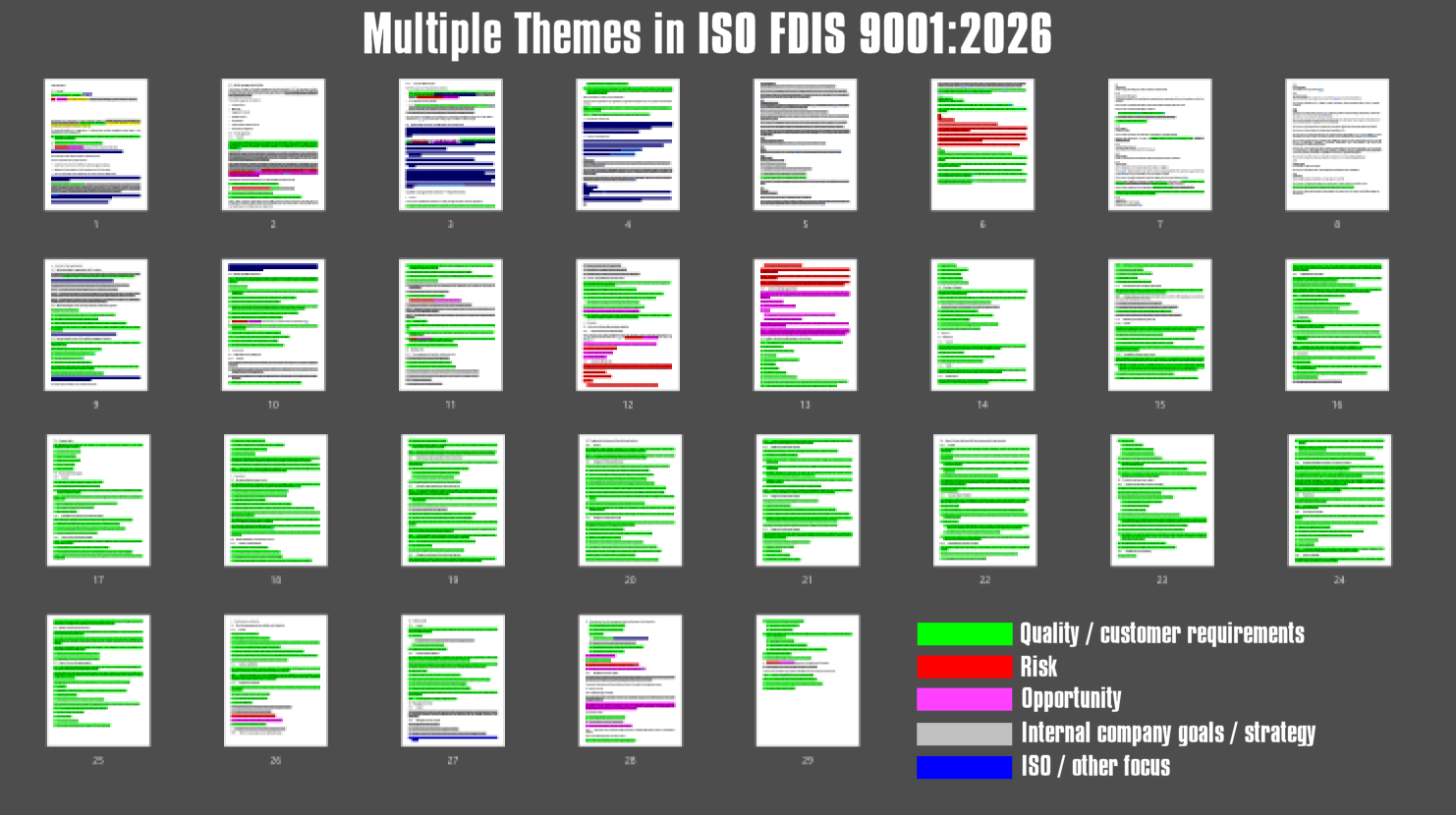
Now, keep in mind, this is me applying a closest fit coloring to each sentence.
What we see is, yes, the bulk of the standard — especially clause 8 — is still primarily focused on quality. But the surrounding bits, like all the front matter and the clauses near the end, start to lose the plot.
And that’s bad. The stuff upfront is about scoping both the ISO 9001 standard itself as well as your QMS. Here, TC 176 starts injecting all sorts of shiny squirrel distractions, ignoring the fact that they violate their own Quality Management Principle of “customer focus” as they do so.
Of course, for the 2026 version, this is where TC 176 spent all their time (ignoring the horrible annex materials.) They tinkered with scoping all to placate Sergio Mujica, who had designs on becoming the next UN Secretary General, and wanted to convert ISO into the “enforcement arm” of the UN’s sustainable development goals. (He’s now making the same promises to the World Bank, International Monetary Fund, and other political bodies. Be afraid; be very afraid.)
Somerville was hired to run this update purely because she lacks a spine and is craven enough to do whatever Mujica and the TMB tell her.
Again, though, the Nu-Quality folks will insist this is not only normal but good.
They will be wrong. Now, under ISO 9001, a company can ship defective products so long as (1) they thought about risk while doing so and (2) can show how doing so helped meet some vague “organizational objectives” or “strategic direction.”

Christopher Paris is the founder and VP Operations of Oxebridge. He has over 35 years’ experience implementing ISO 9001 and AS9100 systems, and helps establish certification and accreditation bodies with the ISO 17000 series. He is a vocal advocate for the development and use of standards from the point of view of actual users. He is the writer and artist of THE AUDITOR comic strip, and is currently writing the DR. CUBA pulp novel series. Visit www.drcuba.world