Thanks to my endless sources, I’ve gotten an official copy of the Final Draft International Standard (FDIS) version of ISO 9001:2026. I’ll have a more detailed review of it shortly, but the first thing I did was throw it into Adobe Acrobat and compare the clause sections 0 through 10 from the prior DIS version to this new FDIS. I didn’t bother with any of the annexes or front matter, since they are entirely irrelevant.
Why? Well, to see a few things. First, just what TC 176 has been doing for the past nine months since the DIS was released.
And, next, to see whether or not Sam Somerville and her BSI/TC 176 goons actually did anything with those 1,500 comments they received from the DIS version. Let’s see how they did.
[UPDATE: Somerville just released an internal congratulatory email saying, “In total and across all drafting stages the Working Group has participated in 29 meetings representing 267.5 hours of formal meeting time and dispositioned 5,974 comments.” So the actual number is much, much higher.]
Time Wasters
The Adobe comparison reported the following:
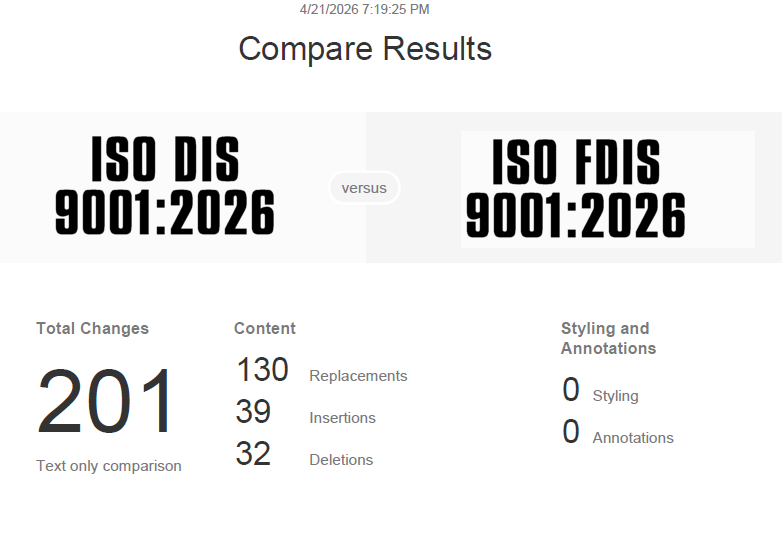
Now, remember, this is just the clause sections, where ISO 9001 end users spend all their time. Of that text, Adobe reported a whopping 201 changes since the DIS. Sounds like a lot, but let’s take a closer look at the nature of the changes. Overwhelmingly, these were pedantic, amateurish and, frankly, cringe-worthy tinkerings.
Have a look at this one. Here, they simply changed “its processes” to “the organization’s processes.”

And, here, we see they just added a reference to “opportunity-based thinking“, TC 176’s new shiny object of distraction:

And, finally, here they changed “a customer’s or external provider’s property” to “property belonging to a customer or external provider.”

I checked all the changes, line by line, and none were substantive. Not one.
When comparing the changes made to the front and back matter, meaning the introductory content and Annexes, Adobe reported another 554 changes. To drive home just how ludicrous this is, I made a pie chart, since that’s about as intellectual a thing as TC 176 can possibly understand:
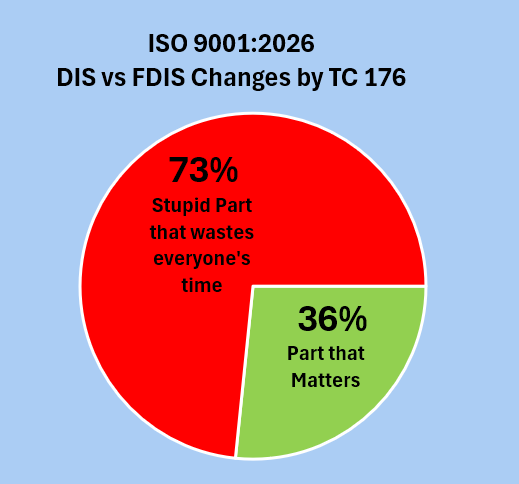
So, TC 176 took nine months to make no changes to the actual text of requirements and, instead, wasted their time tinkering — and flying all around the world! — to edit stuff that isn’t required, doesn’t get audited, and provides no value at all to the reader.
Comments? We Don’t Need No Stinkin’ Comments
Remember when Sam Somerville and her plucky band of dummies bragged about how they “dispositioned over 1,500 comments“ made by ISO members on the DIS? TC 176 tried to brand that as some laborious, intense operation to ensure all voices were heard on the disastrous standard.
(The number of comments was originally reported to be 1,700, but then somehow dropped to 1,500. I don’t know if the first number was wrong or if Somerville “lost” 200 of them. You pick.)
I have a PDF of those comments, and some were rather meaningful. Have a look at what the Netherlands proposed, and see Sam Somerville’s smug comment on the far right, where she tossed it out:

Here, Italy proposed a clarification on the clause on control of nonconforming product, suggesting that each product NC be accompanied by a root cause analysis. Now, I disagree with that suggestion, but look at why Somerville dismissed it. It contradicted the holy Annex SL (“HS”) text, which one is simply not allowed to do! So here you have evidence of an ISO member nation’s nominated quality management expert being overruled because his suggestion contradicted text written by some ISO Technical Management Board goon who has no quality management subject matter expertise.

And here we see (presumably) Jose Dominguez of INLAC get his ass handed to him with a double-whammy rejection. Not only did he dare to question Annex SL, but he also received an extra bitch-slap by Somerville, who claimed his suggestion “did not improve user understanding.” Because Somerville represents the entire planet, all at once!
It’s funny because Dominguez is a sad little sycophant for ISO, and did a world tour to get INLAC members (from Latin America) on board with this revision, only to have his work spat back at him. Jose, if you like being slapped and spit on, I think maybe PornHub might be calling.

In reality, what happened was that Somerville and her gang deleted the 1,500 comments and instead worried about tweaking the introduction and annexes, wasting everyone’s time.
What They Didn’t Fix
Meanwhile, here are some things still wrong with ISO 9001, which now heads for a final vote before it becomes a fully published — if wildly defective — product.
- Still no requirement to write down what you are buying from suppliers; you can totally order 50 million dollars of airplane parts by way of a quickie, verbal phone order!
- “Monitoring and measurement” means “inspection and test” until clause 8.6. Then, they use the term “planned arrangements” in one sentence, and in the next, “release,” to refer to inspection and test. “Monitoring and measuring” shows up in clause 9 under a different meaning entirely.
- PDCA still broken – clause 10 never loops back to clause 4.
- Preventive action is still missing; ISO 9001 is reactive only after problems occur. It’s made worse in the 2026 version, which doubles down on the fact that the risks in 6.1 are only related to those affecting the QMS, not products and services.
- One sentence in 9.2 still refers to auditing as a “programme” then a “process” and then a “programme” (again). Did I mention that’s just in one sentence?
- Quality objectives still competing wth process KPIs. ISO never fully embraced the process approach.
- Still no clause on shipping. TC 176 thinks finished products magically arrive at customers’ doorsteps.
As I said, I will have a review of the actual clause content next, but the short story is this: there were no real changes since the DIS, so everything I said back then still applies.
BTW: still no mention of AI, sustainability, or digitalization in the clauses. Everyone saying that is still lying.

Christopher Paris is the founder and VP Operations of Oxebridge. He has over 35 years’ experience implementing ISO 9001 and AS9100 systems, and helps establish certification and accreditation bodies with the ISO 17000 series. He is a vocal advocate for the development and use of standards from the point of view of actual users. He is the writer and artist of THE AUDITOR comic strip, and is currently writing the DR. CUBA pulp novel series. Visit www.drcuba.world