

Hat tip to Management System World for this news. ISO 9001:2026’s Draft International Standard (DIS) has been approved to move to the FDIS stage with a whopping 97% approval rate of participating countries. This comes after ISO’s top leaker, Didier Blanc, once again spouted off on social media without waiting for any official approval.
Separately, a source has told me that there are nearly no changes between the DIS version and the planned FDIS, all but ensuring the DIS we see now will represent the final, published version to be released in 2026.
Another source within ISO itself told me that there was a “pressure campaign” put on TC 176 member nations to ensure a very high approval rate, to overcome the widespread public criticism the draft had received. ISO wants to pretend that the online criticism, endless editorials, and even semi-official criticisms of the DIS never happened, and that it was all in everyone’s imagination. Yes, ISO is engaging in a full-on gaslighting campaign.
This is a huge blow to ISO 9001 users, who overwhelmingly criticized the DIS version. But for this version, ISO gave control of the development of the standard to private consultants, led by the certification body BSI, and blocked participation by actual end users. The next version adds wholly unauditable requirements, like “opportunity-based thinking,” and includes an entire consulting annex, both of which are a boon for the consultants who wrote them. For users and auditors, however, the standard marks a huge setback and is likely to further erode the world’s adoption of ISO 9001 as a serious QMS standard.
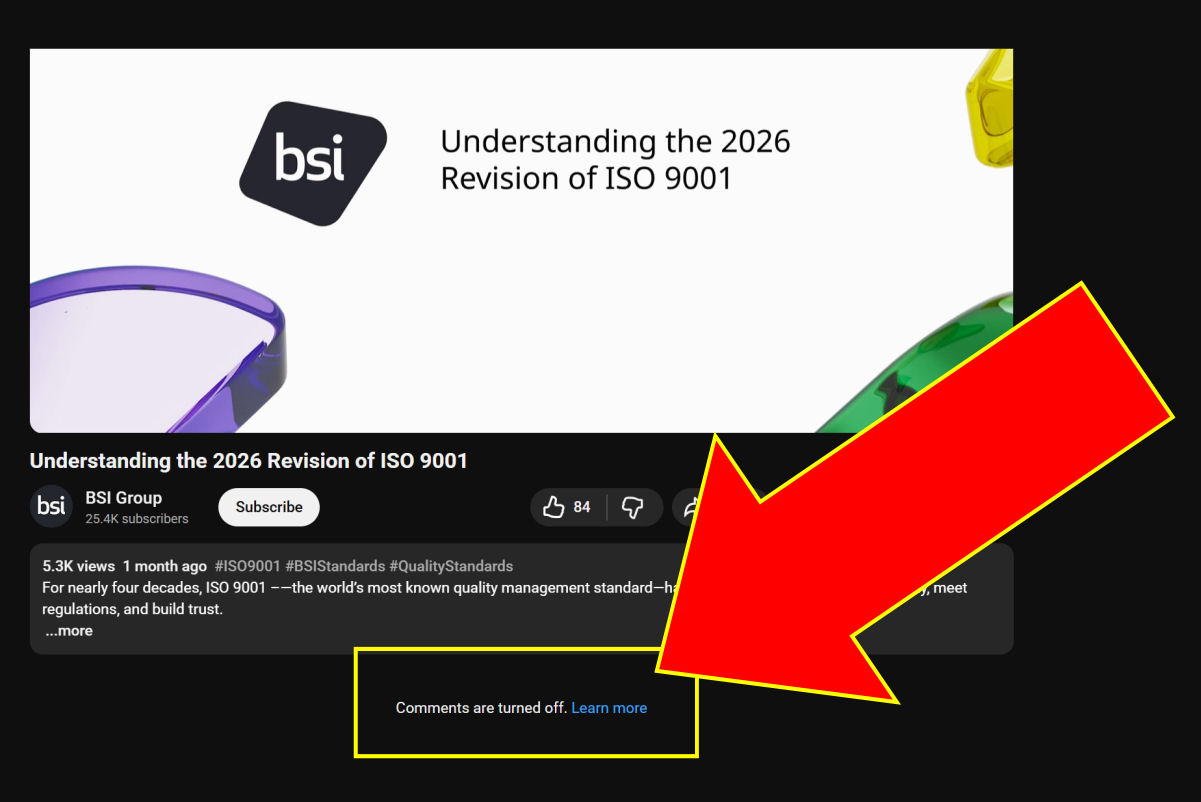
The fix was already in, however, long before the voting. Sam Somerville, the private consultant and former BSI rep who led this revision, had already signalled that no changes would be allowed made to the draft. BSI and Somerville released an expensive, professionally-produced video on YouTube discussing the changes, and they would not have spent that much money on a draft that they intended to edit. BSI naturally turned off comments to the video, because they are actively working against the end users.
The fact that Blanc’s private consulting company, ViaSyst, was allowed to leak the news tells you all you need to know about ISO’s priorities. The new standard was written by and for private consultants, without any concern for ensuring the quality of end users’ products and services. ISO 9001 is now a full-on consultant-led, pay-to-play scam.
At the same time, the IAF is destroying the credibility of the third-party conformity assessment scheme, allowing CBs to consult — another win for the consultant class — and issuing accredited certificates to companies who knowingly make deadly, defective products. IAF members are working to expand remote auditing, allowing for faster and easier “rubber-stamp” certificates to be issued.
But, let’s be absolutely clear here: ISO 9001 end users have had no say in any of this, since consultants overwhelmingly lead the various national “mirror committees” who vote at TC 176.
For my teardown of the DIS, see here. For my teardown of the consulting annex, see here.
Hey, if you have any opinions, here’s Sam Somerville’s email address: sam.somerville@jigsawquality.co.uk

Christopher Paris is the founder and VP Operations of Oxebridge. He has over 35 years’ experience implementing ISO 9001 and AS9100 systems, and helps establish certification and accreditation bodies with the ISO 17000 series. He is a vocal advocate for the development and use of standards from the point of view of actual users. He is the writer and artist of THE AUDITOR comic strip, and is currently writing the DR. CUBA pulp novel series. Visit www.drcuba.world







For many small and medium-sized enterprises, ISO 9001 or AS9100 is a condition of the contract.
If you want work, you have to get ISO 9001 or AS9100 certification.
ISO 9001 or AS9100 certification does not improve the quality of your products or services. In other words, it’s precisely because they know it doesn’t contribute to product quality that they want to buy certification cheaply. In other words, certification is something you buy with money.
Even if the next revision of IS9001 is for consultants, not users, management can fulfill the contract as long as they cover the necessary expenses. Management is not interested in the poor quality of ISO 9001; they simply leave it to the person in charge.
I believe that the majority of companies in Japan that have obtained ISO 9001 or AS9100 certification are like the companies described above. I believe that the increase in quality compliance violations by Japanese companies is proportional to the increase in companies obtaining ISO 9001 or AS9100 certification.
I am not good at English, so I asked Google to translate this for me.
Please forgive me if there are any parts that don’t make sense.
I wish you continued success.