The auditing credentials of Kris Norlander, the owner of K&S Quality Assessments (KSQA), have been suspended by the credentialing body Probitas Authentication. The move comes after multiple complaints were filed against KSQA for falsifying official AS9100 audit reports.
Oversight bodies have refused to take action against KSQA itself, allowing it to continue issuing AS9100 certifications despite evidence of company-wide problems.
Audit Report Falsification
Norlander repeatedly claimed to have performed audits “on-site” when they were actually performed remotely over applications like Teams. The official AS9100 audit reports filed by Norlander in OASIS did not reveal the use of remote auditing, but instead insisted — falsely — they had been performed on-site.
Other members of Norlander’s family then signed off on the validity of his reports, as shown in OASIS records. KSQA largely, if not exclusively, uses Norlander family members as its staff. IAS, led by executive Raj Nathan, is required to examine such conflicts of interest, but has routinely given them a pass.
KSQA had been suspended twice by its accreditation body, IAS, but both bodies violated associated accreditation rules by covering up the suspensions and not revealing them to the supply chain and public as required. While IAS executive Mohan Sabaratnam confirmed receipt of the issue and gave an unofficial shrug-off of the matter, IAS then cut off communications on the matter and eventually lifted KSQA’s suspention.
The complaint was then escalated to the IAQG in OASIS, which alleged violations by IAS. Both IAS and IAQG have refused to acknowledge receipt of the complaint, which will be automatically deleted should they never take up the matter. This provides evidence of further violations by IAS, which is accredited under ISO 17011. That standard requires IAS to process formal complaints.
Oxebridge then sent a letter to over 50 leaders of IAQG members, alerting them to the scandal and IAQG’s failure to process the issue. Oxebridge warned that this gives a green light to any auditor, anywhere, allowing them to falsify aerospace audit reports at will. No one responded, and the OASIS ticket remains untouched.
Probitas Filing
At the same time, Oxebridge filed a complaint against Norlander personally, citing violations of AS98100 auditor requirements. That complaint was filed in OASIS with Probitas, who had issued Norlander his AS9100 Lead Auditor credentials.
Probitas executive Rich DeMary at first appeared to be searching for a way to clear Norlander, as IAS had. First, DeMary cited an IASQ ruling that allowed for 100% remote auditing, but DeMary failed to read the ruling, which was limited only to Stage 1 audits for an initial certification audit. Other rules published by IAQG require on-site auditing for all other audit events.
Next, DeMary appeared to side with Norlander, who claimed that one client had a “policy” that required 100% remote auditing. DeMary again failed to recognize that a company’s internal policy cannot be used to circumvent official accreditation requirements. Instead, had the policy been in effect—which it was not—KSQA would be required to deny certification rather than provide audits. Such a policy still did not explain why Norlander falsified the audit reports by claiming the audits were performed on-site.
Eventually, the evidence against Norlander proved too strong, and DeMary recommended that Norlander’s credentials be “suspended.” The Americas Auditor Review Committee then approved the recommendation.
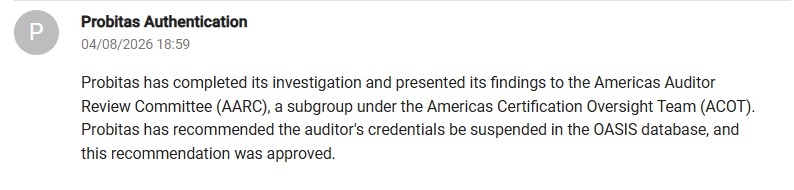
The suspension remains a concern, however, as it is temporary and can be as short as Probitas or AARC desires, potentially makint ig a performative gesture. In prior cases, for lesser offenses, Probitas has fully “withdrawn” auditors’ credntials, denying the ability to ever work as an AS9100 auditor. The decision to suspend Norlander, rather than withdraw from the scheme entirely, means that he will be able to continue auditing aerospace manufacturers in the future.
The length of the suspension is not known, and OASIS still lists Norlander as fully credentialed, as of 10 April 2026.
To date, no serious action has been taken against KSQA, despite other members of the CB’s staff being involved. Likewise, the IAF and APAC have taken no action against IAS, which had attempted to cover up the scandal and eventually refused to hold KSQA accountable.
The seriousness of the issue cannot be overstated, as it allows aerospace auditors to falsify audit reports and claim to have performed quality audits on aerospace manufacturers when, in fact, the audits were not performed. Manufacturers then gain defense industry and aviation contracts based on those AS9100 certifications, allowing them to build components for commercial aircraft, defense products, and spacecraft. Without a functioning accreditation scheme oversight, fraudulent manufacturers can be certified by fraudulent CBs and ABs, and sell defective or counterfeit products that are then installed on aircraft and spacecraft.
UPDATE 15 April 2026: Within OASIS, Norlander is still listed as fully “Approved.” A change was made to his account on 13 April, but seems unrelated to the falsification scandal. The exact nature of that change is not clear, but it appears to have no effect on his approval status.